Three Bags Full
Three Bags Full
A modern alternative to SparkNotes and CliffsNotes, SuperSummary offers high-quality Study Guides with detailed chapter summaries and analysis of major themes, characters, and more.
Summaries & Analyses
Author Insights
Quizzes
NEWReading Tools
Chapters 1-6Chapter Summaries & Analyses
Content Warning: This section of the guide includes discussion of graphic violence and death.
Chapter 1 Summary: “Othello Boldly Grazes Past”
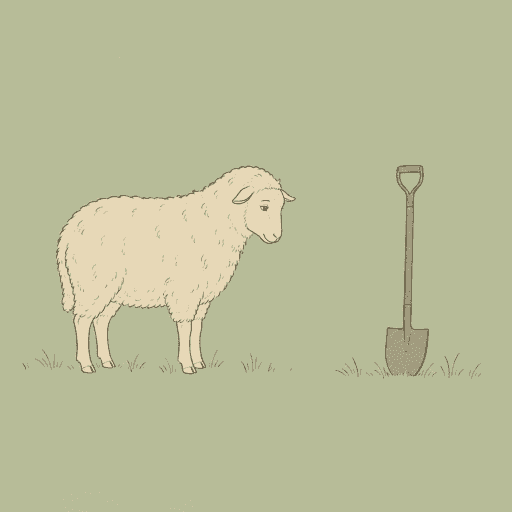
The sheep of Glennkill discover their shepherd, George Glenn, dead in the meadow, impaled with a spade. While some sheep panic about their future, Miss Maple, the cleverest of the flock, calms them and insists that they owe it to George to investigate the murder. Othello, a black ram with four horns and a mysterious past, agrees to graze near the body to observe human events as they unfold. The sheep establish a watch overlooking the meadow, with Sir Ritchfield—whose eyesight is still good—posted on the hill, and Mopple the Whale, the flock’s memory keeper, stationed beside him to remember what Ritchfield sees.
Tom O’Malley, a local man, stumbles upon the scene and reports the death. Soon, a group arrives from the village: a thin man, the butcher Ham, a shepherd named Gabriel, and a woman named Lilly. The sheep overhear tense conversations, particularly one in which Ham threatens Lilly and mentions George’s last will and testament.
After the police and a journalist document the scene and remove the body, the sheep gather in the hay barn. They compile a list of questions about the murder, which Mopple was tasked with remembering. The meeting concludes with a startling revelation from one of the lambs, who claims to have seen a large, shaggy “wolf’s ghost” dancing near the body on the night of the murder. After the others are asleep, Miss Maple privately reflects on what she discovered when she investigated George’s body close-up: a single sheep’s hoofprint on George’s stomach, which causes her to wonder whether the murderer had hands at all.
Chapter 2 Summary: “Heather Suspects Something”
The day after George’s death, the shepherdless flock raids his vegetable garden. They all feel horribly guilty afterward and establish a memorial patch of the meadow, which they name “George’s Place” and which has some of their favorite herbs. They reminisce about George reading to them in the evenings, usually romance novels about red-haired heroines named Pamela, but once a book on sheep diseases and once a detective novel that he threw away without finishing.
Later, George’s red-haired wife, Kate, arrives with the priest, whom the sheep call God—they have heard the pointed house he lives in referred to as “God’s house.” The sheep overhear Kate telling the priest that George had been acting strangely, receiving secret letters, and reading love stories. The priest tells Kate that if she doesn’t want to look after the sheep, he will talk to Ham the butcher, but she says “that business with Ham was over and done with long ago” (24).
Cloud recalls a past incident where the priest took her for a “blessing,” and they agree that it reveals his condescending attitude toward animals. Suspicion tentatively falls on the priest for George’s murder, though Maple urges caution. Kate leaves, and the priest returns alone to inspect the crime scene before being scared off by approaching humans. He flees along the footpath toward the moorland.
Chapter 3 Summary: “Miss Maple Gets Wet”
A large group of villagers, led by Tom O’Malley, arrives to view the murder scene. Tom gives a dramatic and (as the sheep know) untruthful account of discovering the body. The sheep overhear the villagers gossiping about George’s finances, his reclusive nature, and a potential “crime passionel” involving the sheep.
The villagers’ dogs cause a panic in the flock, and a large grey wolfhound attacks them. As the other sheep flee, Othello confronts the dog and defeats it; Zora, watching from her rocky ledge, is the only sheep with a clear view of the confrontation. The frightened villagers quickly leave.
That evening, the winter lamb, an orphan viewed in the flock as a troublemaker, steals milk from a mother ewe. The flock is unsettled, and their discussion turns to who might have killed George. Miss Maple deduces that the killer wanted the body to be found. Later that night, she has a nightmare about the butcher. Waking, she investigates a noise outside near the cliffs but finds nothing. When she returns to the barn, she discovers that the lead ram, Sir Ritchfield, who seems to be sleeping, is soaking wet.
Chapter 4 Summary: “Mopple Squeezes Through a Gap”
The next morning, the meadow is covered in a thick mist, and the flock is too unsettled to go outside. Hungry, Mopple the Whale squeezes through a gap in the barn wall to graze. In the mist, he stumbles upon an unidentified figure moving nearby, loses his nerve and gallops away, and then collides directly into Ham, who furiously chases him. Just as Ham is about to catch him, the butcher falls over the edge of the cliff, not seeing the edge in the thick mist. Mopple hears him screaming from below.
Meanwhile, Othello leaves the barn. He descends via a hole near the pine tree to the beach, walks along the shoreline toward the village, then climbs back up the dunes. He finds a cemetery—which he first takes for a vegetable garden—where he observes George’s funeral. He sees Kate, the priest, and other villagers, noting their lack of genuine sadness. Othello reflects on his own past, remembering how George rescued him from a fight and promised they would travel to Europe together.
Chapter 5 Summary: “Cloud Kicks Out”
The flock endures a tense day in the mist. When it clears, they spot the injured butcher on the beach below and watch as he is rescued. They become anxious when they realize Miss Maple, Othello, and Mopple are all missing. The incident reminds Sir Ritchfield of his twin brother, Melmoth, who mysteriously disappeared years ago. The old ram’s failed attempt to count the sheep only increases their distress.
The narrative shifts to three men—Josh, Harry, and Tom—discussing the butcher’s fall. They fear that Ham, who is still unconscious, will wake up, remember what happened, and expose their secrets. Mopple, who is hiding nearby, overhears their conversation. He returns to the flock, followed later by Miss Maple, who reports that she went to George and Kate’s house in the village. She spied and overheard Kate slam the door in Lilly’s face, saying, “Well, at least you didn’t have him” (73).
Othello also returns and describes the funeral. Heather theorizes George’s death is part of a love story, like the Pamela stories he read to them. Later, Mopple tells Maple about the fact that, when the group of humans came after George’s death, one of them bent down and either picked something up or left something, but Ritchfield can’t remember who. Maple confides in Mopple about the hoofprint on George’s stomach, suggesting a sheep may be involved. Their conversation is interrupted when they learn Heather has found a forbidden “Thing.”
Chapter 6 Summary: “Maude Scents Danger”
The flock confronts Heather for possessing a “Thing,” a human-made object, which is against sheep customs. Miss Maple argues that it could be a clue. An expedition of senior sheep goes to the dolmen in the meadow, where she left it. When they find it, a thin chain with a piece of metal on it, they are disappointed.
While they are there, three men in stocking masks—Josh, Harry, and Tom O’Malley—arrive, planning to break into George’s caravan. They believe he was hiding “dope” and that finding it is necessary to protect the town’s reputation. The sheep hide in and around the dolmen, and Maude’s keen sense of smell detects another human, hiding on top of the dolmen. The three men are scared off by an approaching car and hide in the hayloft. A new man gets out of the car, goes to the caravan, tries and fails to pick the lock, and then leaves. Throughout the encounter, Maude senses that the man hiding on the dolmen was terrified of the newcomer.
Chapters 1-6 Analysis
The flock’s discovery of George Glenn’s body impaled with a spade immediately establishes their nonhuman perspective as the novel’s central investigative lens. Although their role as amateur detectives, particularly Miss Maple (whose name references Agatha Christie’s classic amateur detective, Miss Marple), seems to be a digression from cozy mystery conventions with the introduction of animal investigators, the sheep, in fact, hew closely to the conventional characteristics of the amateur detective trope. Miss Maple’s methodical approach to the crime scene—sniffing the body, inspecting the wound, and ultimately discovering a single sheep’s hoofprint on George’s stomach—establishes her as the lead detective and grounds the inquiry in The Unique Intelligence and Capability of Animals. In addition, Miss Maple uses the skills of the sheep around her to facilitate her investigation. Their detective work becomes a collective effort, with each sheep contributing a specific, species-appropriate skill: For example, Miss Maple provides intellect, Mopple offers perfect recall of sensory data, Maude uses her superior sense of smell, and Othello deploys physical prowess and leadership. This distribution of labor forms a surprisingly effective, if unconventional, detective agency. Swann’s approach playfully engages with the traditions of the German “Krimi,” or crime novel, the genre from which the book originated, by intertwining it with the cozy mystery genre, setting a classic whodunit in a distinct rural locale but twisting expectations with its animal protagonists. Their investigation challenges the human characters’ assumption that they are simple livestock, positioning them instead as intelligent observers capable of piecing together a complex puzzle.
Through the sheep’s eavesdropping, the human world of Glennkill is revealed as a landscape of duplicity and self-interest, establishing the novel’s examination of The Absurdity of Human Nature from the flock’s perspective. Tom O’Malley’s sensationalized and untruthful account of finding the body, followed by the villagers’ gossipy speculation about a “crime passionel,” contrasts with the sheep’s direct, sensory-based gathering of evidence and literal interpretation of events. The conversations they overhear reveal a web of secrets, from Ham’s threats toward Lilly regarding a “Last Will and Testament” to the hushed fears of Josh, Harry, and Tom about their exposure. The sheep’s literal-mindedness exposes the ridiculousness of human behavior; they cannot comprehend the complex social and financial motivations driving the villagers, interpreting their actions through a more straightforward filter of fear, anger, and hunger. From their perspective, the humans are a chaotic and unpredictable flock, their actions governed by abstract concepts like reputation and finance that have no bearing on the essentials of survival.
George’s habit of reading to his flock introduces the motif of reading aloud, an act that provides the sheep with a flawed but essential framework for understanding the murder. Their only familiarity with concepts like jealousy, murder, and investigation comes from the plots of the “slim volumes printed on greyish paper” that George favored (19). This literary education creates The Gap Between Perception and Truth, as the sheep consistently misapply their understanding of fictional tropes to real-life events. Heather’s confident declaration that the murder must be a “love story” involving George, Kate, and Lilly is a direct consequence of her exposure to the Pamela romance novels. While George’s reading material provides them with a starting point for their inquiry, it also limits their understanding, forcing them to fit the range of human emotions that they witness into the simplified narratives they have learned. Their education allows them to name human concepts while simultaneously misunderstanding their nuances. The narrative they construct is a bricolage of romance conventions and the few facts they gleaned from the unfinished detective story, a process that highlights how all investigators—human or ovine—rely on pre-existing narratives to make sense of chaos.
The introduction of seemingly supernatural events complicates the investigation, weaving the motif of ghosts and souls into the otherwise grounded detective plot, and it also begins to establish the flock’s own understanding of spirituality and mortality. The lamb’s sighting of a dancing “wolf’s ghost” on the night of the murder introduces an element of the uncanny that defies the sheep’s logical, sensory-based approach. Their subsequent debate about whether humans possess souls, which Maude concludes must be located in the sense of smell, humorously translates a metaphysical question into a biological one. This discussion highlights the fundamental difference in their worldview and satirizes humanity’s preoccupation with abstract concepts. The disparity between the flock’s understanding of souls and death and human beliefs is also established here, at the same time that Miss Maple begins to consider that the murderer may be one of their flock. The mystery deepens with inexplicable occurrences like Sir Ritchfield being found soaking wet after Miss Maple hears a noise near the cliffs. These events, combined with Maple’s secret knowledge of the hoofprint on George’s stomach, shift the focus of suspicion beyond the human villagers. They raise the unsettling possibility that the danger may originate from within the flock itself or from a force that operates outside the rules of both the human and animal worlds.
As the investigation progresses, cracks appear in the social structures of both the human and ovine communities, revealing that neither is a monolithic entity. Within the flock, Sir Ritchfield’s authority is undermined by his failing memory and hearing, creating a power vacuum. Othello’s mysterious past and unexpected combat skills set him apart, while Miss Maple’s private investigation and secret knowledge of the hoofprint create a separate, more clandestine inquiry. These internal dynamics complicate the novel’s depiction of the flock to illustrate that it is a complex society with its own hierarchies and secrets, embodied by the legend of Ritchfield’s lost twin, Melmoth. In parallel, the village society is shown to be equally fractured. The conversation Mopple overhears reveals a conspiracy between Josh, Harry, and Tom, driven by fear of what Ham knows. The tense confrontations between Lilly, Kate, and Ham hint at long-standing grudges and hidden relationships. The novel sets up parallel mysteries within both groups, suggesting that the truth of George’s death is entangled in the histories and secrets of both the shepherds and the shepherded. By contrasting the two societies, Swann also highlights the fact that the sheep have a fully developed belief system of their own, and one that they will eventually begin to use as a way to understand the humans.

Get in-depth, chapter-by-chapter summaries and analysis from our literary experts.
- Grasp challenging concepts with clear, comprehensive explanations
- Revisit key plot points and ideas without rereading the book
- Share impressive insights in classes and book clubs