Three Bags Full
Three Bags Full
A modern alternative to SparkNotes and CliffsNotes, SuperSummary offers high-quality Study Guides with detailed chapter summaries and analysis of major themes, characters, and more.
Summaries & Analyses
Author Insights
Quizzes
NEWReading Tools
Chapters 19-24Chapter Summaries & Analyses
Content Warning: This section of the guide includes discussion of substance use, death by suicide, and death.
Chapter 19 Summary: “Maple and a Lovers’ Meeting”
Rebecca opens the caravan door, and a man enters. He carries a pistol and reveals that George worked for their firm, smuggling “grass” and other goods. Because Rebecca now possesses an incriminating file, the man implies he must kill her. Rebecca reveals her own pistol and orders him out; neither disarms the other. After a tense standoff, their confrontation unexpectedly ends in shared laughter. Rebecca gives the man the packets and what she believes to be a videocassette. She admits that she smoked from one of the packets, and a sheep ate the remainder of it, but the man isn’t upset. He leaves.
Soon after, a local woman named Lilly arrives at the caravan. She is looking for a receipt for grass she bought from George on the night he died. She reveals that on that night, George told her he was going to the pub to say goodbye to someone.
Later, Miss Maple has a vivid dream in which George tells her, “I cannot live without my soul” (283), and then a spade animated like a sheepdog menaces her. When she wakes, Miss Maple announces to the flock that she now knows everything about George’s murder.
Chapter 20 Summary: “What Maisie Knows”
Drawing on her dream and her memory of Rebecca reading aloud from “the book,” Miss Maple theorizes that the murderer used the spade not to kill George but to pin his ghost to the ground. She deduces that the killer must be someone who is being haunted by a sheep, and her first suspect is the priest, who has confessed as much. However, Maisie points out a flaw in this theory: The priest believed George’s soul was already lost, giving him no motive to kill him for it.
The flock revises the theory, now suspecting Beth. They reason that Beth, who they believe has no soul of her own, killed George for his soul before he could leave for Europe. Maple argues that Beth’s terrified reactions at the picnic and at the caravan door prove she was being haunted by George’s ghost. The sheep decide that true justice requires exposing Beth to all of the humans.
To do this, they plan to enter the upcoming “Smartest Sheep in Glennkill” contest to capture the village’s attention. Melmoth first demonstrates the trick of walking on his hind legs; Othello then rises on his hind legs too, and together they show the others how to perform for humans. Miss Maple devises a plan to use a theatrical performance and Beth’s cross to communicate the message: “Beth—murderer—George” (298).
Chapter 21 Summary: “Fosco Knows His Way Around”
Frustrated by the unsolved case of George’s death, Inspector Holmes attends the Smartest Sheep in Glennkill contest at the Mad Boar pub. Miss Maple, Mopple, Zora, and Othello enter the pub without a shepherd, causing a stir. Father William, the priest, opens the door for them and reacts with horror—his jaw drops, and he collapses into a chair clutching his chest. Later, while the sheep are on stage, he flees the building entirely.
Inside, the sheep meet Fosco, a veteran ram who explains he wins the contest every year by performing the simple trick of drinking Guinness from a glass. As the sheep take the stage to perform their act, Mopple sees Ham sitting in the front row and freezes in fear.
Chapter 22 Summary: “Mopple Is Important”
The sheep perform their play for the pub’s audience. Zora plays George, acting out his death by poisoning, while Maple plays Beth, stamping on Zora’s chest with one front hoof to represent the spade attack; Othello plays Death. To identify the killer, Miss Maple displays Beth’s cross in her teeth while Mopple waves a foul-smelling rag meant to represent Beth’s scent. Ham reacts to the scent-rag and cross combination by wheeling his chair onto the stage and chasing Mopple through the hall.
Beth comes forward and retrieves the rag, which is actually a handkerchief she once made for George. She sits on the stage and confesses to the crowd that George died by suicide. She explains she helped him stage the scene as he wished, positioning the spade after he was already dead and fulfilling his final wish to “give them something to think about” (326).
Fosco, the wise ram, explains the concept of suicide to the baffled flock. Ham corners Mopple and expresses deep guilt for having been a poor friend to George. Meanwhile, a discreet man gives Inspector Holmes a videocassette about “that man McCarthy” and suggests the cassette could benefit his career (331).
Chapter 23 Summary: “Heather Is Right”
In the following days, Rebecca reads newspaper articles to the flock with headlines like “Sheep Bring the Truth to Light” (332), which detail George’s death and the flock’s role in revealing the truth. She also continues reading aloud to them from their book. Ham visits Rebecca, expressing a new respect for the sheep and explaining that he reads a lot “so as to understand the connections” in life (335).
The flock notices that George’s Place, the spot where he died, is slowly shrinking. Having faced the butcher, Mopple finds new courage and overcomes his fear of heights to stand on Zora’s rocky ledge. The sheep reflect on their investigation, with Heather concluding, “It was a love story” (337).
Chapter 24 Summary: “Zora Sees a Cloud”
Rebecca finishes reading aloud and announces that the flock will depart for Europe the next morning. She also brings George’s sheepdog, Tess, back from the animal shelter. Melmoth gathers the flock, promising a final story about saying goodbye, but then he vanishes near the cliffs. Zora spots a single grey cloud in the sky, and the other sheep decide that Melmoth has transformed into a “cloud-sheep.”
Othello knows the real story: Melmoth simply climbed down the steep tunnel through the rock under the pine tree and went away alone. He decides to let the others keep their more magical explanation. With his mysterious rival gone, Othello feels the wind and scents the ewes, content in his undisputed role as the flock’s lead ram.
Chapters 19-24 Analysis
In a dream, Miss Maple hears the ghost of George quote the novel Wuthering Heights, lamenting, “I cannot live without my soul” (283). The sheep interpret this literary cry of despair as a literal statement of fact, a misreading that propels the final stage of their investigation and crystallizes the theme of The Gap Between Perception and Truth. The sheep incorporate this new reading into what they know from George’s readings, and they construct a coherent but incorrect narrative in which Beth, whom they perceive as soulless due to her scent, murders George to steal his soul before he can take it to Europe. Their reasoning is sound within their own experiential framework, which equates souls with a keen sense of smell and murder with the logic of predation. The eventual revelation that George died by suicide does not discredit their intellectual process; instead, it exposes a chasm between human and animal consciousness that their intelligence cannot bridge, a concept so alien to them that it must be explained by the wise ram Fosco.
The flock’s elaborate performance at the Smartest Sheep in Glennkill contest serves as the climax of their investigation and a powerful assertion of The Unique Intelligence and Capability of Animals. To communicate their findings, they stage a complex piece of nonverbal theater, using pantomime, assigned character roles, and sensory props like the “foul-smelling rag” to reenact their version of the crime. Zora plays the victim, Maple the killer, and Othello embodies the abstract concept of Death. This collaborative, abstract act of communication contrasts with the simplistic “tricks” performed by other sheep, particularly Fosco’s winning stunt of drinking a Guinness from a glass. The human audience’s enthusiastic response to Fosco, who merely imitates their own behavior, and their confused reaction to the flock’s sophisticated play satirizes the narrow, anthropocentric standards by which humans judge animal intelligence. The sheep’s ability to devise and execute such a plan, even if based on a false premise, demonstrates a high-level cognitive and social intelligence that operates independently of human validation.
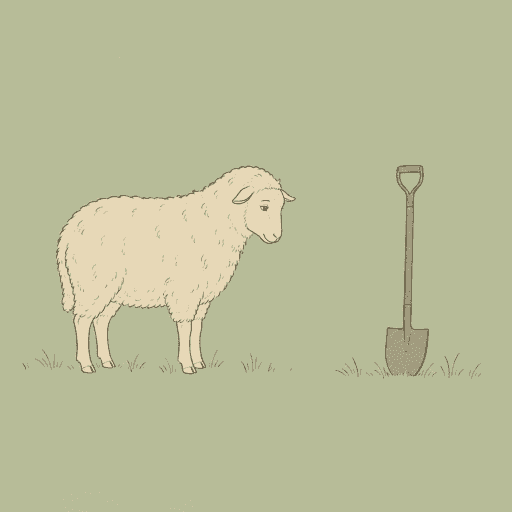
Beth’s public confession finally clarifies the meaning of the spade, resolving the novel’s central symbol and shifting the narrative’s genre. Throughout the investigation, the sheep have viewed the spade as a murder weapon, a sign of “wolfish brutality.” However, Beth reveals that George was already dead when she drove it into his body, fulfilling his last wish to “give them something to think about” (326). With this additional context, the spade is reframed from an instrument of violence into a tool of communication—a final message from a man who felt he could no longer be heard. This reveal dismantles the whodunit plot that the sheep have been following, underscoring the idea that the mystery was never about finding a killer; it was about understanding the depth of a man’s loneliness and despair. The search for a murderer was a red herring, but the quest forced the community to confront the uncomfortable truth behind George’s isolation, a truth they had long ignored. The sheep’s flawed investigation paradoxically leads to the very outcome George seems to have wanted.
Fosco’s explanation of death by suicide—that humans sometimes “look at the world and decide they don’t want to live” (328)—is met with deep bafflement by the sheep, who are driven by their biological imperative. This conceptual impasse offers a more serious application of the novel’s deepest exploration of The Absurdity of Human Nature. From the sheep’s pragmatic perspective, George’s actions are incomprehensible. Beth’s confession further complicates the picture, revealing her love for George, which is intertwined with grief and regret. Ham’s confrontation with Mopple ends in his confession of guilt for being a poor friend, an emotion directed at the sheep who exposed his failing. These behaviors are driven by a web of complex human emotions—despair, love, guilt, and loss—entirely foreign to the flock, whose world is centered on food, predators, and procreation.
As the mystery of George’s death resolves, the internal conflicts and character arcs within the flock also reach their conclusion. Mopple the Whale, having faced down his greatest fear in the form of the butcher, undergoes a significant transformation, finding the courage to overcome his vertigo and stand on Zora’s rocky ledge. His journey toward bravery is a direct result of the challenges posed by the investigation. Othello’s development is more internal; the mysterious guiding voice in his horns disappears, leaving him “alone” but self-reliant and secure in his position as lead ram now that his enigmatic rival, Melmoth, has departed. Melmoth’s ambiguous exit, which the flock mythologizes as a transformation into a “cloud-sheep,” preserves his mystique while conveniently removing Othello’s primary challenger. The investigation, therefore, acts as a crucible for the flock, forcing individual sheep to evolve and solidifying the social order. Heather’s final, insightful summary of the human tragedy as “a love story” signifies the flock’s ultimate success: Though they misunderstood the facts of the case, they correctly identified the emotional truth at its core.

Get in-depth, chapter-by-chapter summaries and analysis from our literary experts.
- Grasp challenging concepts with clear, comprehensive explanations
- Revisit key plot points and ideas without rereading the book
- Share impressive insights in classes and book clubs