Three Bags Full
Three Bags Full
A modern alternative to SparkNotes and CliffsNotes, SuperSummary offers high-quality Study Guides with detailed chapter summaries and analysis of major themes, characters, and more.
Summaries & Analyses
Author Insights
Quizzes
NEWReading Tools
Important Quotes
Content Warning: This section of the guide includes discussion of animal cruelty, death, death by suicide, and substance use.
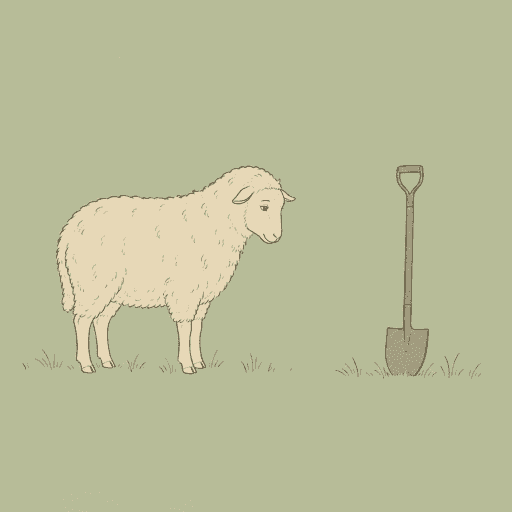
“I think we ought to find out what kind of human. We owe old George that. If a fierce dog took one of our lambs he always tried to find the culprit. Anyway, he was our shepherd. No one had a right to stick a spade in him. That’s wolfish behaviour. That’s murder.”
(Chapter 1, Page 4)
The author uses staccato sentence fragments (“That’s wolfish behaviour. That’s murder.”) to lend the sheep’s declaration the cadence of a courtroom verdict. The repetition of “That’s” functions as anaphora, hammering home moral certainty, while the metaphor “wolfish behaviour” translates human crime into terms the sheep can understand, establishing the novel’s hybrid tone of fable and detective fiction.
“There, on George’s pale stomach, slightly above the place where the spade had gone in, was the print of a sheep’s hoof—a single hoof print, just the one.”
(Chapter 1, Page 16)
The sentence relies on periodic delay, withholding its revelation until the em-dash triggers a fragmentary coda: “a single hoof print, just the one.” That appositive repetition slows the prose, and the assonance of “single” and “just” isolates the clue. The device converts a mystery trope—the incongruous mark—into a description whose very syntax mimics the singularity it describes.
“‘The murderer always returns to the scene of the crime,’ said Mopple the Whale. ‘And the long-nosed man did return to the scene of the crime.’”
(Chapter 2, Page 27)
Mopple’s syllogism is built on exact repetition of the phrase “the scene of the crime,” a device that echoes genre convention. The aphoristic first sentence—a borrowed maxim—is applied through parallelism to the particular case. The humor arises from the mechanical rigidity of the repetition, which exposes the sheep’s literal-mindedness even as it produces a formally valid inference.
“[I]s something unnatural, something that doesn’t really exist. If I snap my fingers and Othello suddenly turns white, that’s magic. If I fetch a bucket of paint and paint him white, it isn’t.”
(Chapter 2, Page 31)
George’s definition works through parallelism and antithesis: two “If I…” clauses balanced against opposite conclusions (“that’s magic” / “it isn’t”). The rhetorical symmetry mimics a syllogism, functioning almost as an aphorism. The repetition of “white” emphasizes that the visible effect is identical—only causation differs—turning the passage into a lesson in logical distinction delivered as folk wisdom.
“The memory of a scent still lingered in Othello’s nostrils. Ideas circled around his horns like swirling mist. Joy, anger, fury, a thousand questions and a tingling sense of embarrassment.”
(Chapter 4, Page 53)
The passage moves from sensory image to simile (“like swirling mist”) to a closing asyndetic list. Dropping conjunctions from that final catalogue—“Joy, anger, fury”—creates the effect of emotions crowding in simultaneously, while the sibilance of “swirling,” “sense,” and “embarrassment” mimics the drifting mist.
“‘It’s a detective story,’ said Miss Maple with conviction.
‘It’s a love story,’ Heather bleated suddenly.”
(Chapter 5, Page 75)
The exchange uses syntactic parallelism—identical framing (“It’s a ___ story”)—to stage a generic dispute in miniature. Only the middle noun shifts, so the repetition itself becomes the argument, with each sheep’s word-choice bearing the whole weight of interpretation. The metafictional gesture is delivered through a simple rhetorical device: substitution within a fixed frame.
“‘We need that grass,’ said Harry. ‘So we break the door down.’”
(Chapter 5, Page 86)
Two clipped sentence fragments, joined only by a blunt “So,” reduce human motivation to a brutal syllogism. The absence of subordination or qualification produces an ironic effect: The compressed logic sounds childishly simple yet reveals grown avarice. The monosyllabic rhythm (“need,” “grass,” “break,” “door,” “down”) hammers with consonantal finality.
“Either you find the wolf or the wolf will find you. It’s as simple as that! All stories have an end! It’s no use throwing the book away in the middle of it just because you don’t understand something!”
(Chapter 7, Page 99)
Miss Maple opens with chiasmus—“you find the wolf or the wolf will find you”—whose mirrored syntax lends the threat inevitability. The passage then uses aphorism (“All stories have an end!”) and shifts to an extended book-metaphor. Successive exclamations create anaphoric urgency, while the rhetorical devices render her intellectual imperative as something closer to prophecy.
“She was still following her nose now, clever as a sheep as she made her way towards the village. She hadn’t let the road lead her astray. She’d make the pale people dance, swinging their spades in a big circle. Something to look forward to.”
(Chapter 8, Page 105)
The inverted simile “clever as a sheep” upends a stock human comparison, and the anaphoric run of “She…She…She’d” builds a rhythm of purposeful advance. The macabre image of villagers made to “dance” with spades is a grim metaphor, while the closing sentence fragment—“Something to look forward to.”—delivers menace through sheer understatement.
“Well then, the police say George was poisoned first. He fell asleep peacefully. Then came the spade. When he was already dead, you understand? The question is why, and the CID from town probably don’t think anything much of that.”
(Chapter 9, Page 123)
Beth’s revelation is delivered in a sequence of short declaratives whose chronological ordering (“first…Then…When…already”) produces a forensic timeline in miniature. The inverted syntax of “Then came the spade” gives the weapon autonomy, as if it arrived under its own agency. The rhetorical question “you understand?” breaks the reportorial surface, drawing the listener into complicity with the deception.
“The whole village has rotted away like an apple, if you see what I mean. From the inside out. Like an apple.”
(Chapter 10, Page 134)
The simile is stated, qualified, and then repeated as an isolated fragment—“Like an apple.”—so that the figure returns with the finality of a refrain. Framing repetition (epanalepsis) closes the utterance in on itself, mimicking the enclosed decay it describes. The intervening fragment, “[f]rom the inside out,” reinforces the image spatially before the simile lands a second time.
“‘Do you want to make confession?’ The voice sounded as glutinous and sticky as the resin oozing from pine trees.”
(Chapter 11, Page 150)
The scene’s verbal texture is carried by simile and consonance. “Glutinous and sticky” doubles the adjective, thickening the sound with hard g and k stops before the sibilant “sticky…resin…pine” glides toward the tree image. The comparison uses synesthesia to convert an auditory impression into a tactile revulsion.
“The two rams were facing each other like reflections on two sides of a puddle. Except that the black birds weren’t reflected.”
(Chapter 12, Page 155)
A simile of perfect symmetry (“like reflections”) is immediately undone by the sentence fragment that follows (“Except that the black birds weren’t reflected.”). The device is a rhetorical bait-and-switch: The figure of doubling is proposed only to be broken, and the fragment’s grammatical incompleteness enacts the incompleteness of the reflection itself.
“A sheep on its own is unpredictable. Sometimes being alone is an advantage.”
(Chapter 13, Page 185)
The two sentences function as paired aphorisms, each self-contained, gnomic, and generalizing. Their asyndetic juxtaposition invites the reader to supply the connective logic, mimicking the way maxims accrue authority through compression. The abstract nouns are alliterative, binding the two claims into something resembling a proverb.
“[A]nyone who saw him like that in the night, with his quiet heart and loud blood and the spade through the middle of his life, anyone who saw him then could be fairly sure he was dead.”
(Chapter 14, Page 189)
The sentence is structured by anaphora (“anyone who saw him […] anyone who saw him”) framing a central tricolon whose middle term startles: “his quiet heart and loud blood and the spade through the middle of his life.” “Quiet heart and loud blood” is an antithesis and near-oxymoron, while “the middle of his life” substitutes “life” for the body itself, turning biography into anatomy.
“In Gabriel’s hand, the strange implement turned into a gigantic iron claw that passed through the grass with a hostile singsong note.”
(Chapter 15, Page 210)
The scythe is transfigured by metaphor (“a gigantic iron claw”) and personification (“hostile singsong note”), the latter compressing oxymoron into two words: “singsong” evoking nursery lightness, “hostile” undercutting it. The onomatopoeic hint in “singsong” gives the blade an audible malevolence, while the sibilance running through “passed…grass…hostile…singsong” mimics the hiss of the cut.
“The head of a ram! Looked me straight in the eye! A black ram! With four horns!”
(Chapter 16, Page 229)
Four exclamatory fragments in succession produce a staccato hysteria, each one shorter and more elemental than the last, to emphasize the speaker’s panic. The absence of finite verbs in three of the four fragments strips the speech of grammatical composure. Dramatic irony operates against this rhythm: The reader understands why he is seeing the black ram, while the priest cannot.
“I leave to my sheep so that they can go to Europe as I promised them.”
(Chapter 17, Page 254)
The clause runs on a plain, almost legalistic rhythm, but its plainness is the device—understatement of enormous consequence. The indirect object “to my sheep” quietly performs the substitution at the heart of the plot: livestock in the grammatical slot reserved for human heirs. The subordinate “as I promised them” retroactively frames the whole sentence as the fulfilment of an oath.
“One after another the sheep clustered round Rebecca.”
(Chapter 17, Page 258)
The line’s power lies in its brevity and its front-loaded adverbial phrase, “One after another,” which establishes a serial rhythm before the collective verb “clustered” resolves it. The prose enacts what it describes: sequence dissolving into congregation. Alliteration on the hard c’s (“clustered round Rebecca”) gives the gathering an audible cohesion.
“I cannot live without my life! I cannot live without my soul!”
(Chapter 18, Page 267)
The passage uses anaphora and parallelism, offering twinned exclamations distinguished only by the substitution of “soul” for “life.” Italicized “cannot” doubles as typographical emphasis and metrical stress. The near-synonymy of “life” and “soul” turns the couplet into a rhetorical intensification rather than a distinction, and the device of paired absolutes bequeaths the flock a template for reading haunting itself.
“When the mysterious stranger—and without a shadow of doubt, they had one of those here—was left alone with a woman you could expect the story to trail off into nothing. The man and the woman stopped talking at some point, and that was the end of the chapter. You never found out what happened next.”
(Chapter 19, Page 276)
The syntax deploys a parenthetical aside (“—and without a shadow of doubt, they had one of those here—”) that lets the sheep confirm a genre convention mid-sentence. The idiom “trail off into nothing” is enacted by the diminishing specificity of the following clauses, which themselves trail toward the vagueness of “at some point.” The narrative voice mimics the elliptical convention it describes.
“‘The murderer was afraid of being haunted. The idea of the spade was to prevent that. How could George haunt his murderer if the spade was pinning him to the ground of the meadow? That’s what the murderer must have thought. But’—and she paused for effect—‘but he was wrong.’”
(Chapter 20, Page 286)
Miss Maple structures her deduction as a set of short declaratives punctuated by a rhetorical question, before the sentence is fractured mid-conjunction by the dash and the stage direction “she paused for effect.” The repetition of “but…but” across the pause is epizeuxis under strain, and the final three-word fragment—“but he was wrong.”—lands with the compression of a verdict.
“‘Wrong,’ said Fosco. ‘By drinking Guinness. From a glass. That’s what they all do themselves. So of course they’re convinced it’s the cleverest thing anyone can do. That’s why I win. Every time.’”
(Chapter 21, Page 309)
Fosco’s speech is a cascade of fragments—“From a glass.”, “Every time.”—each isolating a link in his cynical chain. The opening one-word rebuttal “Wrong,” pre-empts argument by fiat, and the italicized “Guinness” carries a mocking emphasis. The situational irony is embedded in the reasoning itself: The “cleverest” behavior is defined by humans as human behavior, a circularity his clipped syntax refuses to disguise.
“But it absolutely had to be the spade. ‘That’ll give them something to think about,’ he said. I couldn’t persuade him not to do it. It was terrible.”
(Chapter 22, Page 326)
The confession nests direct quotation (“That’ll give them something to think about”) within reported speech, so that George’s voice appears inside Beth’s. The device—embedded quotation—stages the climactic revelation as ventriloquism, the dead man speaking through the living. Surrounding fragments (“It was terrible.”) shrink around the quotation, framing his defiant sentence as the only utterance that matters.
“‘It was a love story,’ bleated Heather, waggling her ears in triumph.”
(Chapter 23, Page 337)
The line closes the novel with structural repetition, returning verbatim to Heather’s earlier bleat and thereby forming a rhetorical bookend (epanalepsis on the scale of the whole text). The dialogue tag “bleated” is a small onomatopoeic reminder of the speaker’s nature, and “waggling…triumph” alliterates lightly on w’s, granting a comic-solemn cadence to the vindication.

Unlock every key quote and its meaning
Get 25 quotes with page numbers and clear analysis to help you reference, write, and discuss with confidence.
- Cite quotes accurately with exact page numbers
- Understand what each quote really means
- Strengthen your analysis in essays or discussions