Three Bags Full
Three Bags Full
A modern alternative to SparkNotes and CliffsNotes, SuperSummary offers high-quality Study Guides with detailed chapter summaries and analysis of major themes, characters, and more.
Summaries & Analyses
Author Insights
Quizzes
NEWReading Tools
Symbols & Motifs
Content Warning: This section of the guide includes discussion of death.
The Spade
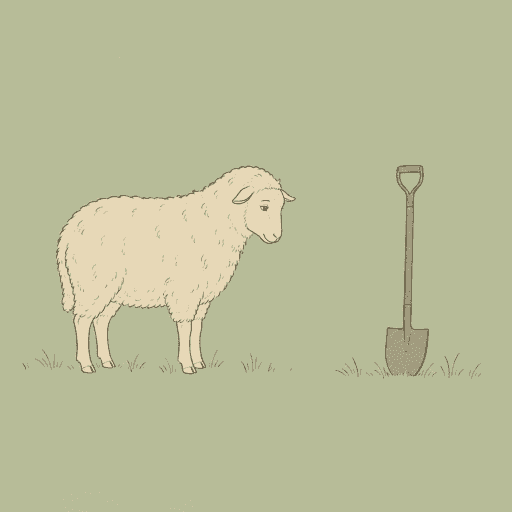
The spade is one of the novel’s central symbols, initially representing the brutal fact of the murder but ultimately coming to symbolize The Gap Between Perception and Truth. When the sheep first discover their shepherd dead, the spade seems to be an unambiguous murder weapon, a “heavy iron thing like that driven right through you” (3). This initial perception launches their entire investigation, which is predicated on the belief that a human killer used this tool to commit a violent crime. The spade, therefore, is the physical anchor for the mystery, a grisly and seemingly straightforward piece of evidence that focuses the flock’s attention on finding a culprit with a motive for murder. Its presence in the green Irish grass creates a jarring image of violence intruding upon a pastoral world, leading to the sheep’s detective work.
However, the spade’s meaning is completely inverted by the novel’s conclusion, when it is revealed to be a prop in George’s elaborately staged death by suicide. As Beth explains, George insisted on its use, saying, “That’ll give them something to think about” (326), his goal to send a final, cryptic message to the villagers he felt had betrayed him. The spade is revealed to be a red herring of George’s own design, planted to manipulate human assumptions and fears, particularly the local superstition that pinning a body to the earth can prevent its ghost from haunting the living. This revelation reframes the narrative, demonstrating how a single object can be deeply misinterpreted and how the most obvious “clue” can be the most misleading.
Ghosts and Souls
The motif of ghosts and souls illustrates The Absurdity of Human Nature as the narrative delves into the flock’s spiritual foundations, rooted in their pragmatic worldview. Maude straightforwardly states, “[Y]our soul is in your sense of smell” (14), a belief that ties identity and existence directly to sensory perception. This straightforward understanding makes them unable to comprehend the humans’ terror of the supernatural. The villagers, particularly Father Will and Ham, are terrified of being haunted, a fear the sheep find baffling. This contrast between the sheep’s earthy logic and the humans’ abstract fears allows the narrative to satirize human behavior, suggesting that our complex spiritual anxieties are comically inefficient and often lead us astray from observable truths.
In the final pages of the novel, the human fear of haunting is revealed to be central to the plot. George orchestrates his death around this fear, raising the specter of McCarthy’s earlier murder, a performance designed to manipulate a uniquely human psychological weakness. Because the sheep lack this specific fear, they are paradoxically better equipped to investigate the physical evidence without the filter of superstition, showing The Unique Intelligence and Capability of Animals.
Reading Aloud
The motif of reading aloud represents the important, if flawed, transmission of knowledge between the human and animal worlds. George’s habit of reading to his flock from a variety of genres—romance novels, fairy tales, and even a book on sheep diseases—forms the basis of their entire understanding of human concepts. This shared activity establishes the unique bond between the shepherd and his sheep, but it also creates a distorted lens through which the flock perceives humanity, leading to many of the novel’s comedic and analytical insights. The sheep’s ability to conduct a murder investigation is entirely dependent on this literary education; they understand the concept of a “detective story” and “clues” only because George introduced them to the genre. This motif is thus fundamental to the novel’s premise, establishing a world where interspecies communication shapes the narrative.
This motif also directly drives the plot’s resolution. While the sheep’s knowledge is imperfect, a human text ultimately provides the key to the mystery. When Rebecca reads from Wuthering Heights, “The murdered do haunt their murderers” (267), Miss Maple synthesizes her observations into a coherent theory about the spade that, although not entirely correct, does lead to the truth about George’s death. The act of reading aloud bridges the gap between the sheep and the humans, demonstrating that while the sheep’s literal-mindedness causes them to misunderstand many things, their ability to apply information makes them effective investigators.
The Shepherd’s Caravan
The shepherd’s caravan is a symbol of George’s secret life and the container of the mysteries that perplex the human characters. For the sheep, it is a familiar part of their landscape, the place from which their shepherd emerges and reads them stories. After his death, however, it transforms into an object of intense human fascination, greed, and paranoia. The villagers’ repeated, desperate attempts to break into the caravan reveal their true natures: Josh, Tom, and Harry believe it contains drugs or the key to a hidden fortune; Lilly seeks a receipt that could implicate her; and Gabriel, the “master hunter,” fears that the truth about McCarthy’s murder is hidden inside. The caravan’s surprisingly effective lock represents the impenetrability of George’s private world and the failure of the villagers to ever truly know him.
The caravan is central to the theme of the gap between perception and truth. The humans project their own corrupt motives onto it, revealing that the caravan’s secrets are not about George’s criminality but their own. The desperate desire to get inside the caravan is an illustration of the absurdity of human nature, as characters risk exposure and violence for secrets they fundamentally misunderstand, all while the sheep look on with bemused indifference.

Unlock the meaning behind every key symbol & motif
See how recurring imagery, objects, and ideas shape the narrative.
- Explore how the author builds meaning through symbolism
- Understand what symbols & motifs represent in the text
- Connect recurring ideas to themes, characters, and events