Gilded
Gilded
A modern alternative to SparkNotes and CliffsNotes, SuperSummary offers high-quality Study Guides with detailed chapter summaries and analysis of major themes, characters, and more.
Summaries & Analyses
Quizzes
NEWReading Tools
Part 3Chapter Summaries & Analyses
Content Warning: This section of the guide references graphic violence, child death, and illness or death.
Part 3: “The Crow Moon”
Part 3, Chapter 20 Summary
At an inn in Mondbrück on the night of the Crow Moon, Serilda is unnerved by a black bird she saw that morning, fearing it was one of the Erlking’s spies. Her father insists they hide one more night before fleeing. As dusk falls, they slip out separately and meet at the unfinished town hall, where he has stashed blankets. They press melted candle wax into their ears as protection against the hunt’s call and wait out the night.
A muffled thump wakes Serilda. She spots her father stumbling away in the dark and finds a glob of wax—his fallen earplug—where he’d been lying. She follows as he breaks the planks sealing the main doors and, when she tries to stop him, he shoves her aside and rushes into the square.
She tracks him to the stables, where he emerges leading their horse, Zelig, then mounts the unsaddled animal and rides into the square. There, Serilda freezes: her father and Zelig are surrounded by the hunt. The Erlking sits at the fore, a riderless horse waiting for her. He welcomes her and raises the hunting horn.
Part 3, Chapter 21 Summary
Serilda is given the riderless horse and swept into the hunt, which races across the countryside at impossible speed. The experience is intoxicating and feral. When a fox is killed and the hunt cheers, Serilda laughs. Looking back, she realizes her father is gone, though Zelig still charges on.
They thunder into Adalheid Castle. The moment Serilda dismounts, the spell lifts and horror returns. Zelig collapses inside the wall, trembling and drenched in sweat. When she calls for water, the Erlking seizes her for presuming to command his servants. She wrenches free and demands to know where her father is. He twists her braids and presses a blade to her throat, warning her to hold her tongue.
A ghostly blacksmith runs from the keep, reporting a problem in the armory. The Erlking stalks off. Manfred cautions Serilda against running and leads her to the armory where hundreds of weapons dangle from twine. Enraged, the Erlking strikes the blacksmith and orders the weapons cut down.
The Erlking orders Serilda to follow. When she asks again about her father, he replies coldly that the man was thrown from his horse and he neither knows nor cares if he lives. He shoves her into a former larder containing straw, a spinning wheel, and a short candle, commanding her to spin the straw into gold by sunrise or die. Serilda breaks down just as Gild appears, and she collapses into his arms, sobbing.
Part 3, Chapter 22 Summary
Gild holds Serilda while she cries, apologizing for his pranks and admitting he orchestrated the chaos in the armory. Noting the larger pile of straw and the short candle, he reminds her of what’s at stake. Serilda despairs, blaming herself for trying to run, but Gild reassures her and gently brushes a tear-damp strand of hair from her face.
When he asks for payment, she first offers the rest of her story, but he refuses—his magic requires something truly valuable. He explains his magic will not work without payment and asks for the ring from the moss maidens. She jokes about him asking for her hand before admitting the ring symbolizes her courage. She gives him the ring, and a pulse of magic seals their bargain.
Gild spins while Serilda readies the straw. He admits he freed a hound during her previous visit as a prank. She remarks that he seems more solid than the other ghosts. He agrees that he’s different, though he has no explanation. As the candle burns low, he asks for the rest of her tale. Serilda continues: the wounded prince finds the castle in ruins and the huntress, Perchta, dying on a bridge. Velos, god of death, appears and drags Perchta through a gateway to Verloren with a chain. A thorn hedge seals the portal. Near collapse, the prince sees an ancient woman with foxlike eyes approach.
Part 3, Chapter 23 Summary
Gild’s light touch on Serilda’s wrist startles her. She realizes that while she was telling the story, he had finished spinning all the straw into gold. He asks if the old woman is Shrub Grandmother, proof he was absorbed in her tale. Serilda deduces his fascination with touch stems from the fact that she is alive rather than a ghost.
Deflecting his plea for more story, she presses him for answers. She points out that his talent could make him a king, but he replies grimly that the ability is a curse—people only care about wealth and what he can provide. What he truly wants cannot be bought. He makes her promise not to tell the Erlking about his power, fearing enslavement. Currently, the Erlking dismisses him as a mere poltergeist.
Serilda shares her theories about him, suggesting he might be a sorcerer under a spell. Gild laughs that off, joking he could be Hulda, which she rejects. Studying his solid form and lack of ghostly transparency, she makes her final assertion: whatever he is, he is not a ghost.
Part 3, Chapter 24 Summary
When Gild asks why she is so certain he’s not a ghost, Serilda says he is too alive. He confesses he did not feel alive until he met her. He can move anywhere within the castle but cannot leave. He’s been imprisoned for ages with no memory of his life or death. He watches the people of Adalheid from a tower and loves their laughter. She intuits that his pranks are a defense against bleak circumstances. She tells him about Leyna, whose laughter he may have heard.
Gild apologizes for her father’s disappearance but admits he is not sorry to see Serilda again. Understanding his isolation, she offers her hand. He takes it, trembling, and leans his head on her shoulder, confessing he is not all right.
He asks why she thinks she isn’t beautiful. He touches her eyes and asks what her markings mean. Serilda reveals she was marked by the god Wyrdith and that people distrust her, believing her to be an omen of bad luck. He says it’s wrong to blame her for what she cannot control and adds that even untrustworthy things can be beautiful. The candle sputters and footsteps approach. At her urging, he whispers an apology and kisses her, briefly, before vanishing.
The Erlking enters, sees the spun gold. He orders Manfred to show her to a tower. When she demands news of her father, he repeats that he neither knows nor cares if the man is dead. When she asks about her mother, taken by the hunt years ago, he says that if she is among his ghosts, she belongs to him now, and that those who join the hunt do so willingly. He warns Serilda to remain in Adalheid—he will see her on the Chaste Moon. In a blink, the gold, wheel, and Erlking vanish, leaving Serilda alone in the decayed larder.
Part 3, Chapter 25 Summary
In the rain-drenched ruins of the castle, Serilda gropes through the dark, clinging to the hope that her father survived. Her resolve hardens: she will find and free her mother’s spirit, help Gild, and avenge herself on the Erlking. She searches for the southwest tower, recalling the night she was attacked by a drude and saved by a moving candelabra—perhaps Gild’s doing.
She finds a spiral stair and emerges into a circular room with panoramic windows. A soft touch grazes her neck, but when she turns, no one is there. She whispers Gild’s name and holds out her hand. A phantom touch meets hers, then vanishes. A guard’s scream echoes through the room, and she sees a spectral guard collapse and disappear. More echoes follow—a child’s scream from the courtyard and a man’s frantic pleading.
Panicked, she flees through the corridors as a ghostly kobold rushes past, crying that they must save the king and queen before clutching its throat and reenacting its death. A wrong turn leads her to a corridor ending in a strangely glowing room. A disembodied voice orders her to leave. The glowing door slams. Each of the other doors along the hall begin to slam in a threatening rhythm. A drude perches on a chandelier, ready to pounce. Serilda retreats and runs.
In the entry hall, she confronts the weeping ghost of the woman rider from the hunt, lamenting that she failed him and deserves punishment. A red line slices across the ghost’s neck; its head falls and rolls to Serilda’s feet, lips shaping a plea for help. Serilda bolts from the castle.
Part 3, Chapter 26 Summary
Serilda finds Zelig alive but spent beneath the wayfaring tree by the drawbridge. She stables him at the Wild Swan before seeking a room. Lorraine greets her warily, noting the town’s unease at the Erlking’s break in routine. Serilda explains she has been ordered to remain in Adalheid for the next full moon. Lorraine agrees to give her a room but warns that people view Serilda as a bad omen and that Leyna has been spreading a tale that Serilda intends to kill the Erlking. Serilda deflects, privately nursing her own desire for vengeance.
Leyna arrives and explains the town’s pact with the hunt: on the spring equinox, Adalheid hosts a Feast of Death, providing a celebration and animals for the hunt. In return, no townspeople are taken. She asks if Serilda has met a ghost who can make gold. When Serilda says she has, Leyna reveals the town’s secret of the Vergoldetgeist—the Gilded Ghost—who leaves spun gold on the rocks near the castle every year after the Feast of Death. Serilda realizes that Gild must leave gifts that have made the town wealthy. Leyna makes her promise to tell no one, fearing the interference of treasure hunters or the queen, and speculates that the ghost chooses that night because the castle is empty of the Erlking and his court—a theory Serilda knows is not entirely right.
Part 3, Chapter 27 Summary
Despite the rain, Lorraine lends Serilda a saddle, and Serilda rides home to see if her father has returned. At the edge of the Aschen Wood, she must choose between the short, dangerous path through the forest and the longer route around. When she urges Zelig toward the trees, he rears in terror, forcing her onto the safer road.
She reaches the mill in Märchenfeld at dusk to find the house cold and empty. Hearing the gristmill running, she goes outside in sudden hope, only to find Thomas at the machinery. To conceal the truth, she lies that her father stayed in Mondbrück to finish a job.
Days pass. Serilda waits, clinging to the idea that her father was thrown far from his horse and is still making his way home. She keeps up appearances in the village, feigning illness and pretending to post a letter to her father. Nachtkrapp—crow-like spies of the Erlking—keep returning to the mill. She throws stones to drive them off, but they always come back. Her father never returns.
Part 3 Analysis
The Crow Moon sequence at the start of this section shatters the illusion of mortal safety, exposing the intoxicating nature of the Wild Hunt motif. Despite attempting to hide in Mondbrück with wax in their ears, Serilda and her father are drawn into the ghostly cavalcade. During the ride, Serilda experiences a feral elation, momentarily seduced by the adrenaline and the illusion of absolute freedom the hunt brings. The disappearance of Serilda’s father highlights the callous disregard of the Erlking as the story’s antagonist. When Serilda fears for her father, the Erlking dismisses the miller’s fate, stating coldly, “Whether or not the fall killed him, I neither know nor care” (199). His polished, magnetic exterior conceals his fundamental cruelty, demonstrating the novel’s thematic interest in The Façade of Beauty and the Nature of Monstrosity.
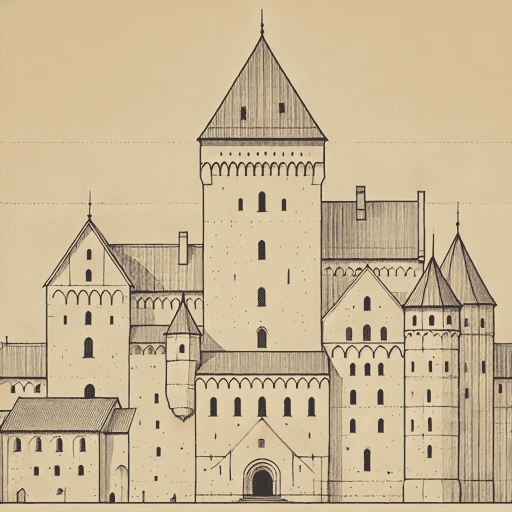
The setting of Adalheid Castle functions as a physical manifestation of erased history and generational trauma. While searching for her father, Serilda wanders through the daylight ruins of the fortress and encounters phantom echoes of a forgotten massacre. She witnesses a spectral guard choking on blood, a ghostly kobold reenacting its death, and a woman being decapitated just as her lips form a plea for help. The physical environment absorbs and projects past horrors inflicted by the Erlking. By trapping these souls in a perpetual loop of suffering, the Erlking ensures that their trauma remains fresh, even as the outside world forgets their identities. The pristine, magical version of the castle, as seen during the full moon, masks its gruesome reality, emphasizing the ways unacknowledged historical violence lingers long after the original atrocity occurs.
Within this oppressive environment, Gild leverages the strict parameters of his confinement to carve out moments of freedom and autonomy, highlighting the importance of Finding Agency Within Restrictive Boundaries. Bound permanently to the castle and dismissed by the Erlking as a mere poltergeist, Gild utilizes his perceived insignificance to sabotage the armory. His magic requires transactional payment to function, a rigid rule that dictates his interactions with Serilda. When he accepts the moss maidens’ ring in exchange for spinning the straw, the exchange seals with a magical pulse. Rather than viewing this requirement as a limitation, Gild uses the mandatory exchange to build a genuine alliance with Serilda. Unlike the villagers who shun her for her unusual appearance, Gild embraces it, noting that “sometimes the most untrustworthy things are also the most beautiful” (226). Their first kiss shifts their transactional relationship to a romantic one, raising the narrative stakes and escalating the dramatic tension. By maneuvering within the inescapable rules of his existence, Gild transforms his curse from a mechanism of isolation into a tool for hidden resistance and human connection.
Serilda’s improvised story unconsciously parallels actual supernatural dynamics, laying the groundwork for the story’s climactic reveal. Her gift, bestowed by Wyrdith, allows her to draw upon hidden truths, transforming a fictional tale into a conduit for suppressed memories, underscoring The Power and Perils of Storytelling. Her tales evolve into an active method for unearthing the realities obscured by the Erlking’s reign. Serilda begins to discover that her narrative abilities operate as an intuitive force that bridges invention and reality.

Get in-depth, chapter-by-chapter summaries and analysis from our literary experts.
- Grasp challenging concepts with clear, comprehensive explanations
- Revisit key plot points and ideas without rereading the book
- Share impressive insights in classes and book clubs