Streets of Laredo
Streets of Laredo
A modern alternative to SparkNotes and CliffsNotes, SuperSummary offers high-quality Study Guides with detailed chapter summaries and analysis of major themes, characters, and more.
Summaries & Analyses
Quizzes
NEWReading Tools
Background
Content Warning: The section of the guide includes discussion of graphic violence, sexual violence, racism, gender discrimination, and death.
Genre Context: The Revisionist Western Movement
The classic American Western valorizes white colonizers and their attempts to “civilize” the American West and its “uncivilized” Indigenous communities. By the late 20th century, the traditional Western, with its clear-cut ideas of “good” and “bad” and romanticized white, male heroes, had given way to the revisionist Western. This movement, prominent in both literature and film, sought to demythologize the frontier by portraying a West defined by moral ambiguity, brutal realism, and psychological complexity. Unlike its predecessors, revisionist Westerns
challenge the simplistic standard of ‘good versus evil’ and […] delve into the darker facets of frontier life, portraying flawed characters whose actions blur the lines between heroism and villainy. Such complexities reflect a more nuanced understanding of human nature and […] address previously marginalized perspectives, shedding light on the experiences of Indigenous peoples, women, and minorities, highlighting the brutality of colonization. (Buscemi, Alex. “Revisionist Westerns/Anti-Westerns.” Austin Public Library, 2026)
Its emergence coincided with the cultural upheavals of the 1960s and 1970s, including the Vietnam War and the civil rights movement. A simultaneous scholarly reckoning with the racial and colonial violence of westward expansion and the dispossession of Indigenous peoples made the triumphalist frontier narrative untenable for many writers and filmmakers.
Audiences impacted by images of televised war and institutional failure were increasingly skeptical of the lone hero riding to enact redemptive violence, and artists responded by turning the genre’s conventions against themselves. Films like Sam Peckinpah’s The Wild Bunch (1969), Robert Altman’s McCabe & Mrs. Miller (1971), and Clint Eastwood’s Unforgiven (1992), alongside novels such as Cormac McCarthy’s Blood Meridian (1985), John Edward Williams’s Butcher’s Crossing, and E. L. Doctorow’s Welcome to Hard Times (1960), stripped the West of its romance and exposed its greed, racism, and casual brutality. Works in this genre often feature aging protagonists who question their violent pasts and inhabit a world where heroism is obsolete.
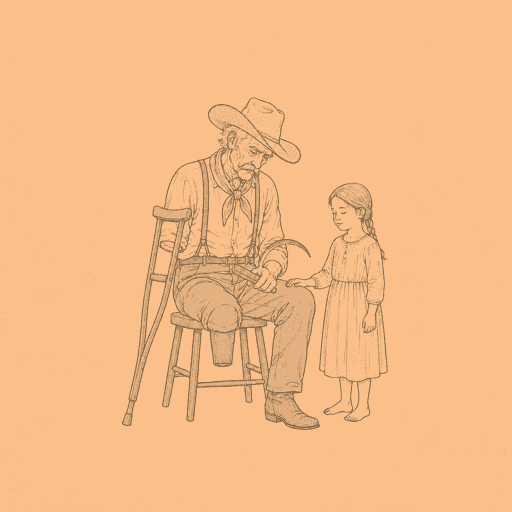
Larry McMurtry’s Streets of Laredo is a quintessential example of the genre, presenting a stark contrast to the heroic sagas popularized by mid-century films like John Ford’s The Searchers. Instead of a triumphant lawman, the novel centers on an aged Woodrow Call, a man physically worn down by his past. His body is failing, his joints ache, and his legendary status offers no comfort. The violence is not cinematic, but rather ugly and often emphasizes the growing impotence of its perpetrators. For example, when the ancient scout Billy Williams drunkenly tries to shoot his own horse, he misses entirely and instead kills a bystander’s goat. This focus on frailty, decay, and unglamorous violence firmly places the novel within the revisionist tradition, which uses the Western framework to explore themes of decline, regret, and the harsh realities behind the frontier myth.
Historical Context: The Closing of the Texas Frontier
Streets of Laredo is set in the early 1890s, a period that marks the definitive end of the Texas frontier era. The open-range cattle drives that defined the post-Civil War West had largely vanished by the late 19th century, supplanted by an industrialized landscape. This historic shift was driven by two key developments: the widespread use of barbed wire, patented in 1874, which carved the vast plains into privately owned ranches, and the rapid expansion of the railroad. By the 1890s, rail lines crisscrossed Texas, connecting its agricultural and cattle industries to Eastern corporate interests.
McMurtry’s novel heavily features this transition from rugged frontier to industrial groundswell. Captain Call is no longer a Texas Ranger defending settlers but a freelance bounty hunter hired by a railroad president from New York. His antagonist, Joey Garza, is a modern criminal who preys on the very symbol of the new era: the train. The character of Ned Brookshire, a Brooklyn accountant completely bewildered by the Texas landscape, embodies the encroachment of Eastern corporate culture. His presence emphasizes the central tension of the novel: The old, mythic West of legendary rangers has been irrevocably replaced by a commercialized world of timetables, payrolls, and contracts, leaving figures like Call as relics in a tamed land.
Series Context: The Lonesome Dove Tetralogy
Streets of Laredo is the final installment in Larry McMurtry’s Pulitzer Prize-winning Lonesome Dove tetralogy, though it was the second book published. Lonesome Dove (1985), the first novel published in the series, follows celebrated former Texas Rangers Woodrow Call and Augustus “Gus” McRae as they take a herd of cattle from Texas to Montana. It was later adapted into a mini-series for television starring Robert Duvall and Tommy Lee Jones as Gus and Call. The series also includes the prequel Dead Man’s Walk (1995) inspired by the ill-fated Texan Santa Fe Expedition of 1841, in which the Republic of Texas organized an initiative “to establish Texas jurisdiction over the Santa Fe” (Carrol, H. Bailey. “The Texas-Santa Fe Expedition of 1841: A Failed Quest for Trade and Territory.” Texas State Historical Association, 1952). Against this historical backdrop, a young Captain Call and Gus are commissioned by the Texas Rangers to annex what is now Santa Fe and the northern part of New Mexico. Dead Man’s Walk is followed by Comanche Moon (1997), which explores the twilight years of the Hat Creek outfit’s survivors.
Streets of Laredo’s origins significantly shape its elegiac tone. began as a screenplay, also titled Streets of Laredo, that McMurtry wrote in the early 1970s for a film meant to star John Wayne, James Stewart, and Henry Fonda as aging Westerners on one last adventure. When the stars turned the project down, McMurtry repurposed the script, transforming it into a sequel to his epic Lonesome Dove. The New York Times reports that “Streets of Laredo is suffused in melancholy: melancholy for lost chances, lost youth, lost loved ones. In deciding to create a sequel to Lonesome Dove, Mr. McMurtry has written a sad, funny elegy not only for his characters' pasts, but for the waning of the American West” (Kakutani, Michiko. “Books of The Times; McMurtry’s Cowboys Ride Off Into the New West.” The New York Times, 30 Jul. 1993). This context explains the novel’s intense focus on aging, physical decay, and the obsolescence of the heroic archetype. Instead of creating new characters, McMurtry places his beloved ranger, Woodrow Call, into the role originally intended for Wayne, recasting the legendary hero as a diminished and haunted figure, forced to confront the brutal realities of a world that no longer has a place for men like him.

Get in-depth, chapter-by-chapter summaries and analysis from our literary experts.
- Grasp challenging concepts with clear, comprehensive explanations
- Revisit key plot points and ideas without rereading the book
- Share impressive insights in classes and book clubs