Streets of Laredo
Streets of Laredo
A modern alternative to SparkNotes and CliffsNotes, SuperSummary offers high-quality Study Guides with detailed chapter summaries and analysis of major themes, characters, and more.
Summaries & Analyses
Quizzes
NEWReading Tools
Character Analysis
Content Warning: This section of the guide includes discussion of graphic violence, suicidal ideation, death by suicide, child abuse, child death, animal cruelty, animal death, racism, gender discrimination, ableism, sexual harassment, sexual assault, illness, and death.
Captain Woodrow F. Call
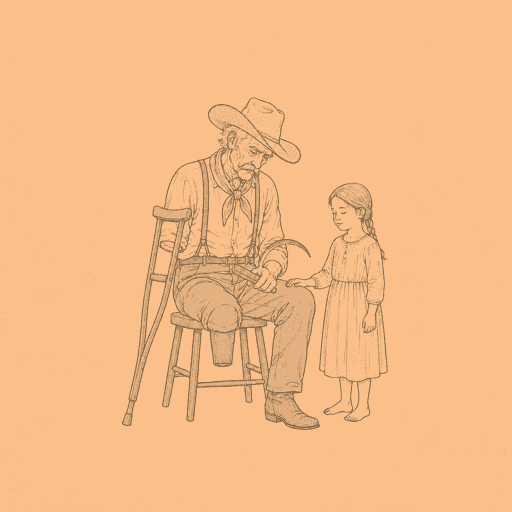
Captain Woodrow Call, the novel’s protagonist, has a reputation as a living legend of the Texas Rangers whose aging body and rigid adherence to a frontier code are increasingly at odds with the changing West. His arc centers on his decline rather than his growth, underscoring the novel’s thematic engagement with The Myth of the Frontier Hero. Call’s physical deterioration directly undermines his legendary competence. At the start of his mission, he is pragmatic and self-reliant, rejecting a fancy, engraved pistol because as impractical. However, across their journey, his body begins to betray him—arthritis swells his knuckles, making it difficult to use his rifle, and a stiff neck compromises his vigilance. This physical decline culminates in his failure to notice Joey’s ambush because his eyesight prevents him from recognizing a hobbled horse from a distance. The wounds he sustains result in amputated limbs, transforming the once-indomitable Ranger into a man dependent on others for the most basic needs—a shift he views as a final, tragic sign of his obsolescence.
McMurtry presents Call’s character as stoic and emotionally isolated. Having spent his life in the harsh, unsentimental world of frontier justice, he is uncomfortable with praise, personal connection, and his own vulnerability. He views Pea Eye’s decision to remain with his family as a form of desertion, a violation of the code of masculine loyalty that has governed his entire life. Call is a man who prizes his self-sufficiency, a leader who “always looked after [his] own mounts” (365). He experiences his post-injury challenges as a source of deep shame, particularly the indignity of requiring Lorena’s assistance with his bodily functions. His emotional connection with Teresa, Maria’s daughter, provides comfort to him because, he believes, since Teresa cannot see his physical ruin, she relates to him without the weight of his past legend or present decrepitude. In her presence, Call’s hardened exterior softens, and he finds a new, gentle purpose in connecting with her—an unexpected fatherly connection for a man who has no family but the men with whom he rides.
Joey Garza
Joey serves as the novel’s primary antagonist, a new breed of outlaw whose intelligence, cruelty, and methods challenge the archetypes of the Old West. He is a round but static character, as his motivations are explored but his cold nature remains unchanged. Joey’s criminality is marked by its efficiency and psychological coldness. Unlike the outlaws of legend, he is not a member of a gang but a solitary predator who uses the railroad—a symbol of white colonial industrialization—as his hunting ground. His gun, a German rifle with a scope, which he uses to kill from a clinical distance, underscores this symbolism. His violence is detached and self-interested: He kills for profit and to test his skills or on a whim. This detached cruelty, combined with his meticulous planning and skill at evasion, makes him a more formidable and modern threat than the brutish outlaws Call is accustomed to hunting.
Joey’s character is driven by a deep-seated narcissism and a deep resentment of his mother, Maria. He is preoccupied with his appearance and his collection of treasures, which he values far more than the money he steals. This focus on beautiful objects reflects a desire for the status and power denied him within the dominant systems of power. His hatred for his mother is rooted in his traumatic childhood, including being sold to the Apache by her second husband, and this unresolved anger fuels a virulent misogyny. He kills his final victim, his own mother, in a fit of rage while trying to murder his siblings, an act he intends for her to witness.
As an antagonist, Joey functions as the catalyst for Captain Call’s final journey and ultimate downfall. He shows a new kind of enemy that the old hero is not equipped to handle. Joey’s patience, cunning, and skill at remaining unseen neutralize Call’s traditional methods of pursuit. In their final confrontation, Joey’s clever use of a hobbled horse as cover for his ambush is a tactic that exploits Call’s eyesight, one of his critical vulnerabilities. By so easily injuring the legendary Ranger, Joey not only triumphs physically but also symbolically destroys the myth of the invincible frontier lawman, cementing his own reputation as the new, more dangerous predator of a changing West.
Lorena Parker
Lorena Parker, formerly the central female character of Lonesome Dove, reappears in Streets of Laredo as a resilient matriarch and, ultimately, the hero of the story. She is a round and dynamic character who has transformed herself from a sex worker with no resources, beholden to her handler, into an educated and employed schoolteacher, wife, and mother. Lorena’s primary motivation is the protection of her family, introducing the novel’s thematic interest in The Power of Maternal Devotion. She resents her husband’s loyalty to Captain Call, seeing the manhunts as a pointless continuation of a violent past that threatens her family’s stability. Her journey from the Panhandle into the dangerous border country to retrieve Pea Eye emphasizes her determination, resilience, and bravery.
Lorena’s competence and strength are central to her character. Having survived a brutal past, she has developed a hardened pragmatism that allows her to face extreme adversity. For example, she performs a field amputation on Captain Call’s leg with a bowie knife. While the act is gruesome, she undertakes it out of a sense of duty to preserve life, even the life of a man she resents. Her ability to manage her farm, raise five children, teach school, and navigate the dangers of the trail illustrates a more sustainable and community-oriented form of strength than the solitary violence of the manhunter.
McMurtry positions Lorena as the novel’s moral compass, challenging the values of the Old West. She views Call’s life’s work simply as “killing” rather than heroism. In a key moment, she tells the wounded Call that he must find a better reason to live than vengeance, encouraging him to evolve. She declares, “I didn’t stay what I was—can you understand that?” (411). This statement encapsulates her fight for safety, agency, and familial love, and her belief in a future beyond the cycle of violence. By taking in Maria’s orphaned children at the end of the novel, she reaffirms her commitment to nurturing and building a future, solidifying her role as a figure of hope and civilization in a dying, violent world.
Pea Eye Parker
Pea Eye Parker, Captain Call’s former corporal, is a gentle man caught between his violent past with the Hat Creek outfit and his settled, domestic present with Lorena and his children. As a round and dynamic character, his central conflict is the struggle between his ingrained loyalty to Call and his devotion to his family. At the novel’s start, Pea Eye still feels a tie to his past role as a member of Captain Call’s posse. McMurtry emphasizes that his affinity for marriage was a surprise to Pea Eye rather than something he imagined for himself during his decades with Call. As Call explains to Brookshire, “He served with me more than thirty years—he's the last man I would have thought likely to marry. He never sought women, when he rode with me” (37). However, marriage and fatherhood transform his priorities and motivations, revealing his true nature. As Lorena asserts, Pea Eye “was a gentle man. […] There were many men who dealt out violence naturally [but Pea Eye] was comfortable with gentleness, [he] would spend hours taking prickly pear stickers out of the boys' hands, working at each one gently until he got it out” (152). Pea Eye’s initial decision not to go after Joey represents a step toward establishing his own identity separate from Call.
Despite his reluctance, Pea Eye remains caught between his old identity and his new one, a tension that defines his arc across the novel. Even though he’s eventually compelled to go after Captain Call, he continues to recognize that he’s developed a revulsion for the violence that defines Call’s livelihood. Separated from Call and left in charge of a small party, his new identity as a husband and father comes to the fore when he’s forced to rely on his own judgment. When confronted by Joey, Pea Eye’s primal desire to return to his family pushes him to rise to the occasion. As Pea Eye tells himself, “He meant to use every ounce of fight he had in him to beat the killer and get back to his wife” (449). In a desperate and courageous charge, he wounds the seemingly invincible outlaw with a shotgun, succeeding where Call and others had failed. He acts out of a fierce need to survive for his loved ones rather than a commitment to justice or a love of violence. In this moment, Pea Eye transcends his role as a follower and becomes a hero in his own right.
Ned Brookshire
Ned Brookshire, an accountant from Brooklyn, is a foil to Captain Call, embodying The Tensions of Industrialization. He is a round but largely static character whose city sensibilities and corporate mindset are in constant, often comical, conflict with the harsh realities of the Texas frontier. Sent by the railroad president Colonel Terry to manage the finances of the manhunt, Brookshire’s tools are a ledger and a telegraph key rather than a pistol and a rope. His physical unsuitability for the environment is immediately apparent; he cannot keep his hat on in the Texas wind and is entirely inexperienced with horses and firearms. He is the quintessential “salaried man,” a cog in a corporate machine that is replacing the individualistic ethos of the frontier with bureaucracy.
Despite his discomfort in the rugged landscape of the Texas frontier, Brookshire possesses an unlikely form of courage that emerges as he confronts the challenges of life outside his comfort zone. At the start of the journey, he’s a self-defined follower, insisting that “[h]e had never chosen. He had taken the only job he had been offered, married the only woman who would agree to marriage […] Choice didn't play any part in his life. His choices were made for him, by people who were smarter than he was” (118). He insists on accompanying Call into extreme danger because he has been ordered to do so. Over the course of their journey, his stubborn commitment to the task earns him a grudging respect from Call as he adapts to the hardships of the trail. His death is both tragic and absurd; having resolved to abandon the senseless quest and return to civilization, he is unceremoniously shot by Joey Garza. His demise emphasizes the unforgiving nature of the West and the ultimate failure of his orderly, ledger-driven worldview to comprehend or contain its violence.
Maria Garza
Maria Garza, Joey’s mother, is the novel’s deuteragonist—a character second in importance to the protagonist—whose life is defined by suffering and an unwavering maternal instinct. She is a round, static character who embodies The Power of Maternal Devotion, a central theme in the novel. Despite knowing her son is a killer who feels hatred for her, Maria undertakes a perilous journey to the lawless Crow Town to warn him that Captain Call is hunting him. This act is born from an inescapable maternal bond despite knowing Joey’s true nature. He is her child, and she will protect him from those who mean him harm. McMurtry positions this maternal devotion as a powerful force in a world governed by male violence, vengeance, and retribution. When a neighbor rapes her at the age of 10, Maria “carefully sharpen[s a machete] on the grindstone until its blade [is] as keen as a razor” and “wear[s] the machete in its scabbard over her shoulder” (133), ensuring she will never be caught and assaulted by the neighbor again.
Maria’s life demonstrates female resilience and resourcefulness in a brutal, patriarchal world. She survives four husbands, abuse at the hands of Texas lawmen, and the challenges of raising two children with special needs while her eldest becomes a hunted killer and thief. Yet, she maintains her strength and her capacity for care, working as the village midwife and showing compassion to others, including the wounded Captain Call, the man who killed her father and brother. Her final act is one of ultimate sacrifice. When Joey returns to murder his helpless siblings, Rafael and Teresa, Maria confronts him. She fights and wounds him not to kill, but to protect her other children, a decision that allows Joey to fatally wound her. Her death at her son’s hand cements her legacy as a fierce protector of her children.
Mox Mox
Mox Mox, also known as The-Snake-You-Do-Not-See, is a secondary antagonist who represents pure, self-interested violence. A former member of Blue Duck’s outlaw gang, his defining characteristic is his pathological desire to burn his victims alive. This gratuitous cruelty distinguishes him from a pragmatic killer like Joey, who kills for professional or personal reasons. Mox Mox’s violence is an end in itself, an expression of pure malice. His re-emergence serves to heighten the sense of danger in the West, demonstrating that even as the frontier is being colonized, settled, and industrialized, its lawlessness persists. Captain Call’s successful ambush of Mox Mox’s gang serves as his final heroic act, a grim duty performed to remove a villain from the world.
John Wesley Hardin
John Wesley Hardin, a real-world historical figure that McMurtry imports into the novel as an aging, unrepentant killer holed up in Crow Town. He offers a cynical perspective on both the new breed of outlaws like Joey and old-guard lawmen like Call. The novel presents him as a relic of the West’s violent past, now drinking away his notoriety and complaining about the lack of available sex workers. His presence emphasizes the squalor and irrelevance into which the legendary outlaws of the frontier have descended.
Billy Williams
Billy Williams, once a legendary scout, is now aging, nearly blind, and has an alcohol addiction. His inability to track his own horse reinforces the myth of the frontier hero as his skills, once essential to survival on the plains, have declined, leaving him with one remaining purpose: his loyal, unrequited love for Maria. In his devotion to Maria and her children, Billy retains a battered decency that outlasts his usefulness as a frontiersman.
Charles Goodnight
Charles Goodnight, another real-world figure incorporated in McMurtry’s novel. A former Texas Ranger turned successful cattle rancher, Goodnight acts as a foil and peer to Call, a fellow frontiersman confronting his own obsolescence. Unlike Call, Goodnight has accepted the shift of the times and recognizes with clear-eyed pragmatism that Call is too old for his violent trade. His blunt assessments and refusal to romanticize the manhunt provide an authoritative counter-voice to Call’s stubborn adherence to duty. His recognition of Lorena’s strength, intelligence, and value reflects a wisdom that Call himself cannot access until it is too late.
Famous Shoes
Famous Shoes, the Kickapoo tracker, represents a connection to the land that is being lost. His ability to read the signs and track his targets contrasts sharply with the aging senses and instincts of the white manhunters, marking him as a repository of a way of knowing that predates the frontier itself. McMurtry’s portrayal of Famous Shoes’s preternatural abilities and wisdom incorporates elements of the “noble savage” and “magical native” tropes without interrogating them—the “noble savage” trope casts the Indigenous person in binary opposition to the “civilized” yet industrious colonizer, while the “magical native” trope dehumanizes Indigenous characters by stripping them of realistic qualities. His desire to learn to read “book tracks” points to the impact of colonization and industrialization on his world, suggesting a need to adapt to, or be erased by, the encroaching order of print media and railroad.
Teresa Garza
Teresa, the blind daughter of Maria, becomes the focus of Captain Call’s affection in the final chapters of the novel. Because she cannot see his physical injuries, she allows him a measure of human connection and a gentle purpose stripped of his violent past. Her blindness paradoxically enables Call to connect with her without feeling the shame of his physical decline. Her quiet, unsentimental acceptance of him offers a moving end to his journey, suggesting that the only redemption available to the broken frontier hero lies in tenderness rather than triumph.

Unlock analysis of every major character
Get a detailed breakdown of each character’s role, motivations, and development.
- Explore in-depth profiles for every important character
- Trace character arcs, turning points, and relationships
- Connect characters to key themes and plot points