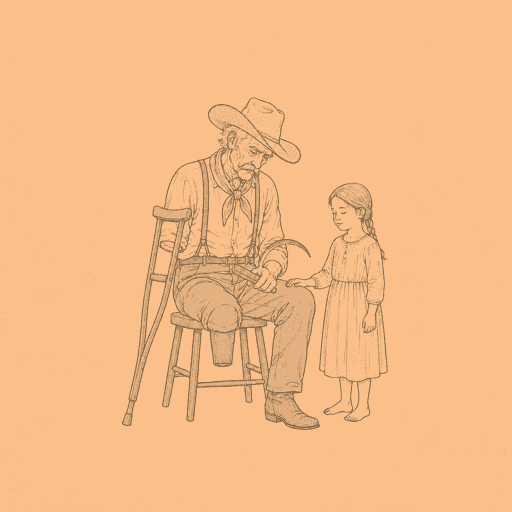
Streets of Laredo
Streets of Laredo
A modern alternative to SparkNotes and CliffsNotes, SuperSummary offers high-quality Study Guides with detailed chapter summaries and analysis of major themes, characters, and more.
Summaries & Analyses
Quizzes
NEWReading Tools
Part 2Chapter Summaries & Analyses
Content Warning: This section of the guide includes discussion of graphic violence, death by suicide, child abuse, child death, animal cruelty, animal death, racism, gender discrimination, ableism, sexual harassment, sexual assault, illness, and death.
Part 2: “The Manburner”
Part 2, Chapter 1 Summary
While at home, Lorena receives a visit from Charles Goodnight, a wealthy pioneer who funded the school where she teaches. Goodnight has come with unsettling news: Mox Mox, a brutal killer known as “the Manburner” whom Lorena believed was dead, has reportedly reappeared and is burning people in New Mexico. The name plunges Lorena into a state of terror, and she recounts her past ordeal.
Lorena explains that when she was a captive of the outlaw Blue Duck, his associate Mox Mox prepared to burn her alive. Blue Duck intervened, not out of mercy, but because he wanted to use Lorena as bait to lure Captain Augustus McCrae. While Lorena was still held captive and present, Mox Mox burned a young captive boy to death in her place. Goodnight confirms her story, revealing that he later found and buried the boy’s remains. Horrified that Mox Mox is alive and might come after her family, Lorena decides to send her five children to stay with her friend Clara in Nebraska and to close the school temporarily. She then resolves to find her husband, Pea Eye, and bring him home. Goodnight agrees to help arrange the children’s train travel and provides her with a gun for her journey south.
Part 2, Chapter 2 Summary
Joey Garza’s mother, Maria, travels toward the outlaw settlement of Crow Town to warn him that Captain Call is hunting him. Her journey is difficult, culminating in a freezing-cold crossing of the Pecos River. Along the way, she encounters the Kickapoo tracker Famous Shoes, who is guiding Pea Eye to meet Call. Angered that Famous Shoes is aiding her son’s pursuers, she sends him away. In Crow Town, Maria finds Joey, who is dismissive of her warning, claims he already knew about Call, and refuses to flee. As she leaves, he steals her horse, leaving her stranded.
Maria seeks help from another notorious killer, John Wesley Hardin, in the local saloon, but he refuses and makes a crude sexual proposition, so she walks out. After shooting a massive, feral pig that had been terrorizing the settlement, Maria butchers it for food. Inspired by her defiance, the other downtrodden women of Crow Town—including a prostitute named Beulah and two young Mexican girls, Gabriela and Marieta—ask to leave with her. Maria agrees, and after a failed attempt to convince an old Comanche woman, Naiche, to join them, she leads the company of women away from Crow Town on foot.
Part 2, Chapter 3 Summary
Mox Mox arrives in Crow Town with his gang of seven men. He orders his men to trample the elderly Comanche woman, Naiche, to death under their horses before burning her hut with her body inside. The gang includes the dim-witted giant and ex-wrestler Hergardt; a swift Cherokee named Jimmy Cumsa; a violent Mexican named Oteros and his partner Manuel; a killer from Vera Cruz named Pedro Jones; and a furtive man from Mississippi called Peon.
In the saloon, they find John Wesley Hardin, who is openly contemptuous of them, calling Mox Mox a “cross-eyed runt” and dismissing the gang as incompetent “chicken fryers.” After Hardin strikes Hergardt in the temple with his pistol, knocking him unconscious for blocking his light, Mox Mox decides to avoid a confrontation. He vows to return with the heads of Joey Garza, Charles Goodnight, and Captain Call to earn Hardin’s respect. The gang then rides out of Crow Town, leaving the smoldering remains of Naiche’s camp behind.
Part 2, Chapter 4 Summary
Captain Call, his Brooklyn-based accountant escort Brookshire, and Deputy Plunkert endure a severe ice storm on their journey. Call finds his ability to function hampered by age and arthritis, which causes his knuckles to swell so much that he can barely fit his finger through his rifle’s trigger guard. The party arrives in the Mexican village of Ojinaga, where Call is surprised to find the old scout Billy Williams.
Billy is caring for Joey Garza’s two other children: a perceptive girl named Teresa, who is blind, and a boy named Rafael, who has a mental disability. Billy informs Call that everyone knows he is hunting Joey and that Maria has already left for Crow Town to warn her son. Call realizes with a start that he is at the very house where he and Gus McCrae once returned the bodies of three horse thieves they had hanged—Maria’s father, her brother, and a brother-in-law. After a brief, unsuccessful attempt to get information from Billy about a rumored cave where Joey hides his loot, Call and his party cross the river into Presidio, Texas.
Part 2, Chapter 5 Summary
In Presidio, Texas, Pea Eye and Famous Shoes are arrested by the local sheriff, Joe Doniphan, a hard man with a reputation to uphold. Despite Pea Eye’s protests that they are deputies working for Captain Call, Doniphan is determined to hang Famous Shoes on an old horse-theft charge. Doniphan, who secretly plans to capture Joey Garza himself to boost his own fame, dismisses Call and Goodnight as has-beens and refuses to release his prisoners. He keeps Famous Shoes on display in his jail and denies him food for two days. When Captain Call arrives, Doniphan defies even a telegram from the governor of Texas and draws his pistol. Call seizes a rifle from the wall rack, beats Doniphan severely, locks him in his own cell, and throws the jail keys into the cistern before riding out with Pea Eye and Famous Shoes.
Part 2, Chapter 6 Summary
In Laredo, Plunkert’s wife, Doobie, grows increasingly desperate for news of her husband. Her frequent visits to the jail to ask Sheriff Jekyll for information about Captain Call’s mission bring her unwanted attention from the sheriff. One day, when she enters the empty jail, Jekyll attacks and rapes her. Overwhelmed with shame and convinced her life and marriage are ruined, Doobie resolves to die by suicide before Plunkert can return and learn of her dishonor. She goes to the riverbank and consumes a large quantity of rat poison mixed with water. After a period of agonizing pain, she dies.
Part 2, Chapter 7 Summary
Maria leads the women from Crow Town through a brutal ice storm. To keep their spirits up during a freezing night, she encourages them to share stories of their pasts. An old woman named Maggie enthralls the group with tales of her life, first as the wife of a circus juggler and then of a smuggler. The storytelling works, and the women survive the night. Exhausted from her efforts to lead and protect the group, Maria eventually collapses. The other women, grateful for her leadership, care for her while she sleeps. Eventually, they reach the railroad, and a reluctant conductor offers to take Maria to Fort Worth, but she refuses, insisting she needs to return to her children. The other women board the train and travel east while Maria, already barefoot after her shoes cracked and wore out on the journey, turns back toward Mexico alone.
Part 2, Chapter 8 Summary
Lorena arrives by train in Laredo eager to find Pea Eye. She’s immediately recognized by Tinkersley, her former handler when she was a sex worker. Tinkersley is thrilled to see her, but Lorena is wary and wants nothing to do with him. As a funeral procession passes, he informs her that the service is for Doobie Plunkert, the wife of the deputy traveling with Captain Call. Tinkersley explains that Doobie was raped by Sheriff Jekyll and subsequently died by suicide. The story deeply unsettles Lorena, reminding her of her own past hopelessness. She joins the procession, forcing Tinkersley to keep his distance. At the bleak cemetery, she is moved by the beautiful song sung by a young sex worker, one of several Tinkersley lent for the service. Later, Lorena learns from two Texas Rangers that Call was last seen in Presidio, where he violently assaulted the local sheriff to free Pea Eye from jail.
Part 2, Chapter 9 Summary
As Captain Call’s party travels east from Presidio, they hear dogs baying in the distance. Famous Shoes recognizes the tracks of Ben Lily, a legendary, solitary hunter of big game, particularly bears and cougars. Later that night, they hear approximately 40 gunshots, followed by the yelping of a wounded dog. The next morning, Famous Shoes finds a distraught Ben Lily, who explains that Mox Mox and his gang ambushed him, killed all nine of his dogs, and burned his best one, Flop, alive. Lily, who only escaped by hiding in a snake den, is disoriented but refuses Call’s offer of protection, determined to go to Santa Fe for new dogs before continuing his hunt. The old hunter walks off alone to the north. A few miles on, Call’s party finds the charred remains of the dog.
Part 2, Chapter 10 Summary
Call and his men arrive at the Jersey Lily Saloon, run by the heavily armed Judge Bean. After settling a years-old debt for Famous Shoes, Bean reveals that John Wesley Hardin recently passed through in search of a sex worker, complaining that Maria had led all the women out of Crow Town. Bean also confirms that Joey stole his mother’s horse, leaving her on foot. Recognizing the dual threats of Mox Mox and Joey, Call decides to split from his men. He instructs Pea Eye to take Brookshire, Plunkert, and Famous Shoes back into Mexico and wait for him near Ojinaga, believing Joey will eventually return to his mother’s village. Call then rides off alone to hunt Mox Mox’s gang.
Part 2, Chapter 11 Summary
Joey spies on Captain Call and Judge Bean through a telescope taken from one of his train robberies. He plans to kill both Call and the judge before returning home to steal his brother and sister and sell them to Mox Mox, who favors killing his victims by burning them alive. Joey resents the attention his mother gives his siblings and wants to teach her a lesson. Joey also plans to kill Famous Shoes, whom Joey believes is “the last tracker in Mexico capable of tracking him […] With Famous Shoes dead, the treasure in his cave would be safe for years” (335).
After Call rides away alone, leaving the rest of the men at Judge Bean’s saloon. Joey waits until Pea Eye’s group departs. He takes aim at Judge Bean, who is sitting outside reading a newspaper, and shoots him in the belly, shoulder, leg, and arm. Joey rides up and tightens a rawhide noose around the old man’s neck. Tossing the rope over the saloon’s chimney, Joey backs his horse away, slowly strangling and hanging Judge Bean by his own door. After ensuring the body is secure, Joey steals a silver picture frame containing a photograph of a woman he believed might be Lillie Langtry and rides off to pursue Captain Call.
Part 2, Chapter 12 Summary
At his ranch in the Panhandle, Goodnight is troubled by guilt. He feels responsible for the danger Lorena and Pea Eye are in, knowing he pressured Pea Eye into joining Call’s pursuit. Reflecting on the brutal reality of the changing West, he acknowledges that while the frontier is becoming more settled, deadly men like Mox Mox and Joey still roam the empty spaces. Convinced he made a mistake by meddling and putting a good family at risk, Goodnight cleans his rifle and pistol. Before dawn, he saddles his best horse and, telling his foreman he is going on a “wolf hunt,” rides south into a sleet storm, determined to intervene.
Part 2, Chapter 13 Summary
After leaving the women at the railroad, Maria walks barefoot for days back to Ojinaga, exhausted and starving. She finally arrives home, her feet cut and swollen, to a joyful reunion with her children, Teresa and Rafael. She is grateful to find that Billy Williams has cared for them well in her absence. Soon after, a fever takes hold of Maria, and she is bedridden for over a week while Billy and Teresa nurse her. When she recovers, Teresa tells her that the gringo hunting Joey—Captain Call—came to the house while Maria was gone. Even though Teresa is blind, she says she could sense the man looking at her. The news frightens Maria, who warns her daughter to stay away from the bad man. Holding her children close, she wishes they could remain safe with her forever, shielded from the sorrows of the world.
Part 2, Chapter 14 Summary
Riding alone, Captain Call has the persistent feeling he is being followed, but despite his efforts to double back, he finds no tracks. On the fifth day, he crosses the fresh trail of Mox Mox’s gang and closes in for an attack. As he approaches their camp, he is horrified to hear a child screaming and sees Mox Mox brutally whipping a young boy with a quirt, a riding whip with a braided lash. Call rushes to intervene and save the child’s life. He opens fire, killing several gang members and wounding Mox Mox in the shoulder and leg, but Mox Mox and Jimmy Cumsa escape on horseback. Call dispatches the remaining downed men with his pistol. He tends to the two children, Bobby and Marcie Fant, whom he discovers are the son and daughter of Jasper Fant, a former cowboy from the Hat Creek outfit. With the children freezing and in shock, Call begins a desperate journey toward Fort Stockton. His horse goes lame, but he is eventually found by two sheepmen who give him and the children a ride into town.
Part 2, Chapter 15 Summary
In Fort Stockton, Captain Call brings the Fant children to a rooming house, where he unexpectedly encounters Lorena, who had traveled there following the trail of Call’s party in search of Pea Eye. Lorena immediately takes charge, bathing the children and finding a doctor for Bobby’s lacerated face. Call, exhausted, collapses and sleeps for a full day. Soon after, the children’s parents arrive to take them home. As they are leaving, the local sheriff brings news that Joey has murdered Judge Bean, hanging him from his own saloon. The news confirms Call’s suspicion that Joey had been stealthily following him. Feeling his age and admitting to Lorena that he can no longer guarantee her safety, Call nevertheless agrees to take her with him to find Pea Eye. An hour later, they ride out of Fort Stockton together, heading south toward Presidio.
Part 2 Analysis
In this section, McMurtry contrasts the male characters’ missions of vengeance, profit, or ego with the female characters’ perilous quests to protect their families, highlighting The Power of Maternal Devotion. Faced with the return of the sadistic Mox Mox, Lorena’s first instinct is to secure her children’s safety, even at the cost of separation, before setting out alone to retrieve her husband. When Goodnight offers to send a man for Pea Eye, Lorena replies, “None of your cowboys married him” (229), asserting her commitment to protecting her own. Similarly, Maria endures a freezing river crossing and desolate terrain to reach Joey, acting on a maternal duty that her son callously betrays by stealing her horse. Doobie’s tragic death by suicide offers a grim inversion of this theme; driven to hopelessness by rape, she sacrifices her life in a misguided attempt to protect her husband and her unborn child from the shame of her perceived failure, asking, “What if Ted [came] home to a wife who was no longer worthy, a wife who had carelessly let her virtue be lost to the lust of Sheriff Bob Jekyll? […] Doobie knew she mustn't let him know. It would be a terrible failure if she let Ted find out the truth” (292). The misplaced shame and self-blame Doobie feels over the sheriff’s violent assault underscores the contrast McMurtry draws between male self-interest and female self-sacrifice.
Captain Call’s quest to capture Mox Mox alone focuses on his physical decline to emphasize the ways the bodies and codes of these men, once valorized, are starting to fail them in a changing Western landscape. Call’s struggle to fit his arthritic finger through his rifle’s trigger guard provides a small, mundane detail that illustrates that the legendary ranger’s greatest enemy is no longer outlaws but his own aging body, a central tenet of the Revisionist Western genre. This physical decline directly impacts his professional competence; his shooting is poor during the chaotic attack on Mox Mox’s camp, and he later collapses from exhaustion after rescuing the Fant children, forgetting to even stable his horse. His vulnerability culminates in his admission to Lorena that “I just don’t know that I can protect you” (369), a candid acknowledgment of his diminished capabilities. While McMurtry uses Call’s physical decline as a catalyst for self-reflection, the novel doesn’t meaningfully interrogate the valor of archetypal Western protagonists—rangers, sheriffs, and cowboys—whose heroism is predicated on the villainization of communities of color and Indigenous nations, positioning them as an uncivilized threat to white colonizers.
McMurtry uses Goodnight’s internal monologue to further grapple with The Myth of the Frontier Hero. Goodnight, celebrated as a legendary tracker, is haunted by a sense of outdated responsibility as he wrestles with having encouraged Pea Eye to go with Captain Call when the man wanted to stay with his family. Goodnight believes he’d “made a serious mistake […] He had been too blunt and had acted as if things had to be as they had been in the past. Lorena did not stay a whore; no more did her husband have to stay a Texas Ranger” (342). If he hadn’t intervened, Goodnight believes, “these two people […] would be at home with their children […] they would both be safe” (342). He makes the distinction between the mythic ideal of the Western cowboy and the reality of life on his ranch, noting,
The cowboys wore [pistols] from wistfulness […] They wanted to feel that they were living in a West that was still wild […] The cowboys could play and posture all they wanted to, adjusting their holsters and practicing fast draws. The fact was, they were herdsmen, not gunfighters, and it would be colossal, bad luck if their herding ever brought them into contact with a real killer. (341)
Goodnight’s reflections that people grow and change, just as the world around them does, point to a changing understanding of Western heroism without explicitly articulating it.
Amid the isolating violence, fleeting communities of women form to offer temporary refuge and strength. During a brutal ice storm, Maria encourages the freezing, demoralized women of Crow Town to survive by sharing stories of their pasts. Her simple request, “Tell me about your first man” (296), sparks a narrative exchange that generates warmth and connection between them, allowing them to endure the night. The stories of Maggie and Beulah emphasize the shared female experience of love, hardship, and survival on the frontier that reinforces their growing bond. A similar moment of solidarity occurs at Doobie Plunkert’s funeral, where Lorena, a former sex worker, finds a moving connection with the sex workers who have been lent to the church by Tinkersley to sing during the service. The pure soprano voice of one young woman singing hymns for another wronged woman highlights a shared grief that transcends social status. Lorena notes,
[T]he young soprano poured her heart into the song. No doubt she had an inkling of how Mrs. Plunkert had felt. That, at least, was Lorena's view. The girl's voice was so strong and pure […] in lonely lament for the lost life of a woman the young whore had not known and perhaps had not even met. (304)
These moments of female community offer an alternative to the violent, hierarchical, and ultimately destructive bonds that define the novel’s male world.
The changing nature of violence and law throughout these chapters points to The Tensions of Industrialization, a central theme in the novel. The conflict between Captain Call and Sheriff Doniphan in Presidio stages a clash between two eras. Doniphan is a new breed of lawman, a petty man devoid of a moral code and fixated on his own authority who dismisses Call as a has-been. For Call’s generation, the perceived lawlessness of the American frontier gave rise to an unspoken code of ethics that separated the rangers and lawmen from the outlaws they chased. McMurtry positions Call’s violent attack on Doniphan as an act of rage against the loss of this implicit code that prioritizes the pursuit of justice over a petty personal vendetta. The telegram from the governor that Call procures beforehand is an emblem of the new order, where power is institutional and mediated by bureaucratic authority—it’s Call’s effort to work within that system. The Doniphan’s refusal to accept it. The criminal world reflects a similar transition. The legendary killer John Wesley Hardin dismisses Mox Mox’s gang as pathetic “chicken fryers,” while the novel’s primary antagonist, Joey Garza, is a thoroughly modern predator. He uses advanced technology like a telescope and preys on the railroad, the ultimate symbol of the encroaching, industrialized East. This shift transforms the classic Western conflict from a mythic struggle for the frontier into a grim negotiation with its unglamorous, commercialized future.
The section draws a sharp distinction between pragmatic, life-sustaining violence and nihilistic, performative cruelty, primarily along gender lines. When Maria shoots the massive, feral pig that terrorizes Crow Town, her action is immediately productive. This animal, a local symbol of fear and degradation known as the Devil Pig of Crow Town, is transformed through her labor into a source of food for the local women and a catalyst for their liberation from the oppressive settlement. In stark contrast, the violence of the male antagonists is portrayed as senseless and self-interested. Mox Mox’s methodical trampling of the elderly Naiche, his ritualistic burning of Ben Lily’s best dog, and his brutal whipping of a helpless child are presented as acts of pure sadism, designed only to indulge the perpetrator’s desire to inflict pain. Likewise, Joey’s methodical torture and hanging of Judge Bean is a detached exercise in cruelty, a cold performance for an audience of none. By stripping male violence of any heroic or strategic justification, the narrative reinforces its revisionist critique of the West, exposing the celebrated frontier ethos as a cover for destruction of self and others, while positing female action as fundamentally tied to survival and preservation.

Get in-depth, chapter-by-chapter summaries and analysis from our literary experts.
- Grasp challenging concepts with clear, comprehensive explanations
- Revisit key plot points and ideas without rereading the book
- Share impressive insights in classes and book clubs