Streets of Laredo
Streets of Laredo
A modern alternative to SparkNotes and CliffsNotes, SuperSummary offers high-quality Study Guides with detailed chapter summaries and analysis of major themes, characters, and more.
Summaries & Analyses
Quizzes
NEWReading Tools
Part 3Chapter Summaries & Analyses
Content Warning: This section of the guide includes discussion of graphic violence, suicidal ideation, death by suicide, child abuse, child death, animal cruelty, animal death, racism, gender discrimination, ableism, sexual harassment, sexual assault, illness, and death.
Part 3: “Maria’s Children”
Part 3, Chapter 1 Summary
Mox Mox, severely wounded in the lung from Call’s attack, flees with his companion, Jimmy. Unarmed and weakened, Mox Mox watches as Jimmy takes his rifle and scabbard. When Mox Mox’s horse finally collapses, he begs Jimmy for a fresh mount and for help building a fire against the bitter cold. Jimmy refuses, stating that Mox Mox is dying and that helping him would be a waste of time and matches. He abandons Mox Mox, taking his saddlebags and all their supplies.
Left alone, Mox Mox tries to force his exhausted horse from the gully. In a rage at the animal’s refusal, he repeatedly stabs it with his small knife. The horse bolts, then loses its footing and rolls back over Mox Mox, breaking his leg. The fall also causes him to lose his knife, his last tool for survival. As the cold deepens, Mox Mox listens hard for the sound of approaching horses, hoping for a rescuer, but he is left to die alone.
Part 3, Chapter 2 Summary
Brookshire, Pea Eye, and Famous Shoes are back in Mexico searching for Joey. The mission feels pointless, and the group’s morale is low after the departure of Captain Call. As they cross the river, Plunkert considers abandoning the mission altogether to return to his wife. Famous Shoes brings a very large man named Olin Roy, too heavy for his horses, into their camp for the night.
Plunkert asks Olin for news from his hometown of Laredo. Olin reports that Sheriff Jekyll has been jailed for raping a young woman who had come to the jail asking about her husband. He laments that the woman later died after taking rat poison. Realizing the victim was almost certainly his wife, Doobie, a distraught Plunkert mounts his horse and flees into the darkness. The tragic news deeply disturbs Brookshire, who, remembering his own wife’s recent death, begins to feel the expedition is cursed. Famous Shoes, growing weary of the white men’s troubles, contemplates leaving the posse.
Part 3, Chapter 3 Summary
While riding near Crow Town, Goodnight encounters the notorious gunman John Wesley Hardin. Hardin informs him that Captain Call has successfully ambushed Mox Mox and his gang. He explains that Call wounded Mox Mox, who was then abandoned by Jimmy Cumsa and left to freeze to death in a gully. Hardin dismisses Call’s victory as sloppy and lucky, and he warns Goodnight that such luck will not work against Joey, who is far more dangerous.
Determined to see the body for himself, Goodnight follows Hardin’s directions. Two days later, he finds Mox Mox’s remains, confirming his death. He takes Mox Mox’s distinctive belt to give to Call as proof. After inspecting the battle site, Goodnight agrees with Hardin’s assessment of Call’s luck. Looking around, he finds a small rag doll and infers that Mox Mox had captives and had probably planned to burn them, but that Call arrived in time to wound him and rescue the children to safety. Goodnight buries the dead, including Mox Mox, and, feeling his own quest against the manburner is over, turns for home.
Part 3, Chapter 4 Summary
Captain Call and Lorena ride south, with Call suffering from a painful wrenched neck and a persistent feeling that they are being followed. On the evening of the third day, they encounter a small horse herd driven by two cowboys. The next morning, Call spots two horses standing in the distance and assumes they are strays from that herd. In a moment of carelessness, he rides out to check their brands.
The horses turn out to be a decoy set by Joey, who is hiding underneath one of the hobbled animals. Joey shoots Call three times, hitting him in the chest, arm, and knee, before killing his horse. Though grievously wounded, Call retrieves his rifle and crawls toward Joey’s position but quickly weakens from blood loss. In a final, desperate attempt to draw his attacker out, Call stands, but only manages to mistakenly shoot a passing mule deer. Overwhelmed by his failure and his injuries, he loses consciousness.
Part 3, Chapter 5 Summary
Hearing the shots, Lorena hides in a thicket, prepared to die by suicide rather than allow herself to be captured again by Mox Mox. After hours of silence, she emerges and finds Call, critically wounded but still alive. She catches the buckskin horse Joey left behind, moves their camp to Call’s side, and tends to his wounds as best she can. Call urges her to leave him to die, but she refuses.
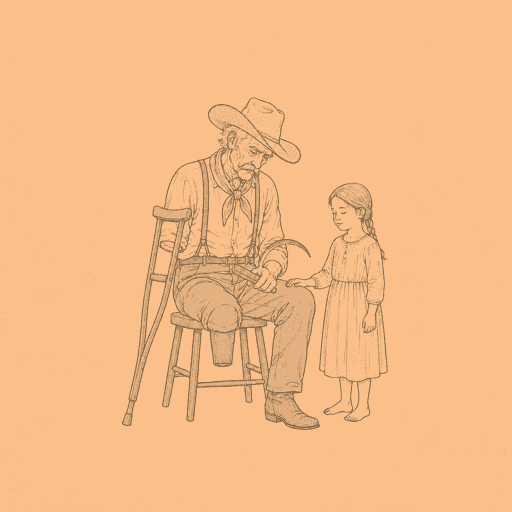
The next day, she manages to lift Call onto her horse and tie him securely. That night, a semi-lucid Call insists that she must amputate his shattered leg, as he and Gus McCrae once did for Dillard Brawley, the barber in Lonesome Dove. He insists he must live to kill Joey. Angered that his only stated reason for living is to kill again, Lorena nonetheless agrees. In a brutal and exhausting ordeal, she saws through the bone with his Bowie knife. Traumatized and spent, she leaves the severed leg by the smoldering fire and continues her journey south, leading the horse carrying the unconscious Call.
Part 3, Chapter 6 Summary
After Plunkert’s frantic departure, his injured horse returns to camp alone. Famous Shoes goes out to investigate and returns hours later with Plunkert’s belt. He reports that the deputy survived a fall from a bluff with a broken hip, only to be murdered and stripped of his belongings by four passing vaqueros. Famous Shoes buried the body. Brookshire is horrified by the cruel death, and Pea Eye, fearing the vaqueros will return, suggests they move on. Famous Shoes, having tracked the killers heading south, assures him they are safe where they are.
Part 3, Chapter 7 Summary
Joey, who had been tracking Captain Call since leaving Judge Bean’s, followed him to the site of the ambush on Mox Mox’s gang, then found Mox Mox’s frozen body. After waiting three days outside Fort Stockton, he set his trap with the decoy horses. Disappointed by how easily he defeated the famous Ranger, Joey decides to let Call live, believing his severed limbs will serve as a warning to others. Through his spyglass, he watches Lorena tend to Call and even amputate his leg. Satisfied, Joey heads to Mexico, planning to kill Call’s deputies first, then go to Ojinaga to murder his own siblings, Rafael and Teresa.
Part 3, Chapter 8 Summary
Captain Call’s condition worsens, and he develops a high fever. Lorena presses on and eventually reaches the Rio Grande, but she sees no town and must choose a direction at random. Heading north, she nearly despairs before encountering an old woman who directs her to the nearby village of Ojinaga.
In the village, Lorena is met by Maria and Billy. Billy recognizes the barely conscious man as Call. Maria hesitates for a moment before offering Lorena and Call shelter. Inside her home, Lorena mentions that their attacker was likely Joey, prompting Maria to reveal that she is Joey’s mother. Maria reassures the frightened Lorena of their safety, saying, “I am Joey's mother, but I am not like him” (435). She sends her to rest while Teresa promises her a story.
Part 3, Chapter 9 Summary
Joey tracks Pea Eye, Brookshire, and Famous Shoes to their camp. Deciding to terrorize them, he shoots their horses and pack mules, leaving them stranded. The men take cover in a dry creek. When they return to camp at nightfall, they discover Joey has looted all of their supplies. As they try to leave, Joey fires shots to force them back. Fed up, Brookshire defies the killer and walks toward him, only to be shot and killed.
Famous Shoes finds Pea Eye the next morning and reveals that Lorena has brought the wounded Captain Call to Ojinaga. He also relays that Joey claims he will spare Pea Eye’s life in exchange for his boots, though Pea Eye considers this a poor dodge. Invigorated by the news of Lorena’s arrival, Pea Eye devises a plan. He gives his boots to Famous Shoes as a ruse and pays him to pause by Brookshire’s body, marking the location of the eight-gauge shotgun Joey had overlooked. As Joey is distracted, Pea Eye charges toward the gun in his stocking feet. Joey shoots him multiple times, but he reaches the shotgun and fires twice, hitting Joey in the back and legs and forcing him to flee.
Part 3, Chapter 10 Summary
A doctor from Presidio is finally persuaded to cross the river to operate on Call. He successfully amputates Call’s ruined arm but deems it too dangerous to remove the bullet lodged near his heart. The doctor tells Lorena that Call killed Mox Mox, citing the testimony of Goodnight, who saw the corpse himself.
Soon after, Famous Shoes arrives at Maria’s house. He tells Lorena that her husband, Pea Eye, has severely wounded Joey with a shotgun. As Lorena prepares to ride to Pea Eye, Maria offers Billy as a guide. Maria is privately tormented, having learned from her daughter Teresa that Joey was recently in the village and threatened to kill both Teresa and Rafael. Meanwhile, Teresa sits with the delirious Captain Call, feeding him spoonfuls of frijoles.
Part 3, Chapter 11 Summary
As Lorena and Billy prepare to leave, she informs Captain Call that he killed Mox Mox, but he is too delirious to comprehend the news, weeping only when told of Brookshire’s death. Billy, certain the wounded Joey is still in the area, guides Lorena cautiously up the Rio Concho. Meanwhile, Pea Eye waits in the creek where he fought Joey, his hip wound leaving him immobile. His hope fades as the days pass. When he hears approaching horses, he prepares for another attack, but he sees, with disbelief, that it is Lorena and Billy. Pea Eye and Lorena share an emotional reunion, and she tells him his fighting days are over.
Part 3, Chapter 12 Summary
Joey, weak and in pain from his wounds, stalks the scout Famous Shoes, but ultimately lets him live, reclaiming his knife and blanket before heading toward Ojinaga to force his mother to treat him. Meanwhile, Maria is called away to assist in a difficult childbirth. Fearing for her children’s safety, she takes Rafael and Teresa with her, placing a cowbell around Rafael’s neck so she’ll be warned if Joey comes to take them. During an important moment in the delivery, Joey abducts the children. After the baby is born, Maria discovers them missing. She returns home to find Call lying helpless outside the back door—he had hobbled out with a chair for a crutch and a pistol but was too weak to stop Joey. Guided by Rafael’s cries, she runs to the river.
Part 3, Chapter 13 Summary
Maria finds Joey in the river trying to drown Teresa. He’s beaten Rafael, who lies wounded nearby. Joey ignores his mother’s warning shots. Maria wades in and stabs Joey’s shoulders with her knife, forcing him to release Teresa. Enraged, Joey turns on his mother. She pleads with him to stop and let her nurse his wounds, but he attacks her with his own knife. Just as Joey is stabbing Maria, Gordo the butcher, drawn by the gunshots, arrives and shoots Joey with his carbine. Joey falls backward into the water. Mortally wounded, Maria collapses as she and Rafael drag his body to the bank.
Part 3, Chapter 14 Summary
Gordo carries the dying Maria home but refuses her pleas to help Captain Call or retrieve Joey’s body. Two drunken vaqueros, determined to steal credit for the kill, find Joey’s corpse, shoot it several more times, and drag it through the village. Maria insists on cleaning her son’s body for burial and, with help from the grateful father of the baby she’d delivered, manages to wash the corpse and put a shirt on it before she collapses. Maria knows she’s dying, but she’s determined to hold on until Lorena comes back.
When Lorena returns with the wounded Pea Eye, Maria asks her to take and raise her children. Lorena agrees without hesitation. After sending Billy Williams away with a final kiss, Maria dies. Lorena brings her husband inside, placing him on a pallet near Call, and then sits with her two new children.
Part 3, Chapter 15 Summary
The next morning, the vaqueros return with a photographer, but a grief-stricken Billy drives them off in a rage and smashes the photographer’s expensive cameras. He and Olin dig graves for Maria and Joey. At the small funeral, Lorena and Olin sing a hymn. That night, unsettled and fearful, Lorena joins Billy and Olin at their campfire and drinks whiskey. She asks them if Maria was ever happy, but their answers don’t provide much information.
Pea Eye’s hip is set by the doctor from Presidio. He makes a clumsy joke to Call about needing a “crutch factory,” which earns him a sharp rebuke from Lorena, who reminds him that Call has lost his limbs permanently while Pea Eye will heal. Pea Eye is ashamed of his remark. Call remains mostly silent and withdrawn, accepting care and companionship only from Teresa.
Part 3 Analysis
The death of Mox Mox in a desolate gully reinforces the brutal, anti-heroic realism that defines this section of the novel. Left to die by his companion Jimmy Cumsa, who believes that helping a dying man is a “waste of matches” (374), Mox Mox succumbs to his wounds, the freezing cold, and his own impotent rage. His final act is to senselessly stab his exhausted horse, a gesture that causes him to break his own leg and lose his last tool for survival. This unglamorous demise is echoed in the fates of Plunkert and Brookshire. Plunkert survives a fall from a bluff only to be murdered and stripped naked by opportunistic vaqueros while helpless with a broken hip. Brookshire, a man completely out of his element, simply gives up and walks toward his killer, ending his miserable journey with a single, unceremonious pistol shot. These deaths are not climactic or meaningful; they are sordid, random, and senseless, reflecting the revisionist Western’s attempts to strip violence of its mythic grandeur. McMurtry replaces the noble sacrifices of older frontier tales with the grim, pointless suffering of ordinary, frightened men.
McMurtry adopts Joey’s perspective to demystify the novel’s antagonist, revealing a cold, narcissistic professional. His primary disappointment in defeating Captain Call is that the legendary lawman “had let himself be shot” so easily (421), diminishing the value of the victory for Joey’s reputation. He analyzes Call’s tactics and Mox Mox’s camp with the detached eye of a craftsman assessing a competitor’s work. His decision to let Call live is a calculated business decision: A maimed Call is a better “warning to other men who might be tempted to hunt him for bounty” than a dead one (425). This self-interested, reputation-conscious form of villainy contrasts sharply with the older, code-driven violence of men like Call or the chaotic sadism of Mox Mox. McMurtry suggests that Joey’s violence is rooted in a personal pathology, a deep-seated hatred for his mother and jealousy of his siblings, which he plans to resolve through their murder. This window into his psyche follows the tradition of the revisionist Western, which favors complex antagonists over one-dimensional archetypal villains.
Captain Call’s catastrophic ambush by Joey foregrounds the novel’s thematic focus on The Myth of the Frontier Hero. After years of legendary vigilance, Call’s body betrays him; a wrenched neck and a moment of carelessness are all it takes for a young killer to dismantle him completely. Joey’s use of a hobbled horse as a decoy—an “old, old trick” that Call’s aging eyes don’t register (397)—emphasizes that the Ranger’s instincts and abilities have eroded over time. The aftermath is a systematic destruction of his former heroic persona: His body is shattered, his horse is killed, and he is rendered utterly dependent on others to survive. Lorena must perform the gruesome amputation of his leg, a procedure he can only endure passively. His silent, withdrawn state in Maria’s house, where he weeps over Brookshire’s death and relies on Teresa for basic care, completes his transformation from an icon of frontier strength into a broken relic of a bygone era. Call’s attempt to grapple with what he has to show for his life as it nears its end hints at the flaws in a traditional portrayal of heroism in the Western genre, heavily predicated on the violence of white colonizers.
The unlikely triumph of Pea Eye over Joey subverts the traditional Western hero. Where the legendary Captain Call’s former skill fails him, the ranger-turned-farmer-and-family-man succeeds. Pea Eye’s charge, running in his stocking feet toward a deadly killer, is an act of pure desperation, fueled by his desire to return to his family and the life they’ve built together. During his tense standoff with Joey, Pea Eye “couldn't forget his wife. She was not far away, and he had to get to her. Joey Garza was the one thing in his way” (451). He defeats Joey with Brookshire’s impractical eight-gauge shotgun, a gun Joey had dismissed as worthless. Pea Eye is driven by a deep, personal love for his wife and children rather than a frontiersman’s code of justice or vengeance. Throughout the section, McMurtry juxtaposes Pea Eye’s will to survive for his family with his growing distaste for violence, positioning Joey and Pea Eye’s confrontation as a standoff between opposing forms of masculinity.
In this section, McMurtry positions the central female characters—Maria and Lorena—as the novel’s voices of reason, underscoring The Power of Maternal Devotion. When Lorena saws off Call’s leg with a Bowie knife, she performs an act of extreme, visceral care, even as she rebukes his single-minded desire for vengeance: “You ought to think of a better reason to live than killing a boy” (410). Her statement highlights the deep divide between his world of violent retribution and her own commitment to preserving and protecting her life with her family and community. This fierce, life-affirming instinct links her to Maria, who, despite having every reason to hate Call, takes him into her home and tends to his wounds. It’s Maria, not Call, who confronts Joey directly. Even as she wounds him to protect Teresa, she offers to nurse him if he will only stop. As Maria puts herself between Joey and Rafael, “she still [holds] her knife, but she [doesn’t] want to stab her son again. The wounds she had given him were light and were meant to distract him, not hurt him. She could help him recover and live” (482). Later, as Maria is dying, she asks Lorena to care for Teresa and Rafael, cementing the connection between them. This exchange between mothers highlights an alternative social contract to the masculine code of honor or the hollow posturing of vaqueros and outlaws—a maternal network that endures when the men around them destroy themselves and each other.

Get in-depth, chapter-by-chapter summaries and analysis from our literary experts.
- Grasp challenging concepts with clear, comprehensive explanations
- Revisit key plot points and ideas without rereading the book
- Share impressive insights in classes and book clubs