Streets of Laredo
Streets of Laredo
A modern alternative to SparkNotes and CliffsNotes, SuperSummary offers high-quality Study Guides with detailed chapter summaries and analysis of major themes, characters, and more.
Summaries & Analyses
Quizzes
NEWReading Tools
EpilogueChapter Summaries & Analyses
Content Warning: This section of the guide includes discussion of graphic violence, suicidal ideation, death by suicide, racism, gender discrimination, ableism, illness, and death.
Epilogue, Chapter 1 Summary
Bedridden and helpless, Captain Call is too weak to stand and must use a jug to relieve himself, an act he often fails to perform properly. His arthritic fingers are so swollen that he cannot even work his own buttons. While Pea Eye is his main caretaker, Lorena matter-of-factly assists him when Pea Eye is unavailable, ignoring Call’s deep shame. Consumed by embarrassment and a sense of degradation, Call wishes he could die, but his pocketknife has been taken away, and he doubts he could succeed with only one hand.
Epilogue, Chapter 2 Summary
The only person Call speaks to is Teresa, who insists on caring for him. He accepts her help because, as a blind child who never saw him in his prime, she cannot see his stumps or the large bruise on his chest from Joey’s bullet. Call wishes the doctor had tried because the attempt might have killed him. Teresa feeds Call, tells him stories about animals, and her light, cheerful voice is his only pleasure. He waits for her patiently each morning when she comes to check his fever with her cool hand.
Epilogue, Chapter 3 Summary
After being shot, Call’s focus had been on surviving his wounds so he could finish the job he was hired to do and apprehend Joey. Now, drifting in and out of fever, his first waking thought is of his irrevocable failure. Now that Joey is dead, he regrets not letting his wounds kill him, as Gus McCrae did, because they have already destroyed the man he once was. He feels worthless and hates being dependent on others. His mind is confused about the recent events; he cannot clearly recall how Mox Mox, Brookshire, or Deputy Plunkert died. His one consolation is knowing that Pea Eye wounded Joey and the butcher finished him, completing the job. He understands that Pea Eye and Lorena will be taking Maria’s children to the Panhandle once he is strong enough to travel.
Epilogue, Chapter 4 Summary
Lorena returns from Presidio with crutches for Pea Eye and Call. Pea Eye, whose wounds have healed, begins using his immediately and is celebrated as a local hero for stopping Joey. Call, however, can only stare at the crutches, seeing them as a symbol of his new, pathetic reality. He realizes he will never mount a horse again and has nowhere to go. Listening to one of Teresa’s stories, he finds brief relief from his despair. When Pea Eye offers to let him live on their farm, Call says he doubts he could be much help, and Pea Eye leaves the offer open.
Epilogue, Chapter 5 Summary
Famous Shoes remains in Ojinaga, determined to acquire Joey’s spyglass, which he calls the “great eye.” Believing he is still owed wages for his tracking, he decides not to approach the ailing and unfriendly Captain Call. Instead, he speaks to Pea Eye, offering to take the spyglass in lieu of Lorena’s reading lessons as payment. Pea Eye, considering the object a useless burden, casually gives it to him. Overjoyed, Famous Shoes retrieves the spyglass from a shed and immediately departs for the Sierra Madre mountains, reflecting that it is time for Call to let his spirit pass on.
Epilogue, Chapter 6 Summary
Finding the silent, suffering Call a constant presence in her main room, Lorena moves him into Maria’s empty bedroom. Teresa becomes his sole attendant, and Call prefers it that way. He spends his days brooding over his failure, which he now attributes to his eyesight, believing that if he had noticed Joey Garza’s horse was hobbled, he would have avoided the ambush. He fixates on the bitter thought that a cheap pair of spectacles might have saved his arm and leg. His only relief comes from Teresa, who brings him news of the farm animals and distracts him with her stories.
Epilogue, Chapter 7 Summary
Nearly a month passes before Call is strong enough to consider traveling. Pea Eye, anxious to get home to his own children, repeatedly asks Lorena when they can leave, finally causing her to lose her temper. Lorena worries about the burden of taking the ruined old man into her already crowded household. Meanwhile, Rafael continues to grieve for Maria, constantly searching for her around the property. Teresa tells Lorena that “[Maria] is among the dead. Rafael doesn't understand where the dead live” (511).
Epilogue, Chapter 8 Summary
When Call is finally well enough, Billy Williams drives the group to Fort Stockton in a borrowed wagon. Rafael is allowed to bring two goats, while Teresa brings her rooster and three hens. As they depart, Gordo, the local butcher, watches with annoyance. He had been attracted to Teresa and had considered marrying her when she was older, a plan now thwarted by the gringos taking her away.
Epilogue, Chapter 9 Summary
The wagon ride is agonizing for Call, who is pained by every jolt. He dreads being seen in his injured state. When they encounter other travelers, Call is ignored, while Pea Eye is hailed as the hero who defeated Joey. Pea Eye feels deeply embarrassed by the praise, especially in front of Call, whom he knows killed the far more dangerous man, Mox Mox. Lorena internally agrees that Mox Mox was worse but decides not to tell her husband that she was once the man-burner’s captive.
Epilogue, Chapter 10 Summary
In Fort Stockton, the group is met at the train station by Colonel Terry, the railroad official who hired Call. Terry demands to know where Brookshire is. Call bluntly informs him that Brookshire is dead and that sending him was a “foolish order.” The irritated Colonel retorts that Call was “the man sent to catch the bandit, and from the looks of you, you made a botch of it.” (514)—a charge Call grimly accepts. Call notes that Terry has also lost an arm. When he inquires about it, Terry tells him it happened during the first battle of Bull Run—the first major battle in the American Civil War. When Colonel Terry demands Brookshire’s ledgers, Pea Eye admits they used them as kindling so they wouldn’t freeze. Terry is annoyed, but he notices Call has lost both an arm and a leg and senses this is not the moment to harp on details. He offers Lorena, Teresa, and the others the use of the bath in his private railcar.
Epilogue, Chapter 11 Summary
Billy loads the wagon with whiskey and begins his return journey to Ojinaga, admitting he already misses Mexico. He declines Pea Eye’s offer to come live with them and try farming. Lorena teases her husband for the invitation, reminding him that he dislikes farming himself and questioning why he would wish it on anyone else.
Epilogue, Chapter 12 Summary
Colonel Terry is attracted to Lorena and considers whether he might make her his new mistress. He offers the group passage on his private train, but he unexpectedly detours to Laredo for a business meeting, extending their time together so he can win her affection. On the journey, Call asks Terry how long it took him to adjust to losing his arm. Terry replies it took five years, aided by the distraction of the American Civil War. In Laredo, Call asks Pea Eye to hire a buggy, and they cross into Mexico to collect Bolivar, the old cook, whom Call had previously left with a Mexican family with a promise to return. However, the woman tearfully reports that Bolivar died the very day Call brought him to her. Devastated, Call whispers that Bolivar was “the last of the Hat Creek boys” (518), prompting Pea Eye to gently remind Call that he is still alive.
Epilogue, Chapter 13 Summary
As soon as Colonel Terry departs for his meeting, Lorena goes to the telegraph office. She wires Clara Allen in Nebraska, asking her to send the Parker children home, and wires Goodnight, requesting a loan for train fare to Quanah. Lorena is desperate to leave before Terry returns, as his behavior has become predatory. During the train ride to Laredo, he’d made constant unwanted advances, culminating in an attempt to pull her into a sleeping compartment. Lorena fought back, slashing his hand with a shard from a broken plate. She warned him that she had cut off Call’s leg with a bowie knife and would readily do the same to him if he ever tried to “be familiar with [her] again” (520).
Epilogue, Chapter 14 Summary
Goodnight promptly wires the money, and Clara telegraphs back that she is bringing the children to Texas herself. Relieved, Lorena buys tickets for the next train. Captain Call remains silent and withdrawn, deeply affected by the news of Bolivar’s death. Pea Eye is surprised by their sudden departure, as he believed they would be traveling with Colonel Terry.
Epilogue, Chapter 15 Summary
Upon returning from Coahuila, Colonel Terry is enraged to discover that Lorena and her party have already left. He confronts the stationmaster, who explains that he could not prevent passengers with valid tickets from boarding the train. In a fit of fury, Colonel Terry fires the man on the spot.
Epilogue, Chapter 16 Summary
During a stop in San Antonio, Lorena takes Teresa to see an eye doctor recommended by the Laredo stationmaster. The elderly doctor, a man named Lee, examines the girl and confirms that her blindness is incurable. Lorena returns to the train with a heavy heart, though Teresa seems content holding her rooster.
Epilogue, Chapter 17 Summary
North of Fort Worth, the train is delayed for hours after colliding with a wagon full of pigs, killing the deaf driver. While they wait for the tracks to be cleared, Lorena passes the time reading Thomas Hardy’s Tess of the d’Urbervilles. When she mentions it to Pea Eye, he replies, "I hope she wasn't blind, like our Tessie" (522).
Epilogue, Chapter 18 Summary
As the train travels through the open plains, Call stares out the window, feeling a deep and permanent separation from his former self. He pictures a deep canyon between the Woodrow Call who saddled his horse on the morning of the attack and the man he is now. He believes his true self was lost in that moment. He can remember the man he was but can never become him again.
Epilogue, Chapter 19 Summary
The train arrives in Quanah late at night. Goodnight and Clara are waiting on the platform. Lorena is thrilled to see Clara. Goodnight is visibly shocked by Call’s physical state. As Clara helps get the animals off the train, she holds Teresa’s chickens upside down by their legs. Teresa, hearing their squawks, tells Clara she is holding them wrong. It’s only then, as Teresa reaches for her birds, that Clara realizes the little girl is blind.
Epilogue, Chapter 20 Summary
Inside the station, Lorena and Pea Eye’s five children are asleep in a pile on the floor. The sight of his children, safe and sound, overwhelms Pea Eye, and he begins to cry with relief. The reunion is chaotic, with sleepy children waking up, a baby crying, and Teresa’s hens running loose around the station.
Epilogue, Chapter 21 Summary
At sunrise, a cowboy sent by Goodnight arrives with a wagon and horses. As Pea Eye takes the reins, overjoyed to be with his family again, Lorena promises Goodnight she will repay his loan. Before riding off, Goodnight tells Lorena he hopes she will reopen her school and says he will visit their farm soon.
Epilogue, Chapter 22 Summary
With their house already overflowing—Clara must sleep in the hallway during her visit—the Parkers put Captain Call in a small, clean granary in the barn. Teresa quickly adapts to the farm, learning her way around by sound and taking over Call’s care. She becomes his constant companion, bringing him food and spending time with him. Lorena’s son, Ben, initially clashes with Teresa, but she easily holds her own in fights.
Epilogue, Chapter 23 Summary
Call prefers the solitude of the granary, wanting to see no one but Teresa. When three old cowboys, one a former Ranger, stop by to congratulate him on killing Mox Mox, he is withdrawn and uncomfortable. He feels like an impostor, no longer the man they once admired. The visitors sense his distance and leave, unsettled by the state of a man they had considered invincible.
Epilogue, Chapter 24 Summary
After his branding is done, Goodnight visits the farm. Seeing Call’s inadequate living quarters in the granary, he leaves and returns three days later with six cowboys and two wagons full of lumber. In a single day, they construct a small shack for Call. Lorena is grateful but insists that she and Pea Eye will repay him for the expense. Goodnight tells her he would have taken up a collection for Call but knew it would only embarrass him.
Epilogue, Chapter 25 Summary
Call only agrees to come to the main house for meals if Teresa persuades him, and he becomes visibly anxious whenever she is out of his sight. Clara observes his deep emotional attachment to the young girl. During her stay, Clara finds herself dreading her return to her empty house in Nebraska, having grown fond of the lively chaos of Lorena’s home.
Epilogue, Chapter 26 Summary
On the day of her departure, Clara goes to say goodbye to Call. He sends Teresa to the house on an errand so he can speak with Clara privately. He asks her if she knows about schools for the blind, explaining that he wants to use his savings to ensure Teresa gets an education. Clara promises to make inquiries. The deep sadness on Call’s face at the thought of Teresa leaving moves Clara.
Epilogue, Chapter 27 Summary
Colonel Terry never pays Call the bounty for Joey as an investigation reveals the fatal shot was fired by a butcher in Mexico. Citing the loss of the accounting ledgers, the railroad cuts Brookshire’s pension in half and sends the remainder to his sister. Lorena writes a letter to the sister, assuring her that the last words Pea Eye heard Brookshire say were to remember his sister and send her his love.
Epilogue, Chapter 28 Summary
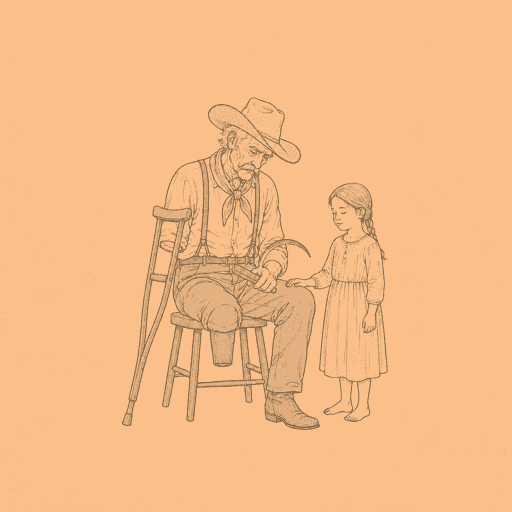
Call discovers a surprising talent for sharpening tools. Soon, Pea Eye, Lorena, and eventually their neighbors are bringing him dull knives, axes, and farm implements to work on. To stand while he works, he agrees to let Lorena order him a wooden leg. He is shy about it at first, allowing only Teresa to be present when he puts it on or takes it off. Clara sends Call information about a school for the blind in Cincinnati, but the thought of sending Teresa away is too painful for Call. Lorena, pregnant again and worried that Call would not survive without the girl, advises him to wait another year.
Epilogue, Chapter 29 Summary
While out searching for a stray bull, Goodnight and a young cowboy named J.D. Brown stop by the Parker farm. They find Call in his workshop, sharpening a sickle. On the ride home, J.D. is despondent, lamenting that a legendary Ranger like Captain Call has been reduced to “sharpening sickles in a dern barn” (536). Goodnight tells him that Call had his time and that life is like a “knife edge,” where everyone eventually slips and gets cut.
Epilogue, Chapter 30 Summary
The following autumn, Clara is killed on her Nebraska ranch. She was pawed to death by Marbles, her prized piebald stallion. Her experienced vaquero, Chollo, had warned her not to enter the pen because the horse was agitated, but Clara insisted the animal would not harm her. The stallion attacked immediately. Though the ranch hands eventually shot the horse, Clara was already dead.
Epilogue, Chapter 31 Summary
Call reacts to Clara’s death with pragmatic stoicism, remarking that raising studs is risky. Lorena, however, is devastated and locks herself in her bedroom, refusing to speak to anyone, even Pea Eye. That night, a distraught Pea Eye seeks out Call, who is quietly sharpening his knife while Teresa sleeps nearby. After Teresa goes to the house, Pea Eye is left alone and decides to sleep in the old oat bin. In the middle of the night, Lorena appears with a lantern, says she feels better, and tells him to come back to bed. He gets up and follows her, nervously trying to brush off the horsehair from the old saddle blankets he used for cover.
Epilogue Analysis
The aftermath of Captain Call’s confrontation with Joey that leaves him without his leg forces him to grapple with The Myth of the Frontier Hero. His injuries leave him unable to perform basic bodily functions, causing him to feel deep shame over his dependency on others and his inability to even button his own pants. The shame Call feels highlights the stoic independence and self-reliance of the archetypal Western hero. Call’s growing despondency and view of himself as a failure point to the fragility of this definition of success and heroism. Call’s identity is rooted in his self-sufficiency—he had “always saddled his own horse and unsaddled it too” (504)—and the loss of this autonomy represents a kind of death that mirrors the genre’s disenchantment with the mythic American West, whose history is fraught with racialized violence and colonization. The narrative pointedly dismantles the archetype of the invincible lawman, replacing it with a portrait of a man so despondent at his need for care and community that he wishes for death. His physical injuries mirror his psychological collapse, a state where he feels like an impostor in his own history, unable to connect with the man he once was.
The confrontation between Captain Call and Colonel Terry at the Fort Stockton train station dramatizes the collision of two eras, foregrounding The Tensions of Industrialization and an emerging world that values profit above all, even justice. The corporate railroad man demands to know where his murdered accountant’s ledgers are and brusquely assesses Call’s mission as a failure. Terry’s primary concern is not the loss of life but the missing account books, a symbol of the new order’s priorities. That Pea Eye casually admits they used the ledgers for kindling emphasizes the clash between the pragmatic survivalism of the old frontier and the bureaucratic logic of the new, industrialized one. The symbol of the railroad, which literally carries the characters away from the borderlands, represents the encroachment of Eastern commercial interests that have rendered men like Call obsolete. The anticlimactic resolution of the bounty on Joey, which is never paid due to legal technicalities, further erodes any notion of heroic justice, replacing it with the impersonal and often arbitrary attempts to protect corporate interests and profit margins.
Call’s obsessive reflection on his own mistake highlights the novel’s thematic interest in The Myth of the Frontier Hero. He attributes his downfall not to his own eyesight, which has been affected by aging. He believes if his eyes had been stronger, he would’ve noticed Joey’s decoy, successfully captured the outlaw, and saved himself from injury. This fixation on a mundane error, the kind of detail a younger Call would never have missed, points to a longing for a bygone era in which the rules that governed his existence felt clear and his identity secure. This sense of disconnection from his past self is reiterated through the metaphor of a canyon separating Call, the Texas Ranger and frontiersman, from the wounded man recovering on the train:
Now there was a crack, a kind of canyon, between the Woodrow Call sitting with Teresa on the train and the Woodrow Call who had made the campfire that morning and saddled his horse. The crack was permanent, the canyon deep. He could not get across it, back to himself. (523-24)
He is no longer the man who lived the stories people tell around dinner tables and campfires, making him feel like an impostor in his own life.
While the novel chronicles the physical decline of its male protagonist, it simultaneously depicts the rise of a resilient, pragmatic community led, structured, and defended by women. Once Joey incapacitates Call, Lorena emerges as the heroine of the story, driving the action forward. Every decision she makes is active, in contrast to Call’s increasingly passive despair. She takes charge of his care, manages the family’s relocation, and decisively protects herself from Colonel Terry’s assault by slashing his hand with a broken plate and purchasing tickets for herself and her family on a different train. Her threat—that she would cut off Call’s leg and would gladly do the same to the Colonel’s hand—demonstrates a fierce, unromanticized capability and strength born of necessity, not myth. By wiring Goodnight for a loan and Clara for help with her children, she mobilizes a support network that operates outside the crumbling world of male heroism. The immediate response from Clara, who travels from Nebraska to deliver Lorena’s children, reinforces this alternative model of community based on female solidarity and mutual aid. This network shows a more durable and adaptive form of survival than the solitary individualism of the obsolete frontier hero.
The epilogue concludes by solidifying Call’s transformation from a legendary figure into a humble artisan. The young cowboy traveling with Goodnight sees Call “sharpening sickles in a dern barn!” and laments his decline (536). Goodnight’s stoic reply, that Call “had his time” and that “Life’s but a knife edge” (536), serves as the novel’s final epitaph for the mythic Western hero. Call finds a new, diminished purpose in maintaining the domestic and agricultural tools of a settled community. His world shrinks to the confines of a small shack and his emotional life centers entirely on Teresa. His final ambition is to save enough money to send her to a school for the blind. Clara’s sudden, arbitrary death—killed by her own horse—provides a final, brutal commentary on the unglamorous and often senseless nature of death in the revisionist West, cementing the novel’s bleak, anti-heroic vision.

Get in-depth, chapter-by-chapter summaries and analysis from our literary experts.
- Grasp challenging concepts with clear, comprehensive explanations
- Revisit key plot points and ideas without rereading the book
- Share impressive insights in classes and book clubs