Streets of Laredo
Streets of Laredo
A modern alternative to SparkNotes and CliffsNotes, SuperSummary offers high-quality Study Guides with detailed chapter summaries and analysis of major themes, characters, and more.
Summaries & Analyses
Quizzes
NEWReading Tools
Themes
Content Warning: This section of the guide includes discussion of graphic violence, suicidal ideation, death by suicide, child abuse, child death, animal cruelty, animal death, racism, gender discrimination, ableism, sexual harassment, sexual assault, illness, and death.
The Myth of the Frontier Hero
Following in its Revisionist Western tradition, McMurtry’s novel methodically dismantles the myth of the indomitable white, male, Western hero by subjecting its legendary figures to the inescapable forces of time, injury, and obsolescence. The novel grapples with the competence and authority of the Old West’s archetypes as their valor and skills are steadily eroded by physical decline and a changing American landscape. Throughout the novel, Captain Call and the other aging frontiersmen are forced to question their own heroism and legacies in the face of their inevitable deaths. The skills that they once believed essential to taming a wilderness reveal greater complexity when rendered useless by the slow, internal betrayal of an aging body.
Captain Call himself, once the most lauded Ranger on the border, has aged into a man whose body constantly fails him. His hands are so swollen with arthritis that his knuckles get stuck in his rifle’s trigger guard, causing him to miss an important shot at a deer when his party needs meat. During a cold snap, his joints ache so badly he can barely perform simple tasks like tightening saddle straps. His strained eyesight and lack of agility compromise his once-legendary vigilance. As he pursues Joey, he’s tormented by a painful neck injury that prevents him from turning his head quickly, a physical limitation that directly contributes to his eventual ambush. McMurtry positions this physical decline as symptomatic of a deeper obsolescence. As the American West becomes progressively industrialized, rendering Call’s brand of heroism more and more irrelevant, these archetypal frontiersmen are left to reckon with their history of violence. While the characters in the novel grapple with the value and necessity of the violence they perpetrated, they fail to investigate the idea that it was largely carried out in defense of “civilized” white colonizers against “uncivilized” Indigenous nations.
The despondency Call feels after his return to Pea Eye and Lorena’s farm highlights the degree to which his identity has been defined by an idea that is ultimately fleeting. His life, first as a Texas Ranger and then as a bounty hunter, has always been ruled by a prescribed code of honor: Finish the job and protect the men that ride with you. This code gave him a certainty that anchored his life and informed his vision of the future. However, as he lies incapacitated in the Parkers’ barn, He’s haunted by his failure to adhere to this code: “[Call] lived, or at least he breathed; yet he had no idea what his life would be” (506). He’s consumed with thoughts “about the disgrace of his failed attempt to catch Joey Garza, or about the two pointless deaths” of Brookshire and Plunkert (506). He didn’t complete the job he was hired to do, and he failed to protect the men at his side. Stripped of the ability to follow his code, Call finds it impossible to find a vision for his future, underscoring the fragility of a heroic ideal whose life has been defined by violence and isolation.
The Tensions of Industrialization
Streets of Laredo’s central plot—the manhunt for Joey Garza—is set against the backdrop of an encroaching industrial civilization with corporate bureaucracy at the helm. The novel portrays the era of the lone ranger and the independent cattleman as a fading memory, giving way to a new order of railroads, ledgers, and impersonal employment. The wild frontier, once a landscape of epic struggle and individual will, is systematically being tamed and industrialized by forces that value profit and efficiency over honor and justice.
The alliance of Captain Call and Brookshire, the Brooklyn accountant sent by railroad president Colonel Terry to oversee the manhunt, embodies this tension. Brookshire is a “salaried man,” wholly out of place in Texas, where the wind steals his hat, and the vast emptiness gives him a “blowing-away feeling” (19). He thrives in a world of ledgers, reports, and budgets, where even a manhunt is a corporate expense to be managed. His presence transforms Captain Call from an independent agent of justice into a contracted employee, subject to the whims of a distant boss who communicates via terse, demanding telegrams. This shift from personal mission to corporate assignment signals the subordination of old frontier codes to the logic of modern business.
The railroad itself is the primary engine of this transformation, a symbol of commerce cutting through the once-limitless prairie. It alters the very nature of crime and justice. Outlaws no longer just rustle cattle; they rob trains, targeting military payrolls and corporate assets. Call is hired to protect the profits of the railroad rather than to bring Joey to justice. After Joey robs a train carrying a military payroll, Brookshire notes, “The military did not take kindly to having its money snatched. Hints had been received; the military let it be known that they might have to find other modes of conveyance if the young Mexican struck one more time” (62). From the opening chapters, McMurtry frames the motivation behind Joey’s capture as primarily financial. The manhunt is a corporate-funded expedition managed by an accountant. The train shrinks the vast distances of the West, but as Call observes, it also weakens the essential skills of the old world, like remembering the location of water holes. The technology that connects the nation also makes the rugged self-sufficiency of the frontiersman increasingly obsolete.
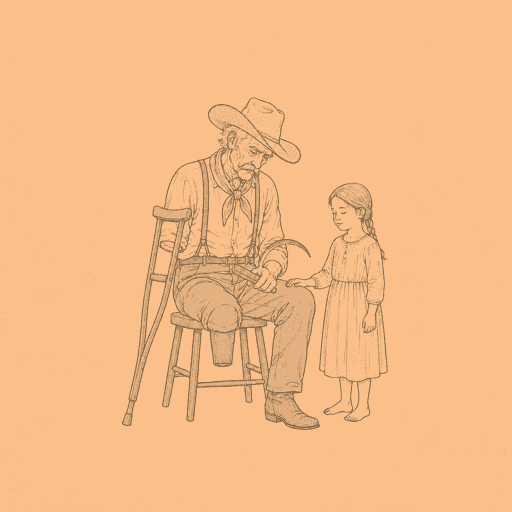
The personal choices of the characters reflect this broader societal change. Pea Eye definitively chooses the settled life of a farmer and family man over the violent, nomadic existence of a ranger, a decision that symbolizes the end of the era of the wandering frontiersman. His loyalty has shifted from his former commander to his wife and his land. By the novel’s end, even Captain Call, the last holdout of the old order, is completely removed from the world he once dominated. Injured and dependent, he is reduced to sharpening tools in a barn on Pea Eye’s farm. This final image acts as an elegy for the mythic West: The great hero, who believed he was taming the wilderness with his gun, is now a relic, his epic skills rendered irrelevant in an industrialized landscape.
The Power of Maternal Devotion
In a world defined by the decaying codes of male honor and nihilistic violence, Streets of Laredo presents the fierce, sacrificial love of mothers as the most resilient moral force. While the novel’s men are driven by duty, ego, or cruelty, characters like Maria and Lorena endure immense hardship and risk their lives for the protection of their loved ones rather than glory or profit. McMurtry frames this maternal devotion as a generative, life-affirming instinct that stands in stark opposition to the destructive impulses of the frontier’s violent men. The sacrifices of Maria and Lorena are among the only truly generative acts in the novel. While the men—Call, Joey, Mox Mox—are agents of death and decay, the mothers are agents of preservation, continuity, and care, even at the cost of their own lives.
Throughout the novel, Maria performs feats of traditionally masculine strength and resilience, each motivated by her desire to protect her children and herself. For example, after she’s raped by her neighbor Ramon as a young girl, Maria sharpens an old machete and wears it slung across her shoulders like a vaquero, leaving no one in her village in any doubt that she will use it. As her mother tells Ramon, “Maria is […] not afraid to cut men” (134). In adulthood, Maria’s fierce strength and determination undergird her devotion to her children. McMurtry notes that “to have gone to Crow Town and survived was a mark of pride to the young pistoleros along the border” (80), yet, without hesitation, Maria undertakes a perilous journey to Crow Town to warn Joey that Captain Call is coming. Far from a naive belief in his hidden goodness, Maria is motivated by an unbreakable maternal bond. This devotion culminates in her ultimate sacrifice: She physically places herself between Joey and her other children, Rafael and Teresa, a sacrifice that costs her her life. Even in her dying moments, her concern is for her surviving children, staying alive long enough to ensure that Lorena will care for them when she’s gone.
Lorena’s journey provides a parallel narrative of maternal and spousal devotion. She travels hundreds of miles into dangerous territory to find her husband, Pea Eye, driven by the fear that he will be killed and leave their five children fatherless. Her protective instinct extends beyond her biological family when she unhesitatingly agrees to Maria’s dying request to raise Rafael and Teresa. Lorena’s most dramatic act of care is the brutal amputation of Captain Call’s leg. She undertakes this gruesome task out of a deep sense of responsibility to preserve a human life. Lorena assures Call, “If you die, I’ll go—but not until then” (405), illustrating a commitment to human connection and care that transcends her personal feelings for Call. Lorena’s expanded family becomes the quiet, stable center of the narrative’s conclusion. In a West where heroism has failed, and male codes of honor have crumbled into violence, the novel highlights the meaningful and enduring legacies forged by women.

Unlock every key theme and why it matters
Get in-depth breakdowns of the book’s main ideas and how they connect and evolve.
- Explore how themes develop throughout the text
- Connect themes to characters, events, and symbols
- Support essays and discussions with thematic evidence