The Eights
The Eights
A modern alternative to SparkNotes and CliffsNotes, SuperSummary offers high-quality Study Guides with detailed chapter summaries and analysis of major themes, characters, and more.
Summaries & Analyses
Author Insights
Quizzes
NEWReading Tools
Background
Content Warning: This section of the guide includes discussion of death, mental illness, gender discrimination, and graphic violence.
Historical Context: World War I and the British Homefront
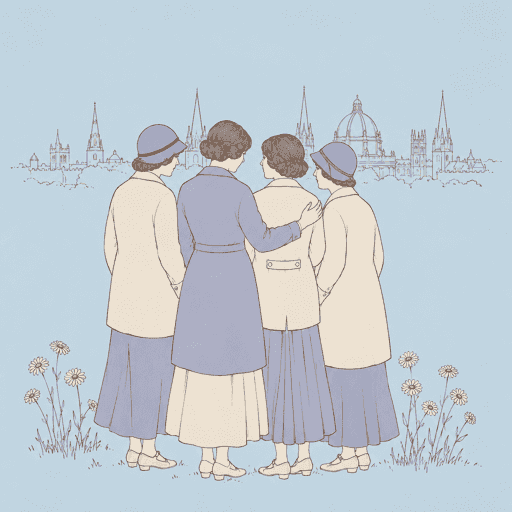
World War I (1914–1918) claimed approximately 750,000 British military lives and left millions more physically and psychologically wounded. Set in Oxford two years after the Armistice, The Eights portrays a generation of young women whose ambitions, relationships, and emotional lives have been fundamentally reshaped by the conflict and its aftermath.
Among the many battles that took place during the war, the Battle of Cambrai in November and December 1917, which produced roughly 44,000 British casualties (“Battles of Cambrai.” Imperial War Museum), serves as the pivotal event that kills Dora’s brother George and supposedly her fiancé Charles within two weeks of each other. Their concentrated losses mirror a grim reality faced by families across Britain, where a single offensive could claim an entire generation of a community’s young men. Dora’s unresolved grief is one of the main challenges she faces during her first year at Oxford, ultimately contributing to her suspension. This demonstrates how bereavement continued to upend lives years after the ceasefire.
The homefront experience features prominently in the novel through Otto’s service in the Voluntary Aid Detachment. Her traumatic nursing probation at Somerville College, which historically housed the Third Southern General Hospital, reflects the toll on young, minimally trained volunteers who confronted wartime injuries firsthand. Otto’s persistent nightmares about “the wet meat inside a human body” (136) reveal the lasting psychological damage of such work. This reality is echoed in Vera Brittain’s memoir Testament of Youth (1933), which documented similar conditions in British and French hospitals.
Miller’s novel further depicts what was then termed “shell shock,” now recognized as post-traumatic stress disorder. When a convalescent officer strips naked in the University Parks, the women witness the manifestation of a traumatic experience that they have never seen before. Dora’s anguished question of whether the suffering is “never going to end” (77) captures the helplessness of a generation witnessing war’s invisible wounds. Through such encounters, Miller demonstrates that the Armistice did not conclude the war so much as transform its presence, embedding trauma in Oxford’s streets and in the lives of women forging new identities within the university.
Historical Context: The British Suffragette Movement
The campaign for women’s suffrage in Britain, which spanned decades of escalating activism, forms a crucial backdrop to The Eights. The Women’s Social and Political Union (WSPU), founded by Emmeline Pankhurst in 1903, employed increasingly militant tactics including arson, window-smashing, and hunger strikes to demand voting rights for women. These methods, encapsulated in the WSPU motto “Deeds Not Words,” provoked severe government repression, including the force-feeding of incarcerated suffragettes under the Prisoners (Temporary Discharge for Ill Health) Act of 1913, widely known as the Cat and Mouse Act.
In Miller’s novel, Beatrice’s mother, Edith Sparks, embodies this militant legacy. A former St. Hugh’s student, Edith is described as having been arrested eight times and experienced force-feeding during hunger strikes at Holloway Prison. Her experiences parallel those of Emily Davison, who appears in the novel as Edith’s close friend. Davison historically attended St. Hugh’s for a semester and died while protesting at the 1913 Epsom Derby, representing the extreme personal cost the movement exacted. When Davison tells young Beatrice that “every cause needs a martyr” (65), her words foreshadow her own death and underscore the conviction that political representation demanded ultimate sacrifice.
The Representation of the People Act of 1918 granted voting rights to women over the age of 30 who met property qualifications, enfranchising approximately 8.4 million women (“The Representation of the People Act 1918.” UK Parliament). Yet as Edith argues in her speech at St. Hugh’s, women under 30 still could not vote and working women were being displaced by returning servicemen. Her insistence that “a country is only truly democratic if opportunity is not withheld from all its citizens” (60) articulates the campaign’s unfinished nature. For Beatrice and her peers, suffrage remains a living struggle that shapes their experience at Oxford, from hostile lectures to the restrictive chaperone rules governing their daily conduct.
Historical Context: Women’s Admission to Oxford University
Women’s presence at Oxford University was contested for nearly half a century before they gained formal recognition. Lady Margaret Hall, the first women’s college, opened in 1878 with nine students, followed by Somerville in 1879, St. Hugh’s in 1886, and St. Hilda’s in 1893. Although women were permitted to sit the same final examinations as men from 1894, they could not receive degrees, a restriction that made Oxford and Cambridge the only British universities to withhold this right. Women who achieved first-class results were publicly acknowledged but left without formal credentials, a disparity that Annie Rogers, Oxford’s first female don, described as reducing women’s achievements to “a courtesy, not a right” (Rogers, Annie. Degrees by Degrees. Oxford University Press, 1938).
The movement to change this gained momentum after the Representation of the People Act of 1918 extended voting rights to women over the age of 30. The Sex Disqualification (Removal) Act of 1919 further required that universities not preclude students from degrees on the basis of sex. In May 1920, Oxford’s Congregation voted to admit women as full members, and on October 7, women matriculated for the first time in the university’s thousand-year history. One week later, women of all ages returned to collect degrees earned years or even decades earlier. The ceremony was covered widely in the national press, and in the novel, the principal of St. Hugh’s, Eleanor Jourdain, calls it “a woman’s day, and a day for women to remember” (59).
Yet formal admission did not translate into equality. Women remained subject to restrictive regulations with no male equivalent: mandatory chaperones at lectures and social events, curfews, prohibitions on speaking with male students, and bans on entering men’s rooms unchaperoned. In 1927, the university imposed a quota capping women’s enrollment at roughly a quarter of the male student body, a limitation not abolished until 1957. Miller dramatizes these constraints through daily humiliations that range from street harassment on matriculation day to a don ejecting Beatrice from a lecture for arriving late while admitting a tardy male student without comment. The novel’s depiction of women navigating a system that simultaneously included and marginalized them reflects the broader reality that, as historian Laura Schwartz documented, early women students operated under “a constant tension between gratitude for access and frustration at its limits” (Schwartz, Laura. A Serious Endeavor. Oxford University Press, 2011). In Miller’s novel, Beatrice’s observation that the vice chancellor framed the rules as “equality with separation” (37) captures how institutional rhetoric masked continued discrimination, a dynamic that persisted at Oxford for decades.

Get in-depth, chapter-by-chapter summaries and analysis from our literary experts.
- Grasp challenging concepts with clear, comprehensive explanations
- Revisit key plot points and ideas without rereading the book
- Share impressive insights in classes and book clubs