The Eights
The Eights
A modern alternative to SparkNotes and CliffsNotes, SuperSummary offers high-quality Study Guides with detailed chapter summaries and analysis of major themes, characters, and more.
Summaries & Analyses
Author Insights
Quizzes
NEWReading Tools
Symbols & Motifs
Content Warning: This section of the guide includes discussion of death, gender discrimination, emotional abuse, mental illness, and bullying.
Marianne’s Locket
Marianne’s locket is a symbol of concealed identity and maternal devotion, representing the secret life she must lead to pursue her education at Oxford. Throughout the novel, Marianne instinctively reaches for the locket during moments of distress, treating it as a tether to the self she cannot openly disclose with others. After the humiliating fall outside Balliol, she resists the urge to grab at “the locket concealed beneath her blouse” (15), a gesture revealing how the object anchors her amid hostility. The locket’s hidden position against her skin mirrors the hidden truth of her motherhood, a secret that could collapse her academic future if discovered.
The symbol’s meaning deepens through misdirection. Otto initially assumes the locket commemorates Marianne’s deceased mother, and Marianne allows this interpretation to stand. Only later does the reader learn it contains “a lock of Connie’s hair” (343), transforming an object of mourning into one of living connection. This revelation reframes every prior scene in which Marianne touches the locket, exposing the dual life she has constructed at Oxford.
The tension at the heart of Friendship as Shelter and Support becomes visible in the scene where Marianne’s daughter reaches inside her blouse and begins sucking on the locket, collapsing in a single physical gesture the boundary Marianne has spent the novel maintaining between her role as mother and her identity as scholar. That collapse is completed when she finally discloses the locket’s contents to Otto and the other Eights. She could not risk this confidence when she first met them, but she can risk it now within the trusted circle the group has become. Where the locket once had to stay hidden to keep Marianne enrolled, she can let it surface among friends without forfeiting her place.
The Number Eight
The number eight operates as a motif binding the four protagonists into a unit greater than themselves, gathering symbolic weight through repetition and the mythology Otto builds around it. When Otto first notices the pattern, she presents it as fate: “Did you notice all of our Christian names have eight letters?” (35) she asks, before observing they all live on Corridor Eight. What begins as coincidence becomes identity, as the women adopt the collective name “the Eights,” a designation that grants them visibility and cohesion within a college that might otherwise reduce them to anonymous freshmen.
The motif’s meaning shifts according to whoever invokes it. For Otto, born on the eighth day of the eighth month, eight signals personal auspiciousness and mathematical beauty. It is an even number, a cube, and a symbol of infinite symmetry. For Beatrice, the city war memorial’s octagonal shape evokes rebirth and christening fonts. The number’s flexibility allows it to absorb multiple meanings: luck, structure, renewal, and unity.
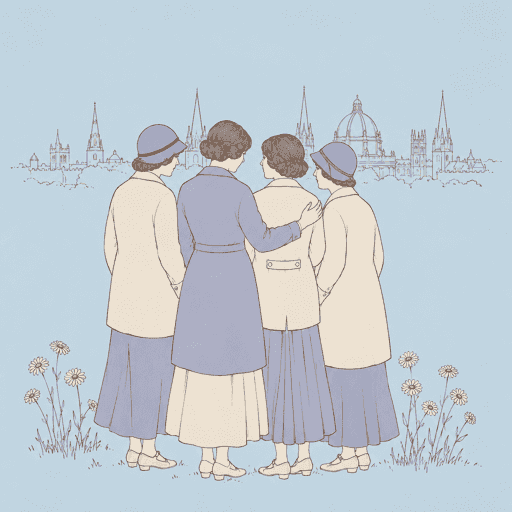
At the novel’s close, when the four women press their heads together and encircle Marianne, they enact the closed symmetry the number has come to represent throughout their shared Oxford years. That scene makes concrete what Friendship as Shelter and Support argues across the full novel: Each woman’s survival of trauma, illness, and institutional hostility depended on the others holding the circle intact. The motif also quietly echoes the rowing eights of Summer Eights, the crews that traditionally excluded women, repurposing a masculine numerical tradition into a feminine emblem of solidarity.
Letters and Telegrams
Letters and telegrams form a pervasive motif throughout the novel, functioning as instruments of both revelation and deception that drive every major plot development. Written communication structures the narrative itself, with entire chapters composed of correspondence. Characters’ fates often hinge on what arrives in their pigeonholes. The motif thus explores how the era’s reliance on the written word created vulnerability: Ink could lie as easily as it could record truth.
The most destructive example of this motif is the letter from Captain L. P. Ferryman announcing Charles Baker’s death, a document Dora carries for three years as evidence of her loss. Charles later confesses the letter was a deliberate fiction, written when he “told [Ferryman] I wanted out, so he sent the letter” (173). This admission reframes every condolence card and mourning ritual Dora endured, exposing how a single piece of paper manufactured years of false grief. The letter becomes a symbol of cowardice masquerading as casualty, illustrating The Enduring Nature of Trauma in a particularly cruel form.
Correspondence also sustains friendship and identity. The notes the Eights leave on string-hung papers outside their doors, Beatrice’s letters from her mother that wound and occasionally affirm her, and Marianne’s careful letters home all demonstrate how writing constructs and maintains the relationships that institutional rules attempt to constrain. Even Miss Jourdain’s disciplinary notes wield authority through paper. When Dora finally opens the Ferryman letter again after Charles’s confession and reads it knowing it was authored to deceive her, the same words that once built her grief now confirm his betrayal. A document’s meaning, the motif shows, depends entirely on what the sender chose to conceal.
Academic Dress
Academic dress operates as a motif tracking the women’s uneasy occupation of Oxford’s ancient spaces. The cap and gown, designed centuries earlier for men, fit the female undergraduates poorly in both literal and symbolic senses. Beatrice’s gown “sits at her waist rather than the regulation hip and cuts tightly into the shoulders of her jacket,” forcing her to consider buying “a man’s size instead” (4). This ill-fitting garment externalizes the broader incongruity of women’s presence in an institution that has neither designed itself for them nor adapted willingly to accommodate them.
The “floppy” woolen cap becomes a particular focus of ridicule and resentment. The Balliol mob mocks the headwear during matriculation, the Daily Mail patronizingly praises it, and Otto repeatedly complains about its absurdity. Yet the cap also becomes a marker of belonging, the object the women clutch and retrieve after each public humiliation. When Dora retrieves Marianne’s cap from the gutter after she falls outside Balliol, the gesture quietly affirms solidarity in the face of institutional mockery.
The motif most directly engages Forging a Place for Women in Patriarchal Institutions. Academic dress promises equality by putting women in the same robes the men wear, yet Vice Chancellor Farnell’s policy of “equality with separation” (37) ensures the women’s altered cut and strange cap mark their separate status at every formal occasion. By novel’s end, when the Eights receive their gowns and prepare for finals, the once-mocked uniform has become genuinely theirs, reshaped by the bodies that wear it.

Unlock the meaning behind every key symbol & motif
See how recurring imagery, objects, and ideas shape the narrative.
- Explore how the author builds meaning through symbolism
- Understand what symbols & motifs represent in the text
- Connect recurring ideas to themes, characters, and events