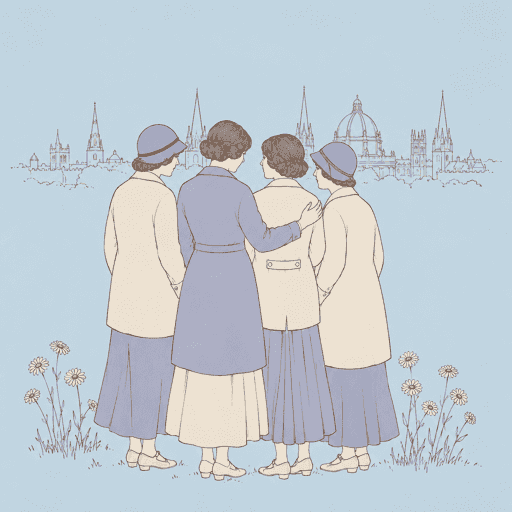
The Eights
The Eights
A modern alternative to SparkNotes and CliffsNotes, SuperSummary offers high-quality Study Guides with detailed chapter summaries and analysis of major themes, characters, and more.
Summaries & Analyses
Author Insights
Quizzes
NEWReading Tools
Part 1, Chapters 8-15Chapter Summaries & Analyses
Content Warning: This section of the guide includes discussion of mental illness, graphic violence, death, bullying, and substance use.
Part 1: "Michaelmas Term"
Part 1, Chapter 8 Summary
On a Saturday in their third week, Otto makes good on the promise of a picnic in the University Parks. Marianne struggles to learn to ride a borrowed bicycle, while Otto, Dora, and Beatrice are already proficient. In the park, Marianne observes a furious young girl whose parents are expecting another child; the scene reminds Marianne of when she selfishly sabotaged her widowed father’s potential remarriage years ago. Her thoughts are interrupted by the sight of war veterans using wheelchairs as they go on an outing from the nearby infirmary.
The girls’ chaperone, a stout woman named Miss Stroud, arrives, and they find a picnic spot near the River Cherwell. Their pleasant afternoon is disrupted when one of the veterans experiences a public mental health crisis, tearing off his clothes and urinating near Miss Stroud. The sight deeply disturbs the four friends, bringing back traumatic memories for each of them. Two male students help restrain the man, after which the girls succumb to uncontrollable laughter. Miss Stroud, who was spattered with urine, is appalled by their reaction and ends the picnic early, lecturing them for being a damaged generation. Otto, furious, stalks off. Later, in Otto’s room, the friends talk about the veteran’s trauma and about the uncertain prospects of finding someone to marry at Oxford.
Part 1, Chapter 9 Summary
On Guy Fawkes Day, Otto wakes with a severe toothache. Marianne arranges a dentist appointment, and Miss Stroud chaperones them. The bus ride and the dental surgery trigger traumatic war-related memories for Otto, who becomes terrified. The dentist extracts the broken tooth while she is under nitrous oxide.
The following Monday, after a weekend at home, Marianne joins her friends, who are now calling themselves “the Eights,” for their regular study session at the Radcliffe Camera library. Afterward, they are targeted in a prank arranged by the students at the adjacent Brasenose College. A student cries for help, luring the women into the college lodge while accomplices steal Marianne’s and Otto’s bags from their bicycle baskets. A handsome student, Arthur Motson-Brown, then approaches, claiming the theft is a tradition for a dining society. He returns their bags and recognizes Otto as the sister of a London socialite, Vita Wallace-Kerr. However, another student arrives and reveals that Motson-Brown was part of the prank, which he devised to meet them. Beatrice is furious and leaves, but Otto is amused. Motson-Brown gives his card to Otto and Dora, inviting them for tea.
Part 1, Chapter 10 Summary
The fifth week of the semester is marked by Armistice commemorations. Beatrice is deeply moved by a newsreel of the Unknown Warrior’s burial. While out with her friends, she witnesses a woman steal food from a shop, which makes her reflect on post-war poverty. Later, Dora speaks for the first time about her brother, George, and her fiancé, Charles, who were killed two weeks apart at the Battle of Cambrai. Dora reveals to herself that she finds solace in imagining Charles is the Unknown Warrior.
That night, a drunk Otto gets locked out and climbs into Marianne’s room. She confesses that her mother wants her to leave Oxford to marry a man named Teddy, and starts crying. Otto has been sneaking out to parties, using alcohol to cope with her war trauma. Soon after, her mathematics instructor, Miss Brockett, delivers a warning from the principal, Miss Jourdain, about Otto’s behavior. Miss Brockett, revealing she was also a Voluntary Aid Detachment (VAD) nurse, offers to talk with Otto about her war experiences and encourages her to join the hockey team. Shaken by the conversation, Otto signs up for hockey, then sees a new notice from Miss Jourdain forbidding unchaperoned visits to men’s rooms under penalty of expulsion.
Part 1, Chapter 11 Summary
In a flashback to June 1915, 15-year-old Dora visits her brother, George, at Jesus College, Oxford, with their mother. George confides in Dora that he is failing his divinity exams and plans to enlist in the army to avoid being expelled from the university. While at the college, Dora feels self-conscious around the male students and meets George’s quiet friend, Frank Collingham.
Dora’s visit is disrupted when she gets her first period. Forced to tell her mother, she is forbidden from joining the planned boating trip and is sent back to her hotel room. A maid brings her a package of sanitary products. Feeling trapped, humiliated, and indignant about her new physical reality, Dora tears the boxes and leaflets to pieces in a fit of rage.
Part 1, Chapter 12 Summary
In the sixth week of the semester, Dora receives an invitation for tea at Jesus College from Frank Collingham, her late brother George’s friend, who recognized her in town. With their chaperone, Miss Cox, the Eights visit his rooms. After tea, Frank takes them to see the college’s new war memorial, which is still under construction. He unveils a large oak panel carved with the names of the dead, and Dora sees her brother’s name, G. P. Greenwood, listed among them.
Meanwhile, Marianne has been secretly caring for the college cat and its newborn kittens in her room. When the kittens become too disruptive, they suddenly disappear. Marianne suspects the scout, Maud, had something to do with it but cannot ask. She then receives a formal warning from Miss Jourdain for keeping animals on the premises. As Marianne leaves for her weekend home, Maud secretly intercepts her at the train station and gives her a basket containing one of the kittens.
Part 1, Chapter 13 Summary
Otto hosts a séance in her room with wine and a Ouija board. After some jokes, the planchette begins to move, spelling out “C-O-W-A-R-D.” Marianne weeps. Otto, enraged, accuses her friends of a cruel prank, throws the board in the fire, and orders Marianne to leave. After Marianne exits, Otto confesses that she considers herself a coward. She reveals that during the war, she failed her probation as a VAD nurse after only six weeks because the experience was overwhelming. This experience continues to haunt her.
Beatrice tries to comfort Otto by deconstructing the word “coward,” but Otto rebuffs her. Hurt, Beatrice leaves and finds Marianne in the hallway. Marianne, though physically ill, appears radiant and tells Beatrice that she received a message from an unspecified girl. Just then, Miss Jourdain appears in the corridor and discovers the scene.
Part 1, Chapter 14 Summary
A flashback details Otto’s traumatic VAD service in January 1918. Posted to a hospital for officers at Somerville College, Otto found the work of a probationary nurse horrifying. She experienced frequent nightmares and a mental health crisis, which contributed to the failure of her probation. Her influential father then arranged her reassignment as a driver in Oxford.
One day, Otto assists an elderly woman, Miss Rogers, a Classics instructor at St. Hugh’s College, who was knocked off her bicycle. Miss Rogers invites Otto for tea, mistakenly assuming she is a student. Otto is inspired by the independent and intellectual Miss Rogers, who recounts her own fight for an education in a system that denied her a place at a men’s college despite her academic excellence. This encounter motivates Otto to seek a university education herself. After her service ends, she prepares for the entrance exams and is accepted to study mathematics at St. Hugh’s.
Part 1, Chapter 15 Summary
In the final week of the semester, Miss Jourdain gives the Eights a lenient punishment for drinking alcohol, restricting them to an 8 pm. curfew. The atmosphere in the group remains tense, as Marianne has withdrawn from them ever since the Ouija board incident. Meanwhile, Frank Collingham gives Dora a book and asks to write to her over Christmas; seeing a practical path to marriage, she agrees. Dora also learns she must retake a mathematics exam she has failed. She feels intellectually inadequate compared to her friends.
On their last night, the Eights get permission to dine at Otto’s aunt’s house, which is empty for the winter. They enjoy a lavish meal and exchange Christmas gifts. Marianne gives each friend a thoughtfully chosen, framed poem she typed herself. In return, Otto gives Marianne a one-pound note for books, which she sees as a generous and understanding gift. The evening of friendship and gift-giving reaffirms their bond. Marianne feels a momentary urge to reveal her secret to them but decides against it.
Part 1, Chapters 8-15 Analysis
The public mental health crisis of the veteran in the University Parks shatters any illusion that Oxford is a sanctuary from the recent past, demonstrating how The Enduring Nature of Trauma are inescapable. The man’s crisis is part of a larger social landscape filled with visible and invisible damage, from veterans using wheelchairs while in recuperation to Otto recalling memories of her experiences as VAD nurse. For Otto, the veteran’s crisis directly triggers her memories; she subsequently experiences terror during a routine dental visit, prompted by the clinical smells and sensations of being held down, which resonate with her VAD service at the military hospital in Somerville. Similarly, Dora’s private memorialization of her fiancé as the Unknown Warrior and her quiet shock at seeing her brother’s name carved on the Jesus College war memorial show that grief is another wound of war, fitting her into the same landscape that Dora and the veterans belong to. Though the war is over, it remains a persistent psychological force that shapes each character’s present-day vulnerabilities, a reality underscored by their chaperone’s accusation that they are a “guilt-ridden and damaged” generation (78).
The elaborate prank orchestrated by the Brasenose College students highlights the casual but pervasive hostility the women face as newcomers. By luring the Eights into the college lodge under false pretenses only to steal their bags, the male students treat them as objects of amusement rather than as academic peers. The perpetrator’s eventual return of the bags, framed as a chivalrous gesture to facilitate an introduction, only reinforces the condescension, showing how their presence is seen as a social opportunity. This dynamic illustrates the core challenge of Forging a Place for Women in Patriarchal Institutions. More than official access, the Eights’ place in Oxford is about confronting an entrenched culture of male privilege. The flashback to Dora’s 1915 visit to Oxford provides a deeper context for this exclusion; her first period leads to her confinement in a hotel room, a stark example of how female biology has historically been used to justify exclusion from public and intellectual life. Now, five years later, her status as a student represents progress, yet the Brasenose prank, the rules on chaperone requirements, and Miss Jourdain’s strict new notice forbidding visits to men’s rooms show how tenuous that progress remains. They are admitted but not yet accepted, their presence contingent on constant surveillance and adherence to restrictive rules.
Across these chapters, the narrative is structured by a dynamic of secrecy and revelation, using flashbacks to expose the hidden origins of the characters’ present-day anxieties. Otto conceals the extent of her trauma and the shame of her “failure” as a nurse; Dora hides her feelings of academic inadequacy and the intensity of her grief; and Marianne’s entire life at Oxford is predicated on a secret her friends know nothing about. These secrets are disrupted during Otto’s séance. The Ouija board’s message of “COWARD” functions as a catalyst for forced confession, breaking through the group’s camaraderie to unlock the story of Otto’s traumatic nursing experience. These individual histories, revealed to the reader through flashbacks but only partially to each other, create a dramatic tension between the women’s shared public experience at Oxford and their unshared private pasts.
Despite these tensions, the women’s emerging solidarity demonstrates the theme of Friendship as Shelter and Support. The group’s bond is tested by the Ouija board incident, which exposes their individual wounds and triggers Otto’s rage and Marianne’s mysterious interpretation of the message. However, the aftermath is a process of repair and empathy. Their private final dinner of the semester is a reaffirmation of their commitment to one another, creating an intimate space where they can exist as a chosen family, free from institutional oversight. The evening culminates in a gift exchange that showcases their deep mutual understanding. Marianne’s gift of thoughtfully selected, hand-typed poems reveals her careful attention to each friend’s personality. In return, Otto’s gift to Marianne of access to books is a gesture of extraordinary sensitivity. It acknowledges their class differences and provides practical, desperately needed financial help without condescension. This act cements their friendship as both a source of emotional comfort and as an essential, practical support system essential for their survival and success in the often-hostile environment of the university.

Get in-depth, chapter-by-chapter summaries and analysis from our literary experts.
- Grasp challenging concepts with clear, comprehensive explanations
- Revisit key plot points and ideas without rereading the book
- Share impressive insights in classes and book clubs