The Eights
The Eights
A modern alternative to SparkNotes and CliffsNotes, SuperSummary offers high-quality Study Guides with detailed chapter summaries and analysis of major themes, characters, and more.
Summaries & Analyses
Author Insights
Quizzes
NEWReading Tools
Prologue-Part 1, Chapters 1-7Chapter Summaries & Analyses
Content Warning: This section of the guide includes discussion of gender discrimination, death, mental illness, bullying, child sexual abuse, and sexual violence.
Part 1: "Michaelmas Term"
Prologue Summary: “Daughters of the University”
An article from the Oxford Times, dated October 6, 1920, announces the historic matriculation of women as full undergraduates at Oxford University for the first time. The event is celebrated by many but is met with disappointment by others who believe Oxford should remain an institution exclusively for men.
Part 1, Chapter 1 Summary
The principal of St. Hugh’s College, Miss E. F. Jourdain, writes a notice advising students on the rules and regulations concerning academic dress.
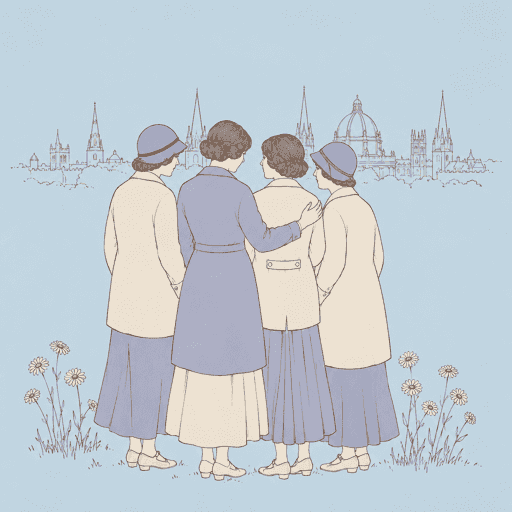
On the morning of Thursday, October 7, 1920, four young women in their rooms at St. Hugh’s College prepare for the matriculation ceremony. Beatrice Sparks, the tall daughter of a renowned suffragette, is an only child with no friends who hopes for a new beginning. In an adjacent room, Marianne Grey, the daughter of a rector, looks at her mantlepiece postcard of Rossetti’s Proserpine, feels overwhelmed and considers abandoning her studies to return home. Across the hall, Theodora “Dora” Greenwood grapples with the grief of losing her brother and fiancé in the war, which is her primary motivation for attending Oxford. Meanwhile, Ottoline “Otto” Wallace-Kerr, a wealthy and rebellious student of mathematics, arrives at the college gates, viewing Oxford as an escape from her life in London.
Part 1, Chapter 2 Summary
The first-year students of St. Hugh’s assemble in the courtyard to walk to the matriculation ceremony. Dora, Beatrice, and Marianne meet for the first time when they are grouped with their fellow Corridor Eight resident, Otto. As the four women walk together, they are accosted by a group of male students from Balliol College. The men use a megaphone to hurl insults, mocking the women’s academic dress and their right to be at the university. While Beatrice tries to lead the group away, Otto confronts the hecklers, bluffing about her connections to their college master’s daughters and threatening to report them. During the commotion, a student stumbles, knocking Marianne to the ground. The men laugh before dispersing, leaving the four women shaken.
Part 1, Chapter 3 Summary
After the incident with the Balliol students, Otto insists on taking the group to the Good Luck Tea Rooms to recover. In the lavatory, a distraught Marianne resolves to leave Oxford.
In the café, the waitress recognizes Otto from her time as a volunteer driver during the war. The four women drink their tea before rejoining the other St. Hugh’s students at the Bodleian Library. Inside the Divinity School, Beatrice notes that the men’s ceremony is taking place in the grander Sheldonian Theatre. After the brief ceremony, the newly matriculated women pose for photographs. Beatrice feels proud but also reflects on the generations of women, like her mother, whose struggles made the day possible.
Part 1, Chapter 4 Summary
That evening at dinner, the four friends sit with another first-year student, Patricia Clough, who criticizes older students for their supposed easy time during the war. Otto sharply defends the women’s contributions to the war effort.
Miss Jourdain gives a speech encouraging the new students to uphold the highest standards of intellect and decorum. Inspired, Marianne decides to stay at Oxford. Later, the four gather in Otto’s room, which is filled with her possessions. They talk about their studies, and Otto notes that all their names have eight letters, matching their corridor number. She deems this coincidence a good omen. They lament the restrictive Intercollegiate Rules for Women Undergraduates and share their wartime experiences, including Dora’s loss of her brother and fiancé. To lift the mood, they help Otto unpack, solidifying their new friendship.
Part 1, Chapter 5 Summary
On Monday, October 11, Beatrice tells her friends that her mother, the famous suffragette Edith Sparks, will be in Oxford to receive her degree. Later, Otto takes a group photograph of “the Eights.” The four attend their first lecture at Exeter College, where they are seated apart from the male students. Afterward, they go to the Bodleian to swear the library oath. Later in the week, Dora has her first tutorial with her English instructor, Miss Finch, who informs her that she has passed her Latin entrance exam but failed mathematics and must retake it.
Part 1, Chapter 6 Summary
On Thursday, October 14, the day former students are awarded their degrees, Otto writes to her sister complaining about the strict college rules.
Marianne reflects on how the Eights have become inseparable, finding true friendship and laughter for the first time in years. Dora writes to a friend, describing the celebratory atmosphere as women from across the country gather for the degree ceremony. She also expresses her mortification over failing her mathematics exam.
That afternoon, St. Hugh’s holds a reception where Beatrice’s mother, Edith Sparks, gives a passionate speech about the long, difficult fight for women’s rights and education. The students are inspired, but Beatrice feels only the familiar weight of her mother’s overwhelming and often cold presence.
Part 1, Chapter 7 Summary
A flashback reveals an incident from June 1912. A 13-year-old Beatrice attends a women’s suffrage rally in Oxford with Edith. As the crowd turns violent, Beatrice is separated from her mother and sexually assaulted by a man who corners her against a railing. When Beatrice later tries to tell her mother what happened, Edith dismisses her and calls her a burden. Beatrice realizes she can never share her trauma with her mother, who would either not believe her or blame her for the assault.
Prologue-Part 1, Chapters 1-7 Analysis
The Eights’ first walk to matriculation, which ends with male students from Balliol College heckling them and knocking Marianne to the ground, immediately establishes the central conflict of Forging a Place for Women in Patriarchal Institutions. While the opening Oxford Times article frames the day as a “memorable occasion,” the reality on the street is one of open hostility. This external resistance is mirrored by institutional structures designed to contain and separate the women. Their modern St. Hugh’s College, which Otto dismisses as looking like “a home for lost governesses” (29), stands in stark contrast to the “dreamy Gothic towers” of the men’s colleges, physically marking them as outsiders (29). This marginalization is reinforced when their matriculation ceremony is held in the Divinity School, a less prestigious venue than the Sheldonian Theatre where the men are inducted, and they are seated apart for their first lecture. The motif of academic dress emphasizes their awkward position; Beatrice’s gown is ill-fitting, and the men mock the women’s “floppy woolen caps” (13). This systemic separation is formalized in the Intercollegiate Rules for Women Undergraduates, a document that curtails their movement and social interactions, effectively turning the university into a space of “equality with separation” (37). Principal Jourdain’s warning that they “must not let our doubters find us wanting” (33) makes clear that the burden of proving their worthiness rests solely on them.
Marianne’s postcard of Rossetti’s Proserpine, the goddess trapped in the underworld after eating a pomegranate, functions as an allusive emblem for the private constraints shaping the women. While the group confronts a collective public struggle, each character navigates an inner world defined by loss and restrictive cultural ideals. Marianne feels she has “given in to temptation” by pursuing her studies and “must pay the price of being separated from home” (6-7), a sense of confinement that aligns her with the passive, tragic heroines of Pre-Raphaelite art. Dora, whose appearance is compared to a Rossetti muse, processes her grief for her brother and fiancé through compulsive organization, an attempt at “Restoring order from chaos” (9). Her trauma is so pervasive that she asks her instructor if it is “normal to see the war in everything one reads,” (51) demonstrating how The Enduring Nature of Trauma acts as an inescapable interpretive lens for her generation. These internal struggles exist within a post-war society anxious about its demographic imbalance, reflected in a Daily Mail headline about “A Million Women Too Many” (20). This context sharpens the stakes of their education: Dora feels pressure to find a husband in a depleted market, while Otto’s academic pursuit is an escape from that very expectation, showing how the war redefined female purpose.
In the face of institutional hostility and private anxieties, the four women discover that Friendship as Shelter and Support is their most essential resource. The bond forms immediately after the heckling incident, first over tea and then solidifying in Otto’s cluttered room, where helping her unpack becomes an act of mutual care. This contrasts sharply with the isolation of the opening chapter, where each woman prepares for matriculation alone. For Beatrice, who has never lived among her peers, the friendship is a novel experience in “mutual reliance and constant company” (44). For Marianne, who arrives with the desire to return home, the group’s nascent solidarity provides the resolve to stay. Otto’s observation that their four names, like their corridor, are connected by the motif of the number eight transforms a coincidence into an omen of good fortune, investing their group with an almost fated quality. The group photograph they take in the garden is a deliberate act of self-definition, creating a new, shared identity that provides a sense of belonging the university itself withholds from them. Their collective identity thus is a powerful counter-narrative to their official status as marginalized newcomers.
The narrative complicates the triumphant history of women’s progress by exploring its personal costs through Beatrice’s relationship with her mother, the suffragette Edith Sparks. While Edith’s speech at the degree ceremony inspires the other students with its rhetoric of collective struggle, Beatrice feels only the familiar weight of her mother’s emotionally distant and demanding personality. The flashback to a 1912 suffrage rally reveals the origin of this strain: As a 13-year-old, Beatrice was sexually assaulted at the Martyrs’ Memorial—a site dedicated to victims of persecution—while her mother was preoccupied with the cause. Edith’s subsequent dismissal of Beatrice’s trauma, whom she even calls a “burden” (70), exposes a painful contradiction between her public fight for women’s rights and her private failure to protect her own daughter. This backstory reframes the hostility the Eights face from the Balliol men as a continuation of the same misogynistic violence that marred the suffrage movement. For Beatrice, matriculating at Oxford is therefore both an inheritance of her mother’s victory and a fraught attempt to escape a past where the political cause she was forced to serve left her personally violated and marginalized.

Get in-depth, chapter-by-chapter summaries and analysis from our literary experts.
- Grasp challenging concepts with clear, comprehensive explanations
- Revisit key plot points and ideas without rereading the book
- Share impressive insights in classes and book clubs