The Eights
The Eights
A modern alternative to SparkNotes and CliffsNotes, SuperSummary offers high-quality Study Guides with detailed chapter summaries and analysis of major themes, characters, and more.
Summaries & Analyses
Author Insights
Quizzes
NEWReading Tools
Themes
Content Warning: This section of the guide includes discussion of bullying, gender discrimination, emotional abuse, death, illness, and mental illness.
Forging a Place for Women in Patriarchal Institutions
Miller frames women’s entry into Oxford in October 1920 as a victory immediately shadowed by hostility, bureaucracy, and ridicule. Though the women’s matriculation is presented as a triumphant occasion, the novel insists that the right to study must be defended daily through small acts of persistence, ingenuity, and mutual defense. The Eights’ first year dramatizes how institutional inclusion can coexist with social exclusion, and how the women must constantly recalibrate their behavior to claim a place that men assume should be exclusive to them.
The matriculation procession itself establishes the precariousness of this victory. As the new students walk to the Divinity School, male students from Balliol College taunt them with cries about Amazons and marriage prospects. A freshman’s drunken stumble sends Marianne crashing to the pavement, exacerbating their humiliation. No proctor or porter intervenes; only Otto’s invented claim to know the Master of Balliol disperses the crowd. The episode shows that legal admission has not translated into civic welcome, and that the women must improvise their own protection. Miller reinforces this point through the Brasenose bag theft, in which Arthur Motson-Brown stages a chivalric rescue for sport, and through the don who ejects Beatrice from a lecture simply for arriving late, declaring that Oxford “is not a finishing school” (190).
The novel locates institutional hostility not only in individual men but in the rulebook itself. The Intercollegiate Rules for Women Undergraduates reproduced in Chapter Four govern everything from tea parties to boating, forbidding women to walk with male undergraduates other than brothers and requiring chaperones for nearly every mixed gathering. Otto reads the curfew clause aloud in mock outrage, and Beatrice notes that the new vice chancellor calls this regime “equality with separation” (37). Miss Jourdain’s regular notices about bobbed hair, animals in rooms, and visits to men’s colleges show how surveillance falls disproportionately on the women, while Dora’s suspensions for failed exams and “melodramas of the heart” (209) demonstrates that the consequences of any misstep are severe. Miller suggests that the women are admitted on probation, expected to prove the success of the entire experiment by their decorum alone.
Against this structural pressure, the novel sets explicit acts of advocacy that span generations. Edith Sparks’s degree conferral speech reminds her listeners that a country is only democratic when opportunity is not withheld at the highest level. This expands the scope of Miller’s critique, as it locates the admission of women into a patriarchal institution like Oxford as part of a larger history of feminist struggle, which parallels it with earlier events like women’s suffrage. Edith’s years of arrests and hunger strikes become a pretext for her daughter’s matriculation and her quest to demonstrate leadership at St. Hugh’s College. Beatrice carries Miss Rix’s stamped suffragette penny as a talisman of “persistence and ingenuity,” (184) a phrase that becomes the operating principle of the Eights. The Oxford Union debate in Trinity term, on the motion that women have no place at the university, crystallizes the ongoing fight: Henry Hadley opposes the motion, Vera Brittain speaks for Somerville, and Edith Sparks invokes the 1919 Sex Disqualification (Removal) Act to argue that “the law says women may have a place at Oxford, but […] is Oxford worthy of its women?” (308). The motion is defeated by only eight votes.
By closing the academic year on so narrow a margin, Miller refuses any tidy sense of resolution. The Eights pass their final examinations, Beatrice becomes Junior Common Room president, and Marianne wins her full scholarship, yet Miss Jourdain’s restrictive policies, the Isis cartoons, and the don’s sneer remain etched in their memories. The novel thus argues that women must continually forge their place in Oxford, in lectures, libraries, and debating chambers, in rooms that were originally intended to exclude them.
The Enduring Nature of Trauma
Although the Eights matriculate two years into the Armistice, Miller depicts 1920s Oxford as a city still saturated with the consequences of the Great War. Bereavement, physical injury, and psychological damage influence every protagonist’s choices, and the novel insists that this generation cannot study, love, or even walk through the parks without encountering what the war has done. Peace, in this story, is a thin overlay on unresolved trauma.
Dora’s entire character arc is driven by loss. Her brother George and fiancé Charles were reportedly killed at Cambrai two weeks after each other, and she comes up to Oxford in part to return to an environment that bears their essence and to escape her mother’s overbearing grief. She cuts and pastes the Times photograph of the Unknown Warrior into her copy of Lyrical Ballads, imagining Charles inside the oak casket, and confesses to Miss Finch that she sees the war in everything she reads. When Charles turns out to be alive and studying at Queen’s College, Dora’s grief mutates into rage and self-disgust; she crops her hair, fails her exams, and is suspended. Later on, Charles’s letter, in which he acknowledges his reasons for deceiving and abandoning her, extends the damage outward, showing how post-traumatic stress can corrode one’s spirit, so that they turn back on their promises and hide from the consequences.
Otto carries the war with her in a different way. Her months as a Voluntary Aid Detachment (VAD) nurse at Somerville proved both challenging and overwhelming, and she was quietly reassigned to driving doctors after fainting on the ward. The Ouija board scene exposes how hard it is for her to escape the trauma of her experiences. When the planchette spells “C-O-W-A-R-D,” Otto breaks the board into the grate and confesses her probation failure, calling herself “the coward of the CO Ward” (130). During the Somerville reception, the queen is recognized for her service during the war, leaving her prone to fury when she overhears two ex-colleagues mocking her over her privilege and style. When Otto presses a lit cigarette into the coat of one of those colleagues, she reveals how easily her memories of the war can trigger her, resulting in recurring nightmares of bedpans and water spilling onto pillows.
Miller multiplies these private hauntings with public reminders of the war’s traumatic impact on the nation. The picnic in the University Parks is interrupted when a convalescent officer experiences a mental health crisis in public, an unmistakable display of trauma that leaves Dora sobbing. Likewise, the city war memorial on St. Giles’ is being carved during eighth week of the academic year; the eroded sculptures outside the Sheldonian remind Marianne of mustard-gas burns. Even the Pre-Raphaelite paintings at the Ashmolean prompt Henry to ask what such idealized images can mean to a world recovering from war.
Veterans like Henry Hadley, with his war scars, and Frank Collingham, who experienced his stammer after officers’ training, embody the difficulty of reintegration. Frank shows Dora the new Memorial Room at Jesus, where her brother’s name appears on a panel of 60 dead. Miller’s point is cumulative: Every classroom, riverbank, and gallery contains a survivor or a name, and the Eights’ education proceeds inside that constant pressure. Whatever futures they imagine must be built on, and against, the trauma the war refuses to release them from.
Friendship as Shelter and Support
Miller treats the friendship of the Eights as the novel’s primary structure of safety, more reliable than family, college, or romance. Thrown together by the symbolic coincidence of their eight-letter names corresponding to the number of their residence, Corridor Eight, Beatrice, Marianne, Dora, and Otto build a private world of cocoa, gramophone records, lent dresses, and broken rules that allows each of them to survive what private life has left them ill-equipped them to face.
The group is forged in the wake of their harassment outside Balliol on matriculation day. After Marianne is knocked into the gutter and the Balliol men jeer at the women, Otto steers the dazed first-years up the narrow stairs of the Good Luck Tea Rooms, where she orders them sugary tea. The retreat from Broad Street to a private upstairs room sets the pattern for the year: Whenever the public world wounds them, the Eights withdraw into a smaller, self-governed space to recover in each other’s company. Otto’s bedsitter, with its rolled rugs, ginger biscuits, and contraband champagne, becomes the central node of that space, the place where they unpack each other’s boxes, debate marriage, and discover the common qualities among them.
The group’s friendship is also a practical infrastructure for crisis. When Marianne is found on the floor during the influenza outbreak, Otto draws on her VAD experience to strip the mattress, sponge her down, and dictate orders to Beatrice, who telephones the Radcliffe Infirmary for aspirin and bedpans. Beatrice consequently leads St. Hugh’s through recovery, posting Miss Brockett’s notices around college. The same competence reappears when Dora vanishes from St. Hugh’s to find the queen and confess her worries in a public display of her grief over Charles’ humiliation. Otto and Marianne intercept her on Parks Road. Later, Otto drives Beatrice 40 miles to Berkhamsted to retrieve Dora after her suspension. Beatrice also remains in contact with Dora when Marianne falls ill. Each woman has a different talent, organizational, medical, emotional, intellectual, and the group’s strength lies in its willingness to mobilize all of those skills to their communal benefit.
What makes this unit durable, Miller suggests, is its tolerance for difficult truths. The Eights survive the Ouija board’s accusation of cowardice and Otto’s furious confession about Somerville; they also absorb Dora’s crisis at the Sheldonian and her subsequent rage when Charles proposes; they accept Marianne’s revelation, in the rectory garden, that she is a widow and mother, a scandal that would have resulted in her expulsion from the university. Otto’s response, that most students are “ordinary people grasping the opportunity of an extraordinary education,” (349) closes the conversation without recrimination. Otto meets Beatrice’s worry that she is not “any good” at friendship because of her introverted qualities with blunt reassurance that the need to escape a quilt-like closeness is normal, and that she is, in fact, very good at friendship after all.
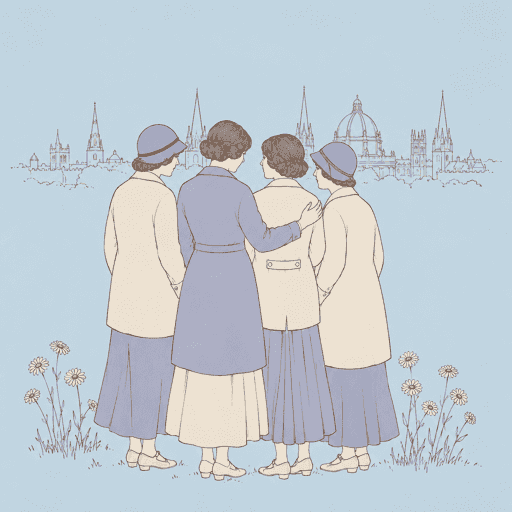
Miller signals the depth of these bonds through small, recurring gestures: the typed poems Marianne frames for Christmas, Otto’s pound-note gift for Marianne, Dora’s careful tidying of Otto’s room, and the currant bun Beatrice leaves on Marianne’s desk. The final image on Boars Hill, with the four women standing arm in arm above the dreaming spires, gathers these gestures into a single tableau. The novel’s claim is that in a setting designed to isolate and alienate them, the Eights’ chosen kinship is what makes both endurance and growth possible.

Unlock every key theme and why it matters
Get in-depth breakdowns of the book’s main ideas and how they connect and evolve.
- Explore how themes develop throughout the text
- Connect themes to characters, events, and symbols
- Support essays and discussions with thematic evidence