The Eights
The Eights
A modern alternative to SparkNotes and CliffsNotes, SuperSummary offers high-quality Study Guides with detailed chapter summaries and analysis of major themes, characters, and more.
Summaries & Analyses
Author Insights
Quizzes
NEWReading Tools
Important Quotes
Content Warning: This section of the guide includes this novel contains depictions of bullying, death, graphic violence, emotional abuse, mental illness, and gender discrimination.
“But she is used to the accoutrements of life being ill-fitting; last night, as she tried to sleep, her feet tangled repeatedly with the cold metal rungs of the bedstead. Nobody could ever label Beatrice an average woman; she has inherited her six-foot stature from her father and her hearty appetite for politics from her mother.”
(Part 1, Chapter 1, Page 4)
This passage uses Beatrice’s ill-fitting gown and bed to symbolize her broader feeling of not conforming to societal expectations. The physical discomfort mirrors her social and intellectual position as a woman who does not fit the typical mold, establishing her character and the theme of Forging a Place for Women in Patriarchal Institutions.
‘Is this what the men of Balliol consider sport?’ she says, gesturing toward the window. ‘Insulting women who probably beat you hands down in the Oxford Senior? What utter bores you are.’ She flicks her cigarette butt, crimson-kissed, at the men’s feet. ‘I’ll make sure I pass on your observations to the Master when I dine with his family next week. His daughters are particular pals of mine.’
(Part 1, Chapter 2, Page 16)
In this moment of confrontation, Otto uses sarcasm and a fabricated social connection to dismantle the male students’ mockery of the new students. Her defiant rhetoric and bold gesture of flicking the cigarette establish her as a protector. This act of resistance in the face of institutional hostility is the catalyst that solidifies the four women’s friendship.
“In my experience, the women who remained here were inventive, hardworking, and relentless.”
(Part 1, Chapter 4, Page 31)
Speaking from her own wartime experience, Otto defends the female students who did not go to the front. Her statement challenges a simplistic, gossipy narrative by showing the unheralded contributions and virtues of women on the home front.
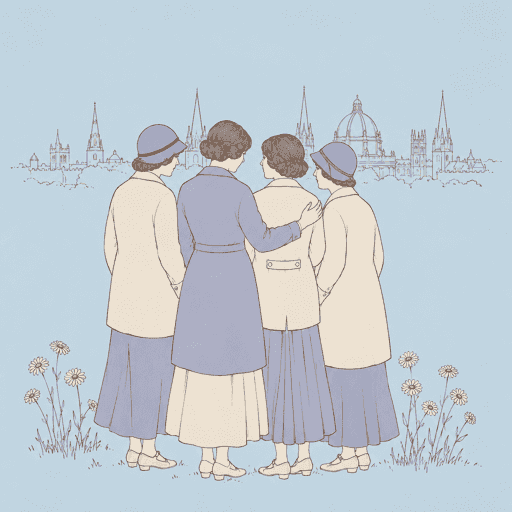
‘Did you notice all of our Christian names have eight letters?’ says Otto. ‘Theodora, Marianne, Beatrice, and Ottoline. On Corridor Eight. I’d say that’s a very good sign. Ginger biscuit, anyone?’
(Part 1, Chapter 4, Page 35)
Otto’s observation introduces the recurring motif of the number eight, which symbolizes the four women’s fateful and auspicious connection. By linking their names, their corridor, and a sense of good fortune, she transforms a coincidence into a foundational element of their collective identity. This moment marks the informal creation of “the Eights.”
‘And how will we ever know the contribution of women to the great scientific and cultural achievements of the past? What about the women who were instrumental in listening, editing, advising, inspiring, recording, and assisting famous men? Women who have been written out of history, their contributions unrecorded and unvalued.’
(Part 1, Chapter 6, Page 60)
Edith Sparks’s speech articulates a central argument of the novel regarding the historical erasure of women. The use of rhetorical questions frames the matriculation as a corrective to a long history of injustice. Her words place the protagonists’ personal struggles within a broader, generational fight for recognition.
“[…] in this brave new world, she has come to learn, guilt is as prevalent, invasive, and necessary as the air.”
(Part 1, Chapter 8, Page 79)
Following the public mental health crisis of a veteran experiencing post-traumatic stress disorder, Dora’s reflection frames guilt as an atmospheric condition of the post-war era. The author uses a triplet of adjectives (“prevalent, invasive, and necessary”) to characterize the inescapable nature of survivor’s guilt, suggesting it is a fundamental element of her generation’s consciousness.
“The bad thoughts come—the ones that visit her sometimes at night. Flashes of blue uniform, rusty dressings in kidney bowls, warm bedpans. Water spilling onto a pillow. Lips on the rim of a tin cup.”
(Part 1, Chapter 9, Page 86)
During a visit to the dentist, the clinical setting triggers Otto’s traumatic memories from her time as a Voluntary Aid Detachment (VAD) nurse. The author employs a series of fragmented, sensory images to convey a visceral sense of post-traumatic stress. This internal monologue reveals how the past intrudes upon the present, illustrating the theme of The Enduring Nature of Trauma.
‘Cut a leg off, it still hurts. I’ve seen it.’
(Part 1, Chapter 10, Page 101)
In a late-night conversation, Otto uses the metaphor of a phantom limb to explain the lasting pain of losing a mother one never knew. While directed at Marianne, the statement reveals Otto’s own capacity for empathy and her understanding of trauma derived from her VAD service.
“Then she gathers up the boxes and leaflets and rips them into a thousand tiny pieces, which float down to the floor like ash.”
(Part 1, Chapter 11, Page 112)
In a flashback, the teenage Dora reacts to her first menstruation and the restrictive sanitary products that symbolize her future as a woman. This destructive act is a potent expression of rebellion against the biological and social constraints imposed upon her. The simile comparing the paper scraps to “ash” suggests a desire to incinerate these confining expectations.
“And there it is. G. P. Greenwood.”
(Part 1, Chapter 12, Page 118)
This short, declarative sentence marks the moment Dora confronts her brother’s name on a war memorial panel at his former college. Its stark simplicity contrasts with the deep emotional weight of the discovery, showing the reduction of a life to a mere inscription.
‘So, you see, our spirit has a sense of humor. I’m the coward, all right, the coward of the CO Ward.’
(Part 1, Chapter 13, Page 130)
Following a chaotic Ouija board session, Otto confesses the source of her deep-seated shame. Her pun on the word “coward” reveals that her sophisticated bravado is a shield for the trauma and sense of failure she feels from her VAD service. This moment of vulnerability is a turning point for her character, directly linking her persona to her wartime experiences.
“They are seated in the center of the curve, facing the lectern and organ, a five-woman archipelago in a sea of men.”
(Part 2, Chapter 16, Page 155)
This metaphor vividly captures the women’s isolation and precarious position within the male-dominated university. The image of an “archipelago” suggests they are a small, separate cluster, while the “sea of men” emphasizes the overwhelming and potentially hostile environment surrounding them, directly addressing the theme of Forging a Place for Women in Patriarchal Institutions.
“Charles Baker. We used to call him Buns. A pal from the war. We met in Berkhamsted at officers’ training—1917, that would have been. Do you know him?”
(Part 2, Chapter 16, Page 160)
Delivered with casual friendliness by Henry Hadley, this dialogue serves as the novel’s shocking inciting incident for Dora’s plotline. The dramatic irony is acute, as the audience understands the line’s destructive impact before Dora fully registers it. The use of a cheerful nickname, “Buns,” starkly contrasts with the gravity of the revelation.
“I’m so sorry, Dora, but I thought it was kinder to you to remain dead.”
(Part 2, Chapter 18, Page 174)
Charles’s statement is the cruel climax of his confession, revealing his deep emotional detachment and warped logic. The paradox of his words encapsulates his character, blending cowardice with a misguided and self-serving justification. This line highlights how the war has destroyed his capacity for empathy and moral clarity, causing him to betray someone he claimed to love.
“People would say I faked my own death to escape an inappropriate liaison with a factory owner’s daughter—from a market town.”
(Part 2, Chapter 18, Page 174)
Here, Charles reveals the class prejudice that underpins his cruel deception, shifting his motivation from war trauma to social snobbery. His dismissive language (“inappropriate liaison,” “factory owner’s daughter”) exposes the rigid social hierarchy he is determined to uphold. He weaponizes Dora’s social standing to justify his actions and ensure her silence.
“Say nothing, just look after it and let it inspire you to never give up. Persistence is the key to change, Beatrice. Persistence and ingenuity.”
(Part 2, Chapter 19, Page 184)
Spoken by the veteran suffragette Elizabeth Rix, this line provides Beatrice with a personal mantra that connects her individual struggles to a wider political legacy. The suffragette penny becomes a powerful symbol of this connection. The words serve as a guiding principle for Beatrice as she navigates Oxford’s misogynistic environment, arming her with historical purpose.
“In watery blue ink are written the words Take No Notice. Beside it lies a hastily plucked snowdrop, still wet with dew, crumbs of earth clinging to the base.”
(Part 2, Chapter 20, Page 191)
This description details a quiet act of male solidarity that contrasts with the public, institutional misogyny Beatrice has just endured. The simple, anonymous gesture offers a subtler perspective on gender relations within the novel. The delicate image of the snowdrop symbolizes hope and resilience in the face of a hostile academic winter.
“An unmistakable story written on her body in hieroglyphics.”
(Part 3, Chapter 27, Page 252)
This quote uses the metaphor of hieroglyphics to describe the stretch marks Otto discovers on Marianne’s body. The language transforms these physical marks into a decipherable, ancient text telling a hidden story of female experience, specifically pregnancy and childbirth. This discovery is a key plot moment, revealing the secret past Marianne carries into her life at Oxford.
‘The best bit is that in England, our bees don’t want to woo the flower, so the plant has evolved to self-pollinate. No need to attract the male bee anymore.’ ‘So bee orchids are independent women,’ says Otto.”
(Part 3, Chapter 29, Page 273)
This exchange establishes the bee orchid as a potent symbol for female autonomy. Dora explains the flower’s biological self-sufficiency, and Otto immediately draws an explicit parallel to their own situation as women seeking independence. The flower’s evolution mirrors the social evolution they are fighting for at Oxford, connecting nature to their feminist struggle.
“By closing myself off to feeling, I lived. At least a different version of me lived, not the eager cadet who fancied himself in love. You could say that Charles Baker really did die, and you really did lose him in battle.”
(Part 3, Chapter 30, Page 278)
In his letter to Dora, Charles uses the metaphor of a past self dying to explain his emotional devastation from the war. This passage articulates the theme of The Enduring Nature of Trauma by framing trauma as a form of death and rebirth into a person who does not have the capacity for feeling that their former self did.
‘When I look at you, I see a woman with a big brain and an even bigger heart […] and someone who cares about making this damaged world a better place.’ […] ‘As Sophocles said: one loyal friend is worth ten thousand relatives,’ says Otto.”
(Part 3, Chapter 30, Pages 285-286)
Otto offers Beatrice validation that directly counters her mother’s criticism, positioning their friendship as a source of strength and acceptance. The quote she provides, though misattributed, elevates their bond by framing it as a classical ideal superior to familial ties. This moment crystallizes the theme of Friendship as Shelter and Support, portraying the Eights as a chosen family.
“You’re not a man, and you’re not going to run the country. What on earth is the point?”
(Part 3, Chapter 32, Page 301)
In a flashback, Otto’s mother dismisses her daughter’s educational aspirations, articulating the societal view that university is pointless for women who are not destined for public life. This dialogue encapsulates the generational and ideological conflict Otto faces, framing her academic pursuit as an act of rebellion against prescribed gender roles.
“Ladies and gentlemen, the law says women may have a place at Oxford, but I ask, is Oxford worthy of its women?”
(Part 3, Chapter 33, Page 308)
During the Oxford Union debate, Beatrice’s mother, Edith Sparks, employs a powerful rhetorical question to reframe the entire argument. Rather than defending women’s right to be at the university, she challenges the institution’s readiness to accept them as equals.
“I can’t marry you, Charles.” […] “Because I’m already engaged to somebody else.”
(Part 3, Chapter 34, Page 325)
Dora’s rejection of Charles’s second proposal is an important turning point in her character arc. Her lie, a fabrication used to create a definitive break between them, demonstrates her newfound agency and her decision to move on from a past defined by war and heartbreak.
“Connie is my daughter.”
(Part 3, Chapter 36, Page 339)
This simple, direct statement from Marianne is the climax of her personal storyline, revealing the secret she has guarded all year. The line’s abruptness shatters the image her friends had of her and recasts her academic struggles as a deep sacrifice for her child’s future.

Unlock every key quote and its meaning
Get 25 quotes with page numbers and clear analysis to help you reference, write, and discuss with confidence.
- Cite quotes accurately with exact page numbers
- Understand what each quote really means
- Strengthen your analysis in essays or discussions