John of John
John of John
A modern alternative to SparkNotes and CliffsNotes, SuperSummary offers high-quality Study Guides with detailed chapter summaries and analysis of major themes, characters, and more.
Summaries & Analyses
Author Insights
Quizzes
NEWReading Tools
Douglas Stuart on John of John
In his own words: quotes and insights from the author.Why he wrote it
The woman who reared backStuart arrived in the Outer Hebrides in 2019 expecting to write a homecoming story. Twelve weeks of traveling from Vatersay north through Harris and Lewis, sitting at strangers’ kitchen tables, changed that. In every small settlement he heard the same explanation for bachelors and spinsters who had never married: they had simply missed their moment. When he suggested, casually, to one woman that some of those people must have been gay, the conversation stopped cold.
That was really the moment that the novel came to life. I had gone thinking it was about the return of a prodigal son, and then I realized it wasn’t about that at all. It was about the people he had left behind.
His first two novels, both set in Glasgow, could draw on an urban queer community for texture, however hostile the city was to it. Harris offered no such resource. A settlement of twenty-six people, all bound by the same Free Presbyterian congregation, had no social vocabulary for gay identity at all, and that absence required him to think about desire in an entirely different register.
I had written so much about queerness and what my country means to me, but it was always in an urban setting. And honestly, queerness when you’re rural is a very different thing.
After finishing Young Mungo, which was driven in part by anger at the double standard that left queer youth condemned while boys were assumed safe with adult men, he wanted different emotional ground. The islands gave him a way toward it.
Once I finished writing that book, though, I wanted to be gentler on the world, and I wanted to be gentler on myself. John of John is about familial disappointment, it’s about duty and care, and I think that’s kind of what called me to the islands.
Father-son love was the one territory his own life gave him no map for. He lost his mother at sixteen, never knew his father, and had spent two novels mining the first loss. The third book required him to imagine his way into a bond he had only observed from outside.
I went into this thinking I had wanted to explore what a love between a father and a son was, almost in a completely imagined way because I had no reference in my own life. [paraphrased from audio]
The men he grew up around in Glasgow — coal miners, shipyard workers — processed their feelings by not processing them, and that silence became, as he described it, the book’s emotional engine.
How he wrote it
Slowing down to the island’s heartbeatHarris Tweed weaving, Gaelic, Free Presbyterianism, and crofting exist nowhere else in Scotland in the same convergence. Before Stuart could write any of it with authority, he spent months at strangers’ doors, asking at shops for introductions and knocking on houses at village ends. The result was a research archive unlike anything behind his first two books.
The culture of the islands is so singular and unique that I had to become an expert in things I had little knowledge of. I became fascinated by sheep farming, conservative Calvinism, tweed weaving, and the Gaelic language. I was truly an outsider. I spent months talking to everyone who would talk to me, and recording over a hundred hours of interviews, chatting about anything from the reproductive cycles of ewes to why some people in rural places never seem to find their special person.
Glasgow novels move on adrenaline and crisis. The Outer Hebrides do not. People on Harris speak carefully because they live out the consequences of their words across generations, and Stuart had to solve this as a structural problem before he could build a single character on the page.
One of the challenges of this new novel was matching its heartbeat to the rhythm of the islands. Nothing happens quickly, and anything that happens is remembered forever. Life is governed by the seasons, and by the changing, often very harsh, weather... Before I could even begin to write the characters, I had to think about time in a way I hadn’t before.
By 2024, six years into the project, Stuart had exhausted his own thinking and submitted a draft to his agent, Anna Stein. Her feedback was brief. Its final note was not.
‘I don’t think the book has revealed itself to you yet….’ If I’m honest, I was devastated. I put the book aside for several months. I fought it. I muddled through. Then suddenly one day the skies parted. A character had done something they shouldn’t have, which set the whole novel down the wrong path. I had to strip the book back and throw out the entire second half. With that, I realized a little too late just how wise my agent had been.
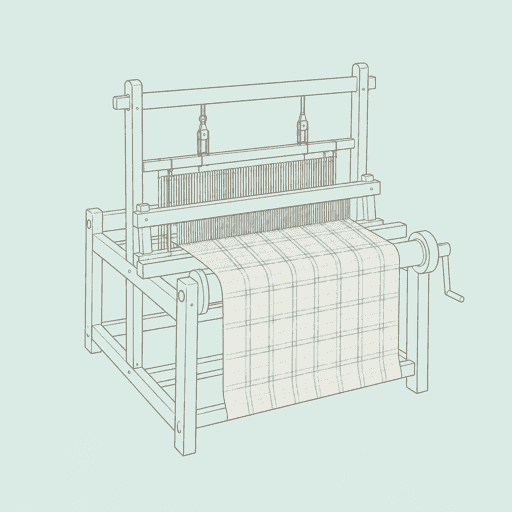
Stuart spent twenty years designing textiles for brands including Calvin Klein and Kate Spade before he became a novelist. That training shows up in the novel’s center, where father and son are most nearly themselves at a Hattersley loom weaving Harris Tweed. It also shapes how he described the act of writing prose.
The discipline required by textiles would be useful training for any writer. Textiles are a lesson in building something from nothing, and you have to be hyper-focussed on the most minute detail. You spend endless hours in the repetitive act of laying one small thing after the other, while also having to be able to stand back and envision the over-all design. Occasionally, when it all goes horribly wrong, you have to find the fault and mend it, or rip it all out and start again.
The personal thread
Faith that would not leave him aloneTo write Free Presbyterianism without caricature, Stuart had to understand it from inside its own logic. In researching that, he found he could not keep a clean distance from the material. The tension the novel places on its characters had been living in him long before he set foot on Harris.
I think homosexuality and faith have been a struggle throughout my entire life. Church is very powerful in Scotland, I have always been gay, and I have deep respect for faith. But I understand that faith doesn’t always think that I’m living the right life.
He lost both parents young and spent his adult life watching friends navigate the ordinary obligations of aging relatives, a set of experiences he was permanently locked out of. That exclusion generated a curiosity that took three novels before he put it at a story’s center rather than its edges.
I’ve been curious my whole life about what it means to still have parents and grandparents. What do you owe them? How much of yourself do you get to be and how much do you have to be a part of this family unit?
By the time the book was done, Stuart was ready to say plainly what the three novels together had cost and what they had been carrying. The anger he names here belongs to the whole triptych, not just to John of John, but this is the book where he finally said it aloud.
I’m angry about faith in Scotland, I’m angry about poverty. I’m angry about all the years when I wasn’t authentically being myself to the people who love me the most.
He also told Esquire that he considers John of John the close of a chapter: he does not expect to write about Scotland again for a long time. The anger is real, but it has been spent.
What he wants us to sit with
Two men who share no word for what they areThe novel’s central dramatic irony, a father and son who are both gay and cannot tell each other, depends on something more than secrecy. Stuart draws a careful line between Cal, who came of age in Edinburgh in the 1990s with access to a queer social world, and John, who has no such framework. Without that distinction, readers might expect a recognition scene that the book refuses to deliver.
Gay is a social term about sexuality that’s also about how you identify in a community. It comes with other assumptions about interests and intersections... But John doesn’t have access to a gay community. He would never even think of himself as a gay man. John has an attraction to other men and that, to him, is a sin.
A reader following Cal might assume the novel is his coming-of-age story, a son returning to claim his identity in the place that shaped him. Stuart pushes back on that reading directly, and in doing so relocates where the novel’s emotional weight actually falls.
As a queer community, we often are so focused on our own story, our own freedom, and our own coming of age, and I was just thinking about what would you do if your parent was also gay? How could you enjoy your life if you didn’t liberate your parent too? The biggest demonstration of love that men can have for one another is filial love. When you sacrifice yourself for your parents so that your parents can know happiness, and that’s what Cal does.
Free Presbyterianism’s position, as Stuart encountered it on the islands, is not merely that homosexuality is wrong but that it effectively cannot exist in that world at all. The novel works against that double erasure by making it a domestic, familial problem rather than an abstract doctrinal one.
For decades, maybe centuries, anybody that was queer on the island, whether they were in the church or not, was invisible. I was trying to make this a very domestic problem for a family.
All three of Stuart’s novels return men to the same terrain: men who feel large feelings in places that punish them for it. In John of John, two men in a weaving shed talk about color and pattern and cloth. Stuart has described that image as a deliberate provocation.
I think when you write about softness, especially in a very masculine world, there is something a little subversive about that. The world is very suspicious of men who feel tender or who feel big feelings. And I feel sad about that, I think, and I want to push that in my novels.