Land
Land
A modern alternative to SparkNotes and CliffsNotes, SuperSummary offers high-quality Study Guides with detailed chapter summaries and analysis of major themes, characters, and more.
Summaries & Analyses
Author Insights
Quizzes
NEWReading Tools
Important Quotes
Content Warning: This section of the guide includes discussion of death, animal death, racism, and gender discrimination.
“He alone is able to parse a polysyllabic string comprehensible only to those who have lived here for generations: He makes the-crossroads-under-the-bluff-where-once-a-hailstorm-killed-a-cockerel read ‘Bluff’s Cross’ and renders the-strand-where-the-yellow-periwinkles-gather-in-spring into ‘Yellowcove.’”
(Part 1, Page 5)
This passage details Tomás’s work for the British army, illustrating the theme of Cartography as Colonial Erasure. The author juxtaposes long, descriptive Gaelic place names with their curt, Anglicized equivalents. This act of translation is presented as a violent reduction that strips the landscape of its history and cultural memory.
“Underfoot, the ground is spongy with damp. It oozes from the soil, the leaf-rot; it sucks and grips at his boot soles. He glances down and sees that there is thick, luxuriant moss, glistening and emerald-bright, blanketing everything: The humps of stones, the long cylinders of fallen branches, the ridged splay of roots, unidentifiable mounds that suggest loaves of bread or animal lairs. Or tiny graves.”
(Part 1, Page 9)
As Liam enters the unmapped copse, his perception shifts from the natural to the supernatural. The personification of the ground that “sucks and grips” establishes an ominous tone, while the final, stark phrase reveals how the landscape is a repository of historical trauma. The imagery explicitly connects the land to the unhealed wounds of the Great Famine, which comprises the narrative’s historical context.
“[M]y point is…that there needs to be a map of how this land really is, of how it has always been, of what lies beneath whatever order or disorder others might impose upon it. There must be a way to create such a document. And to do so would be an act of honour. Honour and resistance.”
(Part 1, Page 25)
Following his transformative experience at the well, Tomás articulates a new philosophy that recasts cartography as a form of cultural reclamation. His declaration reframes maps as political statements. This moment marks his definitive break with the colonial project and establishes the central conflict of the novel, positioning his personal map-making as an act of defiance.
“But this map is in…the wrong language. Don’t the soldiers—”
(Part 1, Page 43)
Father Joseph’s reaction to Tomás’s new Gaelic map reveals the colonial mindset that views indigenous language as being fundamentally “incorrect.” The priest’s bewildered statement frames the conflict as an ideological one, positioning the English language and the Church as forces of assimilation. This dialogue emphasizes the novel’s exploration of language as a battleground for cultural identity and power.
“The pen nib meets the map’s paper and Liam guides it through the swerves of the initial S.”
(Part 1, Pages 55-56)
This action occurs as Liam, under the priest’s influence, completes the Anglicized maps while his father is bound. The focused, sensory detail of the pen meeting paper highlights the gravity of the moment, underscoring how Liam is making the pragmatic compromise to preserve his family at the behest of their colonial oppressors.
“‘We will leave the Lanes. We must. We’re barely getting by here, and you, Phina, you’re worn to a thread with worry. We will go out to the peninsula and live there. It is,’ he urges them all to see, ‘the answer.’”
(Part 1, Page 102)
Tomás’s abrupt announcement, following weeks of catatonia, is a major turning point. His decision to use the family’s savings to return to the site of his trauma and spiritual awakening is presented as a solution, but it reads as an obsession that propels the family’s fate toward his undoing. This heightens the tension at the end of Part 1 as it drives ambiguity around his motivations.
“(Unseen, in the marshy bog, however, like a tuber folded into the soil, Brith’s body survives, against all odds, by some alchemical process of peat acting on water acting on gas, and they are the same colour now, Brith and her hound, fur and skin and teeth and bone and eyelid and plaits leached to a golden-brown, almost indistinguishable from each other; they might be one eight-limbed being.)”
(Part 2, Page 119)
This passage uses a simile comparing Brith’s preserved body to a “tuber,” rooting her physically and symbolically in the land. The alchemical transformation of her and her hound into a single “eight-limbed being” illustrates the theme of Landscape as a Witness to Historical Trauma by merging the two figures into the earth and allowing them to become indistinguishable from the land their bodies inhabit.
“This house is a thing both ancient and disjointed, an entity of addition and subtraction, a palimpsest of stone and wood and caulk and mud. Its existence here, on the peninsula, is proof that everything was once something else: nothing goes away.”
(Part 2, Page 137)
The metaphor calling the house a “palimpsest” conveys the idea that history is layered but never fully erased. The cottage is a physical archive, containing materials and memories from different eras, from the Ice Age standing stone to the rags of famine victims. This expands the scope of the narrative beyond the story of Tomás and Phina’s family.
“Mesmerised, she looks down along the strings, which look to her like a shining road, leading off into the distance. Her shoulder lifts and stretches, an up stroke, a down stroke, her fingers moving on and off the strings, and she listens to the differences, the alterations in tone, the language in which it speaks to her.”
(Part 2, Page 153)
The fiddle’s strings are metaphorically described as a “shining road,” symbolizing a path to freedom and self-realization for Enda. This moment marks her discovery of a personal and cultural identity outside the constraints of her domestic life. Music becomes a unique “language” for her, representing an alternative to the colonial and patriarchal worlds that seek to define her.
“In plucking away the son—no, guiding the son—Father Joseph will show Tomás that a disrespect for the Church will never go unchallenged.”
(Part 2, Page 162)
Father Joseph’s internal monologue reveals that his mentorship of Liam is rooted in a personal vendetta against Tomás. Framing his actions as a spiritual duty to “guide” the boy, he rationalizes his true goal: punishing Tomás for defying clerical authority. This highlights how the colonial church’s power can be weaponized for personal revenge, corrupting its spiritual mission.
“The music in the room comes from her, her fiddle, her fingers, her bow. Tomás gapes, split down the middle between shock and admiration.”
(Part 2, Page 195)
From Tomás’s perspective, Enda’s transformation into a master musician is a moment of deep revelation. She embodies the living tradition of native culture he sought to reclaim. The description of him as “split down the middle” captures his conflicting feelings of patriarchal possessiveness and paternal pride as he witnesses his daughter transcending the limits he had imagined for her.
“He doesn’t speak because that would be letting things out, when he only likes to be taking things in.”
(Part 2, Page 197)
The fisherman’s observation provides the most resonant explanation for Eugene’s silence, defining it as a mode of perception. This frames Eugene as an observer who sees language as a form of corrupted articulation, resonating with the maps that Tomás created at the beginning of the novel, each one failing to capture the historical and cultural realities of the land they tried to name.
“He likes her stillness, her silence, her closed-up face, her grip on her hound. He feels that she, like him, loves her dog. She seems more like him than anyone else he has ever met.”
(Part 2, Page 203)
Upon discovering Brith’s body, Eugene forges an immediate, intuitive connection with her across millennia. Their bond is based on shared silence and love for their dogs, suggesting a spiritual lineage transcending time. This moment unites the novel’s timelines, affirming that the land’s ancient stories are accessible to those attuned to them, like Eugene.
“That he will never speak of Tomás in this room, to these furious men. That his father is somehow antithetical to these men, to the Church. Like magnets held together, his father and the Church will always repel each other.”
(Part 3, Page 213)
During his interrogation by Jesuit leaders, Liam has a deep realization about the fundamental conflict between his father and the institution he has joined. The author employs a simile comparing Tomás and the Church to repelling magnets, externalizing Liam’s internal crisis. The image of magnets foreshadows the rest of Liam’s arc as he finds himself being alternately drawn to one pole of influence and then later to the other.
“Rose is trying her best. She is worn to a husk ensuring the five of them are fed and worked and rested. She is trying, in the face of enormous odds, to keep them all together, but if she must now be the pin in their wheel it is one that has become rickety and uneven, the spokes pulling apart with every jolt and pothole along the way.”
(Part 3, Page 218)
This passage reveals Rose’s internal struggle and exhaustion as she attempts to assume her deceased mother’s role as the family’s center. The “rickety and uneven” wheel metaphor highlights her feelings of inadequacy and the immense strain of holding the fracturing family together in the face of grief and impending separation.
“Tomás’s hand, the right, the one that can draw coastlines and marshes and castles and contours, the one that grasped Phina’s to lead her off the ship, the one that can conjure a landscape in inks and pictograms and lines and calculations, can wield a loy and a spade, can dig and slice turf, is no more. Where once there was a hand is now a mere mess of pulp and bone, useless and crushed, a bloodied stump, dripping with ditchwater.”
(Part 3, Page 234)
This visceral description catalogs the creative, productive, and personal powers of Tomás’s hand before contrasting it with its brutal destruction. The loss is both physical and symbolic, representing the destruction of his identity as a mapmaker, a worker, and a husband, all at the hands of the indifferent colonial force.
“Why are there two Liams? How can Liam be in the library in the House of First Formation, learning about the six principles of the Jesuit Order, and also on a harbourside, about to board a ship, to become a migrant, heading for a new land?”
(Part 3, Page 239)
The narrative poses a direct rhetorical question, creating suspense and revealing the dramatic irony of Enda’s escape disguised as her brother. This technique splits the narrative, simultaneously following Liam into the priesthood and Enda toward a new world. It highlights Enda’s agency in defying patriarchal expectations by seizing a future that her father originally intended for his son.
“She enters the country in trousers and a skirt, one on top of the other; she enters as both herself and her brother, a spliced Enda-and-Liam.”
(Part 4, Page 275)
The physical layering of clothes is a metaphor for Enda’s layered identity. She’s simultaneously performing the role of Liam, to whom the papers belong, and reclaiming her own selfhood. This act of subterfuge fulfills Tomás and Phina’s hopes and dreams for their family in an unexpected way, as it sees Enda claiming Liam’s place as the true heir to their family’s legacy.
“He has rested near where the bog-girl lies for a moment or two, catching his breath, communing with her in silence, before going on his way.”
(Part 4, Page 277)
The verb “communing” elevates Eugene’s action beyond a simple pause, suggesting a spiritual or intuitive dialogue with the ancient past preserved in the landscape. This act contrasts sharply with the scientific, colonial approach of cartography represented by his father and brother. Eugene’s relationship with the land is presented as innate and timeless.
“The music she plays is the land: It summons it; it conjures it here, to this street corner. It is enough to drive her mad. How can she be here and there, all at the same time? She is a person divided, split in two, a tree sundered by lightning.”
(Part 4, Page 300)
The author uses a metaphor (“The music she plays is the land”) to articulate the visceral power of cultural memory. The subsequent simile, comparing Enda to a “tree sundered by lightning,” visualizes the violent psychic split caused by her displacement. Her music is both a comfort and a source of torment, embodying the central tension of her immigrant experience.
“His face as he does so Liam will remember for the rest of his life: its expression of disgust, of betrayal, will rise to Liam’s mind, when he faces the committee’s interrogation, and again when he is an old man, far away from this place and this life, and it will never fail to fill him with shame.”
(Part 4, Page 316)
This quote is a key moment in Liam’s spiritual crisis. Confronted by a grieving father who needs tangible help, Liam offers only prayer, a response the father sees as a useless and insulting betrayal. The man’s disgust exposes the inadequacy of Liam’s priestly role, planting a seed of shame that haunts him and accelerates his disillusionment.
“It occurs to him that it has gone, like a tide pulling off a strand: His faith, his trust, his belief, his conviction. It has simply vanished, drained out of him.”
(Part 4, Page 339)
The natural imagery of the tide contrasts with the structured, man-made institution of the Church that Liam is abandoning. This word choice suggests that his loss of faith is a return to a more fundamental state of nature. While he has spent most of his life choosing to follow the Church, his nature compels him back, catalyzing and foreshadowing his return to the vocation that his father performed throughout his life.
“It takes a fraction of a heartbeat: He is there, beside her, and then he is gone, off the ship, beyond reach, arms outstretched, legs pedalling in vacant, salty air, a bird flinging itself from a rock.”
(Part 4, Page 344)
The author’s choice of language in this passage emphasizes the speed and finality of Eugene’s decision, making it seem less a product of conscious thought than a physical reflex. The image of his “arms outstretched” suggests freedom or even transcendence, rather than desperation. This is complemented by another metaphor, the “bird flinging itself from a rock,” to suggest that Eugene is flying to safety, neutralizing the risks of his decision to abandon ship.
“Liam is simultaneously disoriented and certain of where he is: He is adrift, he is home; this place is both in him and out of him. And the question that keeps tolling through his mind is: who is he here, if none of his people are left?”
(Part 4, Page 368)
The author uses paradox (“adrift, he is home”) to convey Liam’s emotional turmoil upon his return. The statement “this place is both in him and out of him” suggests that while the landscape is part of his internal makeup, the external reality no longer recognizes him. These rhetorical choices underscore the challenge that Liam faces to root himself in a land he willingly turned away from.
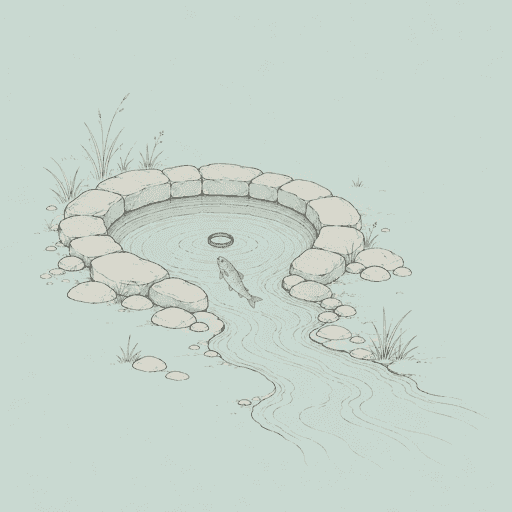
“He holds it out, away from him, and he drops the ring into the water. It turns and turns, the gold of its interlocking creatures revealing then hiding themselves, over and over again. It flickers and spirals, down and down, and then it is gone.”
(Part 4, Page 382)
The detailed imagery of the ring’s spiraling fall into the well creates a sense of ceremony and finality. The “interlocking creatures” on the ring symbolize the intertwined nature of past and present, human and landscape. Eugene’s action is thus one of restoration, returning a piece of ancient history to its source and reaffirming the well’s mystical power.

Unlock every key quote and its meaning
Get 25 quotes with page numbers and clear analysis to help you reference, write, and discuss with confidence.
- Cite quotes accurately with exact page numbers
- Understand what each quote really means
- Strengthen your analysis in essays or discussions