Land
Land
A modern alternative to SparkNotes and CliffsNotes, SuperSummary offers high-quality Study Guides with detailed chapter summaries and analysis of major themes, characters, and more.
Summaries & Analyses
Author Insights
Quizzes
NEWReading Tools
Character Analysis
Content Warning: This section of the guide includes discussion of death, graphic violence, sexual violence, physical abuse, emotional abuse, racism, religious discrimination, and gender discrimination.
Tomás
Tomás is the novel’s complex protagonist, a dynamic and round character whose internal struggles embody the central conflicts of the story. As a surveyor and translator for the British Ordnance Survey, he initially occupies a liminal space, using his knowledge of both Gaelic and English to assist the colonial army in subjugating the land toward its imperialist purposes. His professional identity is built on scientific precision and logic, a disciplined approach that’s a bulwark against his deeply repressed trauma from the Great Famine. It’s his belief that maps must distill historical disaster into “inked symbols and ordered lines” (6), yet this very work forces him to confront the colonial erasure of his people’s history. This internal contradiction defines his character: He’s simultaneously an agent of a colonial project and a secret archivist of the suffering it has caused, privately determined that his maps will “bear an account of what happened” (6).
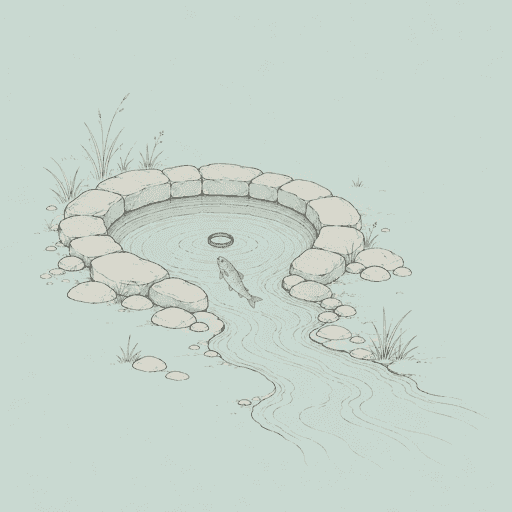
Tomás’s character arc is driven by a deep transformation from a man of scientific rationalism into one of mystical insight. This shift is triggered by his experience at the unmapped holy well, a site representing the deep spiritual memory of the land. After drinking from the well, his repressed grief and cultural identity surge forth, manifesting as a “madness” that rejects the colonial worldview. He denounces the British maps as “enemy tools” and begins creating his own, a document written in Gaelic that prioritizes mythological landmarks and historical trauma over official English place names. This act represents the core theme of Cultural Resilience as Anti-Imperialist Resistance, as Tomás abandons the empirical logic of his colonizers in favor of an indigenous epistemology where myth, history, and geography are inseparable. His newfound garrulousness and eccentric behavior are thus an awakening to a deeper, pre-colonial truth that the landscape itself holds.
Haunted by the memory of the famine, which claimed his family and forced him into a workhouse, Tomás is a man defined by loss. His taciturn and often harsh demeanor, particularly toward his son Liam, stems from this unhealed wound and a desperate desire to equip his children for survival in a hostile world. His work as a surveyor is, for him, a trade that offers security from the precarity of the land. His relationship with his wife, Phina, reveals a capacity for tenderness and love that he otherwise keeps hidden. Ultimately, Tomás’s journey is one of reclamation. By rejecting his role in the colonial machine and creating his “true map,” he transitions from a mere surveyor to a “seanchaí of the land” (55): a custodian of tradition and a storyteller who resists erasure by mapping the soul of the terrain. This culminates in the newfound purpose he tries to seek after losing his arm during a dangerous surveying job. By setting out to find the valley that he believes holds the secret of his origins, Tomás asserts his desire to root himself in the land, even though he can no longer fulfill his mission of counter-mapping: “He will not be deterred from this; he refuses to let the redcoats take this as well as his arm” (260).
Liam
As Tomás’s son and deuteragonist, Liam serves as both a foil and an inheritor of his father’s complex legacy. A dynamic, round character, Liam’s trajectory is a reaction to the pressures of his father’s trauma, the demands of his apprenticeship, and the larger colonial context in which he lives. Initially presented as a timid but dutiful boy, he’s terrified by both his father’s harshness and the land’s untamed and haunted nature. His experience in the copse, where he imagines “tiny graves” in the mossy mounds, establishes his sensitivity to the unhealed wounds of the past. This fear, compounded by his father’s subsequent transformation in the copse, pushes him toward a desire for order, stability, and a different kind of patriarchal authority, which he finds in the figure of Father Joseph and, by extension, the Catholic Church.
Liam’s decision to enter the priesthood represents an attempt to escape his father’s world by assimilating into an alternative power structure. Where Tomás resists colonialism by embracing a mystical, native worldview, Liam seeks refuge in the rigid, hierarchical, and intellectualized system of the Church, which itself has a complex history as a colonial force. This path allows him to pursue his scholarly talents and provides a clear set of rules, a stark contrast to his father’s chaotic and emotionally volatile behavior. His journey to Rome and India is a physical and spiritual displacement, an attempt to find an identity separate from his family and homeland. While facing a religious interrogation committee in Calcutta, Liam feels compelled to confess the experiences they would consider blasphemous, believing that they will illuminate the claim to his religious vocation: “Even knowing that it is hardly likely to help his case, Liam feels the urge to relate the tale to them from its strange start. It might, he thinks, go some way to explain what has happened here, in India” (213). However, his work as a Jesuit in India ultimately forces him to confront the moral failings and inherent hypocrisies of the institution he serves, especially after he realizes Father Joseph’s resentment against Tomás and how he used Liam as a pawn to advance this grudge. This leads to Liam’s deep personal crisis and, ultimately, his loss of faith. He recognizes that his father and the Church are antithetical forces and that he can no longer belong to the latter.
Liam’s journey is a circular one, marked by flight and an eventual, difficult return. His ultimate rejection of the priesthood signifies a rejection of his attempt to assimilate. He returns to Ireland a man stripped of his former identity, forced to build a new one by embracing the very trade he once fled: cartography. By taking up his father’s profession at the Ordnance Survey office, he finds a way to reconcile his past, literally tracing his father’s hand in the archives. His path illustrates the struggle to forge an individual identity in the shadow of historical and familial trauma. While he never fully embraces his father’s mysticism, his return to the peninsula at the novel’s end shows a quiet acceptance of his roots and his place within the long, layered history of the land.
Enda
Enda, Tomás’s eldest daughter, is a dynamic and fiercely independent deuteragonist who embodies cultural resistance through art and functions as a foil for Liam. From a young age, she chafes against the patriarchal limitations imposed upon her, expressing disappointment that her father’s mapping expedition is “no work for a girl” (9). This innate rebelliousness defines her character; she refuses to be confined by the domestic roles expected of women or the cultural suppression enforced by the colonial presence. Her chosen form of defiance is music. The fiddle becomes her primary symbol, representing the preservation and transmission of native Irish culture through a non-literate, embodied, and communal art form. By dedicating herself to collecting and playing traditional tunes, Enda becomes a living archive, ensuring that an essential part of her heritage survives even as its language and history are actively threatened.
Enda’s journey is one of self-determination and artistic pursuit. After the family moves to the peninsula, she finds mentors who teach her the deep traditions of island music, transforming her from a curious girl into a masterful musician. Her decision to impersonate Liam and use his emigration papers to travel to Québec is a radical act of self-liberation. It represents a continuation of her quest to gather and share music, expanding her world beyond the “edges of the charted world” (166). In the “New World,” she faces hardship, poverty, and exploitation, but she consistently relies on her musical talent to survive, forging connections and earning a living in a way that remains true to her cultural identity. Her trajectory demonstrates Cultural Resilience as Anti-Imperialist Resistance through its dynamic movement across diasporic communities.
As a character, Enda shows a form of resilience that is neither mystical like her father’s nor intellectual like her brother’s. Hers is a practical, spirited, and creative endurance. She’s impulsive and passionate, and her connection to her siblings, particularly her complex bond with Liam and her protective feelings for Rose and Eugene, ground her motivations. Though she physically leaves Ireland, she never abandons her cultural heritage; instead, she becomes its ambassador. In finding a new life in Canada with Rose, she creates a new kind of home, one where the tunes of the old country can thrive and evolve, proving that cultural identity is portable and can be replanted in new soil: “The music she plays is the land: it summons it; it conjures it here, to this street corner. […] How can she be here and there, all at the same time? She is a person divided, split in two, a tree sundered by lightning” (300).
Rose
Rose is a round character who embodies the roles of caregiver and keeper of the domestic flame, representing the quiet, often unacknowledged labor of holding a family together in the face of fragmentation. As the second daughter, she’s initially depicted as a sweet and trusting child, deeply attached to her parents and siblings. After Phina’s death, Rose inherits the maternal role, shouldering the immense burden of running the household, caring for her despondent father, and looking after her brother Eugene. Her trajectory explores the immense pressure placed on women to maintain stability amid trauma and loss. While Liam and Enda seek escape through intellectual or artistic pursuits, Rose’s response is to stay, to tend to the hearth, and to preserve the fragile remnants of their family life.
Despite her gentle nature, Rose possesses a deep well of resilience and strength. She manages the family’s meager resources, sells their eggs at market, and attempts to navigate the difficult silence that falls over their home. Her connection to the family dog, Bran, and later his puppy, symbolizes her need for loyalty and protection in an increasingly precarious world. The climax of her story is a moment of brutal violence, when she’s attacked by the viscount’s son and his friend. This event shatters the domestic sphere she has fought so hard to protect and propels her from a position of stasis into one of forced displacement. The act itself emphasizes the vulnerability of the tenant class and women, in particular, showing that the violence of the colonial structure can invade even the most private lives. Her subsequent escape to the US with Eugene marks the final dissolution of the family in Ireland, proving that even for the one who chose to stay, the homeland has become untenable.
Eugene
Eugene, the youngest of Tomás’s children, is a largely non-verbal character who represents a pre-colonial, mystical connection to the land. His silence is presented as a different mode of perception, one that bypasses language to communicate directly with the natural and spiritual worlds. He “hears things no one else does” (199), understanding the whispers of the wind and the secrets of the bog. Eugene shows a complete rejection of assimilation; he exists entirely within an indigenous consciousness, his life governed by the rhythms of the seasons and the spiritual pulse of his environment. His discovery of Brith’s ancient gold ring while digging in the bog physically links him to the deep past, reinforcing the theme of Landscape as a Witness to Historical Trauma. He becomes a conduit between the present and the ancient history embedded in the soil.
His relationship with his sister Rose is his primary human connection; for her, he’s a source of both worry and deep love. For Eugene, Rose is his anchor to the social world. His most significant act is one of brutal protection, when he kills the men attacking Rose with a spade, an instrument of the earth. This violence is portrayed as a primal, almost natural response, the land itself rising up to defend its own. Following this, his journey of displacement is short-lived. His decision to leap from the emigrant ship is a symbolic choice to return to his element. In plunging into the sea off the Irish coast, he completes his arc by merging entirely with the landscape he was always a part of, representing the ultimate refusal to be separated from his homeland.
Seraphina (Phina)
Phina is the maternal heart of the family, a grounding force of love, resilience, and memory. As an orphan of the Great Famine who survived the workhouse, her past provides a direct link to the historical trauma that haunts Tomás. Her rescue by Tomás is the foundational myth of their family, an act of love that offers both characters a reprieve from their solitary suffering. In contrast to Tomás’s taciturn and often harsh nature, Phina is gentle and emotionally intuitive. She understands the needs of her children and repeatedly advises Tomás to be kinder to Liam, recognizing the boy’s sensitivity. Her presence brings warmth and stability to their home, and her skill in sewing and knitting symbolizes her ability to mend and hold things together. Her sudden death is the catalyst for the family’s splintering, removing the central pin that held the competing forces of her husband and children in balance. Her memory, particularly symbolized by the blue tassel from her mother’s shawl, endures as a touchstone of love and loss for her children.
The Widow
The widow is an essential supporting character who is a mentor and an archetypal survivor. Living alone in the depopulated village, she’s a keeper of communal memory, her mind an archive of the lives lost during the Great Famine. Her initial interactions with Tomás, where she recounts the fate of the evicted families, establish the deep historical sorrow that permeates the peninsula. She’s pragmatic and sharp-witted but also deeply compassionate, taking in Tomás and Liam, and later the rest of the family, without hesitation. After Phina’s death, she becomes a surrogate mother and grandmother to the children, teaching Enda the fiddle and ultimately orchestrating Rose and Eugene’s escape. She represents the strength and endurance of the native community, a figure of quiet defiance who ensures the survival of others through acts of kindness and shrewd resistance.
Father Joseph
Father Joseph is a minor antagonist who represents the institutional Church as a colonial and oppressive force. Though of Irish heritage himself, his English upbringing and rigid ideology align him with the forces of cultural erasure. He views Tomás’s mystical awakening as a case of demonic “possession” that must be violently suppressed. His “exorcism” is a brutal attempt to destroy Tomás’s connection to a pre-Christian, native spirituality. Furthermore, he actively works to sever Liam from his family and heritage, luring the boy into the priesthood and away from his father’s world. He’s a flat character, embodying an arrogant and insecure authority that seeks to control and assimilate rather than understand.
Brith
Brith is a historical and symbolic figure whose ancient story is woven through the novel, providing a deep layer of historical resonance. A young girl from a pre-Christian tribe, she is sacrificed near the holy well and buried in the bog. Her perfectly preserved body and the gold ring she swallows become physical manifestations of the theme Landscape as a Witness to Historical Trauma. Her tale, discovered millennia later by Eugene, demonstrates that the land is an archive, holding the memories of past violence and sacrifice directly beneath the feet of the novel’s contemporary characters. Brith is a powerful symbol of the deep, cyclical, and often tragic history that the landscape holds in defiance of any map.

Unlock analysis of every major character
Get a detailed breakdown of each character’s role, motivations, and development.
- Explore in-depth profiles for every important character
- Trace character arcs, turning points, and relationships
- Connect characters to key themes and plot points