Land
Land
A modern alternative to SparkNotes and CliffsNotes, SuperSummary offers high-quality Study Guides with detailed chapter summaries and analysis of major themes, characters, and more.
Summaries & Analyses
Author Insights
Quizzes
NEWReading Tools
Part 2Chapter Summaries & Analyses
Content Warning: This section of the guide includes discussion of illness, death, animal death, graphic violence, and gender discrimination.
Part 2, Pages 105-132 Summary
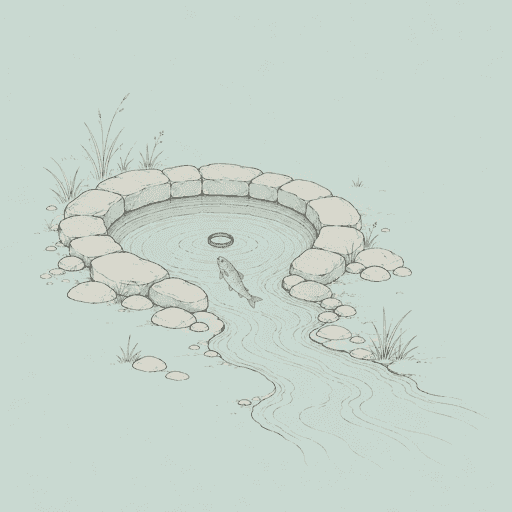
The narrative flashes back to the distant past to follow a young girl, Brith, whose father, a “meanderer” from an ancient tribe, has vanished. While her mother grieves, Brith wanders by a stream and finds her father’s gold ring. She follows the stream to its source: a deep, secluded pool where a talking fish demands that she surrender the ring. Frightened, Brith puts the ring in her mouth for safekeeping but accidentally swallows it.
Years later, after crop failures plague their hill fort, the elders decide that Brith must be sacrificed to appease the gods. Her mother’s fierce resistance fails to stop the sacrifice. The elders first tether Brith’s wolfhound with meat as a precaution before taking her; Brith escapes and flees with the dog, but at dawn, they’re found sleeping together, and the hound is shot and killed. Brith is sacrificed at a sacred stone altar near the spring. The fort’s storyteller, the Teller, mourns the loss, believing that Brith was their link to the land’s first people.
The narrative fast-forwards through millennia as the fort disappears and the landscape changes. The site becomes a place of worship and eventually habitation; the first cottage is built by a man and woman who come to the well seeking a cure for infertility. Generations live and die there until the last family dies during the Great Famine, after which the cottage is abandoned.
The story then returns to the 19th century, where Tomás shows the ruined cottage to Phina. After assessing the dilapidated structure, Phina declares, “We will not be staying here” (132), and walks away with their children, leaving a stunned Tomás behind.
Part 2, Pages 133-153 Summary
After Phina rejects the ruined cottage, the widow finds her and the children by their cart and insists that they stay with her. When Tomás returns, Phina issues an ultimatum: She will move into the cottage only if he fully repairs it and resumes his paid mapping work for the British surveyors. Tomás reluctantly agrees and spends the next month rebuilding the house, incorporating an ancient standing stone into one of its walls.
Once the family moves in, Rose finds a tassel that belonged to Phina’s mother, triggering Phina’s private, painful memories of her family perishing in the famine. Meanwhile, Enda, Tomás and Phina’s eldest daughter, is miserable, feeling trapped by domesticity and grieving the loss of her future as a teacher. Her despair deepens when Father Joseph, a local priest, starts a hedge school but excludes her, saying that Enda “would be too old for schooling” (149). Liam, among other boys, attends the school. Upon seeing Enda’s unhappiness, the widow gives her her late husband’s fiddle and gives her a first lesson, telling her to master the tune before she receives her next lesson. This provides Enda with a new sense of purpose.
Part 2, Pages 154-172 Summary
Phina gives birth to a son, whom she names Eugene. Restless and bored, Enda persuades a reluctant Rose to go exploring. Enda first tries to lead Rose into the copse, but Rose refuses, citing their father’s prohibition. Enda then proposes the rath (an ancient Irish ringfort), and they make their way to the ancient, circular earthwork fort. There, a massive grey wolfhound approaches them. Their initial terror gives way to affection when they realize that the dog is friendly. The dog’s name, Bran, is already established by the time Tomás notices him; no single character is shown coining it.
Meanwhile, at his hedge school, Liam impresses Father Joseph by translating a difficult Latin passage. Resentful of Tomás’s lack of respect for him, the priest decides to mentor Liam, seeing the boy as a way to spite his father. In the days following Eugene’s birth, neighbors arrive to see the new baby; among them, two sisters bring water from the sacred well to anoint Eugene. Tomás announces that he’s taking Liam on his next mapping expedition to a remote island, hoping to pull his son away from the priest’s influence. Liam protests, not wanting to miss school, but Tomás overrules him.
Part 2, Pages 173-189 Summary
At dawn, Liam secretly goes to the holy well in the copse and makes an offering of his saint’s medallion. He prays that he won’t have to go on the mapping trip with his father and, in a moment of unguarded feeling, admits his true desire: to become a priest. Enda, having followed him, overhears his prayer from her hiding spot in a tree and begins mocking him with a song on her fiddle.
Enraged, Liam climbs the tree to attack her and smash her instrument. During the struggle, Enda kicks out, causing Liam to lose his balance and fall to the ground, breaking his shin. His injury makes it impossible for him to travel. Phina disguises Enda in Liam’s jacket and hitches her skirts up, though the sappers (soldiers) immediately realize that Enda is a girl. At sea, a gust of wind blows off Enda’s cap, prompting Tomás to look at the child; upon seeing his daughter’s face rather than his son, he is furious. The boatmen refuse to turn back, and Enda quickly befriends the soldiers by leading them in a sea shanty, leaving her father fuming in isolation.
Part 2, Pages 190-207 Summary
Tomás and Enda spend months on the island completing the survey. Enda flourishes and learns the island dialect, though Tomás himself is uncertain if he hears her correctly, wondering whether he imagined hearing her speak it. Enda becomes a gifted fiddle player under the mentorship of island musicians. During a gathering, Tomás watches her perform and realizes that she has grown into a formidable young woman beyond his control.
The narrative shifts forward several years. Eugene remains non-verbal but is highly perceptive and possesses a deep connection to the natural world. He silently observes the growing rift between Liam, who is determined to join a novitiate, and Tomás, who bitterly opposes his son’s ambition. One day, while playing in the bog, Eugene finds an ancient gold ring. Digging further, he uncovers the perfectly preserved body of a young woman, Brith, clutching her hound. He brings the ring home, and the family all examine it, passing it around; Eugene gestures toward the bog when asked where he found it. Rose eventually places it back in his hand, making him its custodian.
Sometime later, Phina collapses and dies suddenly while walking with Eugene. Tomás, enraged with grief, clashes with Liam over the funeral, wanting to bury Phina on their land, while Liam, who arrives with Father Joseph at his side, insists on giving Phina a Catholic service. At the burial, Rose tells Eugene that their mother is gone, but the boy silently and emphatically refuses to accept it.
Part 2 Analysis
The narrative’s expansive leap into the distant past with the story of Brith expands the story of the narrative beyond Tomás and Phina’s family history, tying it more explicitly to the land on which they live. By opening with Brith’s life and ritual sacrifice millennia before Tomás’s arrival, the novel frames the land itself as its central character and primary witness to the events that transpire. The narrative voice emphasizes that the site of Tomás’s ruined cottage is the same “raised and flat piece of ground” where Brith’s people built their altar and where her blood seeped into the soil (117). The subsequent montage, which sweeps through centuries of invasions, settlements, and abandonments, treats human history as a series of transient events acted upon a permanent stage. The narration observes that the land is “indifferent to the bloody and fearsome shifts going on around it: all land is” (126), yet it physically records every trauma, from the felling of forests to the burning of cottages during the Great Famine. This long-view perspective establishes the theme that the Landscape as a Witness to Historical Trauma is an archive, holding the memories of every human tragedy within its soil, water, and stones.
The tangible links between the mythic past and the narrative present are forged through recurring symbols that surface from the land’s memory. The sudden appearance of the great wolfhound Bran, who adopts Rose and Enda, directly echoes the loyal hound sacrificed alongside Brith. Bran’s origins go unaddressed by the characters; he simply materializes from the landscape, suggesting that he’s a physical embodiment of a cyclical history. Similarly, Brith’s gold ring acts as a direct conduit to the ancient past. Swallowed by Brith and preserved with her body in the bog, the ring is unearthed centuries later by Eugene, another child with a deep, non-verbal connection to the earth. When Rose places the ring back in Eugene’s hand, she makes him its “protector and custodian” (204, entrusting him with a piece of history that predates any written record. The reappearance of both the wolfhound and the gold ring demonstrates Cultural Resilience as Anti-Imperialist Resistance, persisting through potent, cyclical symbols that the land itself offers up to those who are attuned to it.
As Liam’s and Enda’s paths diverge, the chapters explore rebellion against prescribed familial and social roles. Liam’s desire to become a priest is a direct rejection of his father’s trade and worldview, representing a turn away from the tangible world of surveying toward the spiritual authority of the Church. Conversely, Enda’s ambition is thwarted by those same structures; Father Joseph excludes her from the hedge school because of her age and gender, closing off her dream of becoming a teacher. Her frustration and sense of confinement are channeled into a new purpose when the widow gives her a fiddle. This introduces the motif of music and the fiddle, which becomes Enda’s mode of expression and, ultimately, liberation. The violent confrontation between the siblings at the holy well serves as the climax of their diverging ambitions. Liam’s injury ironically answers his prayer to forego the surveying trip and creates the opportunity Enda needs. Her decision to take his place on the mapping expedition, taking the guise of Liam, is a radical act of self-determination that allows her to flourish into a formidable musician and an independent young woman beyond her father’s control.
The family’s attempt to settle the land exposes the complex power dynamics of post-famine Ireland, forcing Tomás to compromise his principles. Phina, a survivor of the Great Famine, refuses to inhabit the derelict cottage, declaring, “We will not be staying here” (132). Her ultimatum that Tomás must resume his work for the British surveyors is born of a pragmatic need for security that overrides his anti-colonial sentiment. This conflict forces Tomás to participate in the very system he detests, illustrating how Cartography as Colonial Erasure functions as a source of economic coercion. At the same time, Father Joseph exerts his own form of influence, cultivating Liam’s piety as a way to undermine Tomás’s paternal authority. Caught between his wife’s practical demands, the priest’s manipulations, and the colonial administration’s payroll, Tomás’s dream of an independent life on his own land is shown to be an illusion, constrained by forces beyond his control.
Through the character of Eugene, the novel presents a form of consciousness that operates outside of language and linear time. His silence manifests a deeper mode of perception, one that connects him directly to the landscape’s stored memory. This is most evident when he intuitively discovers the preserved body of Brith and her hound in the bog, unearthing the novel’s foundational myth. His relationship with the physical world is unfiltered by speech; he understands the world through direct sensory experience and an innate sense of the life within the soil, streams, and stones. After Phina’s sudden death, Eugene’s silent, emphatic refusal to accept her absence reflects this worldview. For him, a person buried in the ground has been absorbed back into the land, becoming part of its continuous, cyclical existence. Eugene thus embodies the novel’s strongest connection to its eco-fictional premise, representing a human consciousness that mirrors the land’s own deep, non-verbal memory.

Get in-depth, chapter-by-chapter summaries and analysis from our literary experts.
- Grasp challenging concepts with clear, comprehensive explanations
- Revisit key plot points and ideas without rereading the book
- Share impressive insights in classes and book clubs