Land
Land
A modern alternative to SparkNotes and CliffsNotes, SuperSummary offers high-quality Study Guides with detailed chapter summaries and analysis of major themes, characters, and more.
Summaries & Analyses
Author Insights
Quizzes
NEWReading Tools
Part 4Chapter Summaries & Analyses
Content Warning: This section of the guide includes discussion of illness, death, animal cruelty and death, graphic violence, sexual violence, rape, physical abuse, and racism.
Part 4, Pages 269-287 Summary
Enda’s ship arrives in Québec, and she’s overwhelmed by the transition from the sea to the crowded dock. Disguised as Liam, she feels faint but is helped by a strong couple from the Baltic region: a man with an accordion and his sister. The man realizes that Enda is a woman when his arm touches her bound chest, but he remains silent. Enda successfully passes through immigration using Liam’s papers. However, a mandatory medical examination reveals that she has ship fever, and she’s sent to the quarantine hospital on Grosse Île.
The narrative shifts back to the peninsula, where the local viscount worries about his debts. From a high vantage point, Eugene watches the viscount’s land steward tear down anti-landowner notices that have been posted on gates.
After more than six weeks, Enda is released from quarantine. On her first night in a crowded makeshift lodging house, a drunken man assaults her and steals the money she had sewn into her jacket seam. Penniless, Enda spends several days searching for a boarding house before sleeping hidden under a bench in a locked park.
The narrative then shifts to Liam, who’s on a silent retreat in Rome. He feels a deep sense of bliss and purpose in his Jesuit vocation.
Part 4, Pages 288-306 Summary
Now destitute in Québec, Enda continues to sleep in the park before she finally shelters in a church confessional. She’s discovered by a kind French priest, who helps her get a job as a hired girl for a fur-trader’s family. Enda proves unsuited for service; though the family’s cook is fond of her, the employers find her high spirits disruptive. She eventually leaves and works at an inn and a hotel before moving to the town of Trois Rivières. There, she writes and mails a letter to Rose, asking for forgiveness and news from home.
Enda discovers that she can make a living by playing her fiddle on street corners. She encounters the accordion-playing man from the ship, who tells her that his name is Anatole and clarifies that the woman he was with was his sister, not his wife. They begin playing music together in the evenings. In one inn, they listen to an old Irish pipe player who, unbeknownst to Enda, is her grandfather. After a night playing music with Anatole, Enda receives a four-month-old letter from Father Joseph, informing her that Tomás has died.
Part 4, Pages 307-325 Summary
The narrative returns to the peninsula seven months after Tomás’s death. Rose and Eugene are living with the widow. While walking near the shore, Rose witnesses the viscount’s son and another gentleman torturing a puppy. When Rose intervenes to protect the animal, the men turn on her and begin an assault.
The family’s dog, Bran, rushes to defend Rose and attacks the men, but one of them shoots and kills the dog. As the viscount’s son and his friend are about to rape Rose, Eugene appears above her on the dune, between land and sky, holding a spade. He brings it down on both men, staving in their heads.
Part 4, Pages 326-345 Summary
The widow discovers the scene on the dunes and quickly devises a plan. She has Rose and Eugene drag the bodies to a high cliff and push them into the sea to make the deaths look like an accident. Eugene buries Bran. That night, the widow gives Rose and Eugene her life savings and Enda’s letter with the address in Canada, insisting that they flee before the bodies are found.
The perspective shifts to Cochin, India, where Liam receives a year-old letter about his father’s death. The news triggers a deep crisis of faith, and Liam realizes that Father Joseph had manipulated him into joining the clergy out of jealousy and score-settling resentment toward Tomás. He informs his superiors that he has lost his faith and, after a period of intense questioning in Calcutta, is permitted to leave the Jesuit Order.
The narrative returns to Rose and Eugene on a ship bound for Canada. As the vessel passes the last visible point of Ireland, Eugene gives Rose the puppy and jumps overboard into the sea. Rose is restrained by other passengers and is left alone, believing her brother has drowned.
Part 4, Pages 346-364 Summary
Liam arrives in Dublin, dressed in an outlandish velveteen outfit obtained from a saffron merchant in Calcutta in exchange for a signet ring, a Bible, and his Order’s robe. After being publicly ridiculed for trying to quiet a rowdy inn, he realizes that he has lost the automatic respect afforded a priest. Ashamed to return to his family as a failure, he gets a job as a surveyor at the Ordnance Survey office.
In Trois Rivières, Enda waits for Anatole to return from a summer logging camp. During his absence, she realizes that she’s pregnant. When Anatole fails to come back at the end of the season, Enda goes to the timber company, where a clerk informs her that Anatole was killed in a river accident. The clerk then reveals that Anatole was married and had children.
Devastated by the news, Enda takes to her bed for days. One morning, Rose appears at her door. She tells a shocked Enda that Eugene drowned on the passage over. Though grieving their separate losses, the sisters are reunited, and Enda feels that they can face the future together.
Part 4, Pages 365-384 Summary
Years later, Liam is a successful surveyor in Dublin with a wife and two sons. His letters to the peninsula are returned, each one declaring that his family members are either dead or have moved away. Believing his family is gone, he takes a work assignment near his old home. There, he’s told that a brother and sister from the area sailed away.
Liam walks to his family’s cottage and finds it inhabited by strangers. He then visits the nearby sacred copse, where he senses a presence at the well and flees in terror, dropping his hat. The cottage’s inhabitant is revealed to be Eugene, who survived his jump from the ship and has lived in isolation on the peninsula ever since. He had watched Liam, though he didn’t recognize him, from the trees.
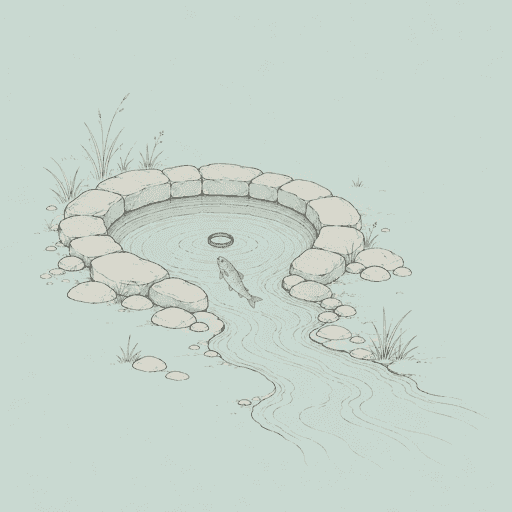
Later, at the well, a fish speaks to Eugene and tells him to give it his ring. He drops the ring into the water, and then a large man appears to leap from the water and bound away through the trees and up the hill. The narrative concludes that Eugene lives to be over 100, becoming a local legend known as a gruagach, or nature spirit. He senses that Enda and Rose are together and that Liam is alive and not far away, though no reunion is described.
Part 4 Analysis
The novel’s final part opens with a structural fragmentation that mirrors the family’s diaspora, scattering the narrative across Canada, Ireland, Italy, and India. This geographic dispersal marks the dissolution of the family unit, contrasting the siblings’ divergent fates. Liam’s initial experience of separation is one of spiritual ecstasy; on a silent retreat in Rome, he feels “suffused with excitement, with bliss” (286), convinced of his divine purpose. Enda’s journey begins with its opposite: disorientation, illness, and assault. Her arrival in Québec places her directly into the historical trauma of Irish emigration, as she’s quarantined on Grosse Île, the site of mass graves for famine victims. Robbed and destitute, she becomes a vulnerable figure in a hostile city. The narrative’s rapid shifts between Liam’s serene devotion, Enda’s precarious survival, and the simmering tensions back on the peninsula underscore the siblings’ deep isolation. They are cast “off the edge of the charted world” (267), each forced to navigate an unknown and unforgiving reality alone, their shared world shattered.
Back on the peninsula, the simmering class conflict between the Irish tenants and the Anglo-Irish gentry erupts in an act of brutal violence. When the viscount’s son and his friend assault Rose after torturing a puppy, the scene culminates in the death of the family dog, Bran. The killing of the wolfhound, who has functioned throughout the narrative as a motif and stands as a breed deeply associated with Irish heritage, symbolizes the violent colonial suppression of native life and loyalty. Eugene’s murderous response is thus an elemental act of justice. He appears on the dune “between land and sky” (325), a figure who seems to emerge from the landscape itself to defend his own. This act, while forcing him and Rose into exile, shows a moment where the oppressed violently reclaim their agency, turning the landscape into a stage for a grim, localized rebellion.
The siblings’ eventual life paths reveal contrasting modes of survival and identity. Enda’s experience as an immigrant in Canada shows that her resilience stems from her heritage. Her attempts to fit into domestic service fail because her spirited, independent nature is deemed “disruptive” by her employers. She finds her footing only when she embraces music and the fiddle, turning a cultural inheritance into a means of economic survival. Playing traditional tunes connects her to a community of fellow displaced people, including her grandfather and her lover, Anatole. This reliance on her roots demonstrates Cultural Resilience as Anti-Imperialist Resistance, providing both spiritual comfort and agency in a foreign world. In contrast, Liam’s journey is one of shedding identities. The news of his father’s death shatters his faith, revealing that his vocation was rooted in a priest’s manipulation rather than genuine belief. Stripped of his Jesuit status, he’s publicly ridiculed and finds himself a powerless “nobody,” leading him to seek refuge in the anonymity of his father’s old profession at the Ordnance Survey. Liam’s return to the peninsula to re-engage with the work that defined his father’s life and marked their connection to each other is a tragic failure to root himself in his native origins; his family is gone, and when he visits the family cottage, he’s an unrecognized stranger to his own brother, Eugene, who watches him from the trees. Eugene’s circle is an inversion of Liam’s. In a desperate act of belonging, he jumps from the emigrant ship to swim back to Ireland, choosing the land over a new life. He successfully returns to the cottage and lives in isolation, his existence fading into local folklore. This transformation shows a complete merging with his native landscape, a choice that severs him from his human family but roots him deeply in the land’s mythic consciousness.
The narrative concludes by moving beyond historical realism into the realm of myth, confirming the land’s depiction as a conscious, supernatural entity. In the sacred copse, Liam is overcome with a primal terror at the holy well, sensing a presence that his rational, secular mind can’t explain. He effectively undergoes the same experience Tomás had at the start of the novel, bookending the narrative with transformative or mystical experiences that transcend the official record and fulfill Tomás’s desire to override the British Ordnance Survey’s imperialist objectives. For Eugene, this same space is a site of communion. The talking fish in the well recalls the mystical folklore of Brith’s story. This magical transaction completes Eugene’s transformation, turning him into Brith’s successor as one who remains rooted and incorruptible to the land where he was born. His evolution into a nature spirit is the ultimate expression of the theme Landscape as a Witness to Historical Trauma, showing that the land not only remembers human history but can absorb individuals into its own timeless, mythic existence, preserving what has been culturally erased.

Get in-depth, chapter-by-chapter summaries and analysis from our literary experts.
- Grasp challenging concepts with clear, comprehensive explanations
- Revisit key plot points and ideas without rereading the book
- Share impressive insights in classes and book clubs