Land
Land
A modern alternative to SparkNotes and CliffsNotes, SuperSummary offers high-quality Study Guides with detailed chapter summaries and analysis of major themes, characters, and more.
Summaries & Analyses
Author Insights
Quizzes
NEWReading Tools
Part 1Chapter Summaries & Analyses
Content Warning: This section of the guide includes discussion of illness, death, physical abuse, emotional abuse, racism, religious discrimination, and mental illness.
Part 1, Pages 3-19 Summary
In 1865, 10-year-old Liam assists his father, Tomás, a mapmaker, in performing a British army survey on a remote Irish peninsula. Tomás, a native Gaelic speaker, translates local place names into English for the “redcoats” (a colloquial term for the British military). While he does this work, Tomás is privately determined to ensure that his revised maps serve as a record of the devastation caused by the Great Famine, a history the British officers want the project to ignore.
Discovering an unmapped copse (grove) of trees, Tomás sends Liam inside to find a stream’s source. Liam becomes terrified in the woods, mistaking moss-covered mounds for the graves of starved children. After hearing a sound like human laughter, he flees in a panic, losing one of his boots. Tomás enters the copse to retrieve it and continue the survey but fails to return. After waiting for hours, Liam limps back to their lodgings in a longhouse owned by a widow. She comforts him, giving him dry clothes from a cedar chest she hasn’t opened in years, containing garments that have never been worn. She recalls having previously told Tomás how the famine had reduced the area’s population from over 40 households to just four. That night, local men search for Tomás but find only his surveying tools.
Part 1, Pages 20-39 Summary
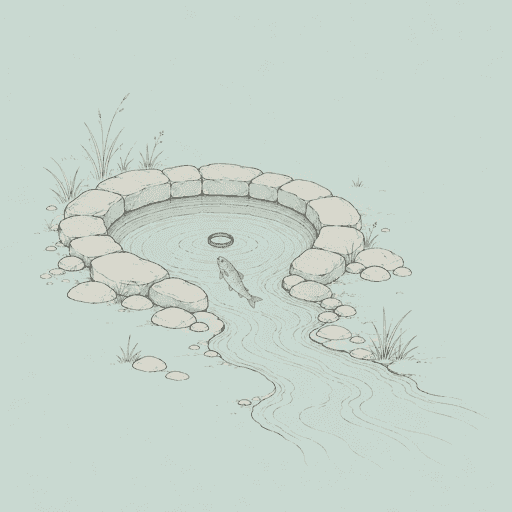
The next morning, two fishermen bring Tomás back to the widow’s cottage. Tomás is delirious, wearing a crown of leaves and speaking affectionately in Gaelic, a language he forbids his children to use in public. The men found him singing by a tobar (well) inside the copse. Tomás’s attitude toward his work is transformed. He denounces the British survey maps as “enemy tools” and tells Liam that he drank deeply from the well’s waters. He gives his son a pebble from the spring and declares his intention to create a new, true map of the land for the sake of both honor and resistance, insisting that Liam must continue the work after he’s gone.
After four days of sleepless talk, Tomás announces that he will build a bonfire to burn all the official maps and notes. Fearing that their family won’t be paid for their work, Liam secretly gathers the documents. With the help of the widow, he hides the papers in the rafters of her byre (cow barn).
A flashback reveals Tomás’s past as a child survivor of the Great Famine. Tomás was caught by charitable men while begging and taken against his will to a workhouse, where he later met a girl named Seraphina, also called Phina.
Part 1, Pages 40-65 Summary
A local priest, Father Joseph, arrives at the cottage to investigate rumors of Tomás’s strange behavior, which he suspects is “heathenish nonsense” connected to the well. Tomás shows the priest his new map, featuring pre-colonial and mythological landmarks labelled in English as “Hill Fort,” “dolmen,” “tumulus,” “evicted village,” “pre-colonial kingdom,” and “navel,” instead of official place names prescribed by the British government.
Father Joseph declares that Tomás is possessed by the devil and resolves to perform an exorcism. The fishermen subdue Tomás on the floor; after they leave, the priest has him bound to a table and gagged. The priest then manipulates Liam, convincing the boy to finish the official maps himself so that the redcoats will pay the family and life can return to normal. For the next three days, Father Joseph subjects Tomás to the exorcism, depriving him of all food. The starvation triggers Tomás’s deep-seated trauma from the famine, causing him to have horrific flashbacks of pigs unearthing his family’s mass grave. The priest repeatedly offers Tomás food, demanding that he repent. After days of torment, Tomás has a mental-health crisis, weeping and begging for a morsel to eat.
Part 1, Pages 66-82 Summary
Father Joseph, believing that he has successfully cast out the devil, releases Tomás, who is now silent and experiencing catatonia. Soon after, two British soldiers arrive to collect the survey. Liam gives them the maps he completed and receives a purse of coins for their work.
A flashback shows how Tomás originally escaped the workhouse: A corporal arrived at the workhouse seeking a replacement chainboy (surveying assistant). Tomás drew a map on the yard wall to attract the officer’s attention, securing the post.
In the present, Tomás and Liam travel home to Dublin. Tomás remains unresponsive, clutching Liam’s hand for the entire journey. At their tenement in the Lanes, they’re greeted by Liam’s younger sister, Rose, who announces that their mother, Phina, is pregnant. Tomás takes to his bed, remaining silent during the day but waking the family at night with screams about his past trauma. Phina cares for her unresponsive husband, washing and shaving him as he sits propped up in bed.
Part 1, Pages 83-102 Summary
A flashback details Tomás’s life after leaving the workhouse. After two years working on the Ordnance Survey, he returned to find his childhood friend, Phina. He discovered that her father had come back from the US to find her but was turned away from the workhouse because a new warden knew her only as “Frances.” Tomás then learned that Phina was being shipped to a penal colony in Australia. Tomás walked to the port, catching a lift on a farmer’s cart, and then bartered his army greatcoat and blanket roll to a sailor in exchange for being led below deck, where he rescued Phina just before the ship sailed.
In the present, after weeks of being bedridden and silent, Tomás suddenly gets up, announcing that he has a plan. He’s gone for several days, during which Phina discovers that their hidden savings are missing. He returns in good spirits, behaving as if he’s fully recovered from his trauma. He gathers his shocked family and reveals that he has used all their money to lease a cottage and land on the very peninsula they were mapping. He announces that they will leave their life in the Lanes and move there, seeing it as the answer to “everything.”
Part 1 Analysis
As Tomás translates descriptive Gaelic place names into English equivalents like “Bluff’s Cross” and “Yellowcove,” the narrative establishes its central tension between two conflicting views of the land. This act of translation, a key part of his work for the British Ordnance Survey, introduces the complex symbol of maps. For his employers, the British army “redcoats,” maps are instruments of administrative control, standardizing the landscape for taxation and asserting colonial authority. Tomás’s initial role places him in a position of complicity with this project, a dynamic that embodies the theme of Cartography as Colonial Erasure. However, he’s simultaneously determined that his maps will “bear an account of what happened, what was lost” during the Great Famine (6). This internal conflict reveals that maps function dually, serving as tools of both oppression and potential resistance. His later transformation and decision to create a “true map” underscores cartography as a contested field of power, where naming the land is an act of claiming its history.
Through the structural use of flashbacks, the narrative grounds Tomás’s motivations for the survey project and his later psychological crisis in the specific trauma of his childhood during the Great Famine. In the wake of losing his family in the famine, Tomás survived by leveraging his intelligence and grit, securing a post as a chainboy by actively drawing a map on the yard wall. This backstory establishes his lifelong connection to cartography as a means of survival and agency. By using his mapmaking skills to change his life in childhood, Tomás projects his agency onto his life as an adult and as a provider for his family in a ravaged Irish landscape. He can both protect his family from the same fate that he experienced in his childhood while also using his mapmaking skills to ensure that Irish identity and culture remain alive in the naming of the land.
The opening chapters portray the Irish landscape as an active participant in the story, saturated with the memory of recent catastrophe. When Liam enters the unmapped copse, his fear transforms the scenery; he sees not just mossy humps but “tiny graves” and mistakes a fern for a “pleading wet hand” (10). This perception introduces the theme that the Landscape as a Witness to Historical Trauma, suggesting that the land itself retains an imprint of the suffering it has seen. Liam’s childlike intuition is later confirmed by the widow’s historical account of how the famine decimated the local population on the peninsula. The landscape is thus a living archive of grief, a truth that Liam senses and the widow confirms with lived experience. This establishes the land as a source of knowledge that predates and subverts the official, sanitized record of the British maps.
Tomás’s sudden transformation is catalyzed by his encounter with the symbol of the holy well, or tobar, which shows a deep, pre-colonial spiritual connection to the land. After drinking from its waters, he returns crowned in leaves, speaking Gaelic, and renouncing his work as collaboration with “enemy tools.” This spiritual awakening puts him in direct opposition to the institutional authority of Father Joseph, who dismisses the well as “heathenish nonsense” and seeks to impose Christian orthodoxy over indigenous belief. The conflict between Tomás and the priest dramatizes the theme of Cultural Resilience as Anti-Imperialist Resistance, pitting an ancient, earth-based spirituality against the rigid doctrine of the colonial-era church. The tobar unlocks a suppressed part of Tomás’s identity, shifting him from a reluctant agent of empire to a visionary resistor who seeks to reclaim his culture by remapping his world according to its own native history.
The conflicting pressures of economic survival and cultural loyalty force Liam into a position of premature responsibility, compelling him to betray his father to save his family. When Tomás announces his plan to burn the official survey, Liam acts less out of malice than out of a pragmatic fear that their family will lack the resources to live on. He colludes first with the widow to hide the maps and later with Father Joseph to complete them, accepting the priest’s logic that finishing the work will allow things to “go back to the way they were” (46). Liam’s decision places the practical needs of his family above his father’s radical act of cultural resistance. This choice forces Liam to become a younger version of his own father: a reluctant collaborator with the colonial project. When Tomás finally recovers and uses the family savings to lease land on the peninsula, calling it “the answer […] to everything” (102), his solution rejects the very compromise that Liam was forced to make, creating a new and uncertain future for them all.

Get in-depth, chapter-by-chapter summaries and analysis from our literary experts.
- Grasp challenging concepts with clear, comprehensive explanations
- Revisit key plot points and ideas without rereading the book
- Share impressive insights in classes and book clubs