Land
Land
A modern alternative to SparkNotes and CliffsNotes, SuperSummary offers high-quality Study Guides with detailed chapter summaries and analysis of major themes, characters, and more.
Summaries & Analyses
Author Insights
Quizzes
NEWReading Tools
Summary and Study Guide
Overview
Maggie O’Farrell’s 2026 novel, Land, is a work of historical fiction that explores memory, loss, and resilience. O’Farrell, born in Northern Ireland, is celebrated for her immersive historical narratives, including the award-winning novels Hamnet and The Marriage Portrait. Set on a remote Irish peninsula in 1865, Land centers on Tomás, a gifted cartographer working for the British Ordnance Survey. In the destructive aftermath of the Great Famine, Tomás is torn between his lucrative colonial employment and his duty to preserve the history of the ravaged land. After a transformative experience at an unmapped holy well, Tomás rejects his role in the imperial project to create his own subversive map rooted in native lore and memory. The narrative examines themes of Cartography as Colonial Erasure and Cultural Resilience as Anti-Imperialist Resistance.
The novel unfolds against the backdrop of two deep historical events: the recent Great Famine (1845-1852) and the ongoing British project of Anglicization. A central theme is that the Landscape as a Witness to Historical Trauma is a conscious participant that holds the memories of both ancient sacrifices and recent suffering. The sprawling, multi-generational saga follows Tomás’s family as they’re fractured by these forces, their lives scattered from the haunted Irish peninsula to the diaspora communities of North America, tracing the far-reaching legacy of cultural survival.
This guide refers to the 2026 Alfred A. Knopf First Hardcover Edition.
Content Warning: The source material and guide feature depictions of illness, death, animal cruelty and death, graphic violence, sexual violence, rape, physical abuse, emotional abuse, racism, religious discrimination, gender discrimination, and mental illness.
Plot Summary
In 1865, on a remote Irish peninsula, Tomás, a gifted but taciturn cartographer employed by the British army, is determined to create a faithful record of the land, one that includes the scars left by the Great Famine. His work leads him to an unmapped copse (grove of trees), into which he sends his 10-year-old son, Liam, to find a stream’s source. Terrified by the eerie atmosphere of the copse, Liam flees, leaving a boot behind. Tomás enters the wood to retrieve it and vanishes. After a fruitless search by local men, Liam is taken in by a kind widow who lost her own family in the famine. The next morning, Tomás reappears, wearing a leaf crown and speaking with an uncharacteristic, affectionate garrulousness about a tobar (a sacred well) within the copse. Over the next few days, Tomás speaks incessantly of myth, history, and the true nature of the land, beginning to draw his own map while declaring his intent to burn the official charts he created for the British. Fearing for their livelihood, Liam conspires with the widow to hide the official maps and field books in the rafters of her byre (cow barn).
The situation escalates when the local priest, Father Joseph, arrives and declares Tomás as being under demonic possession. He has Tomás tied to a table and performs a brutal, multi-day exorcism, withholding food to taunt him. The torment of the exorcism forces Tomás to relive buried memories of his own childhood during the Great Famine, including the deaths of his family members, the desecration of their grave, and his time in a workhouse where he first met his wife, Phina. While Tomás is bound, the priest convinces Liam to finish the official maps, carefully transcribing the Anglicized place names to appease the British soldiers. When Tomás begins weeping, Father Joseph declares the exorcism successful. Tomás is released, but he experiences catatonia. Liam gives the completed maps to the soldiers and receives payment, and the two return to their tenement in the Dublin Lanes. Weeks later, Tomás abruptly rises from his sickbed and uses all their savings to lease a ruined cottage on the peninsula he had been mapping. Phina, who is pregnant, is furious and initially refuses to go, but she eventually strikes a bargain: They will move only if Tomás agrees to continue his lucrative, if morally compromising, work for the British.
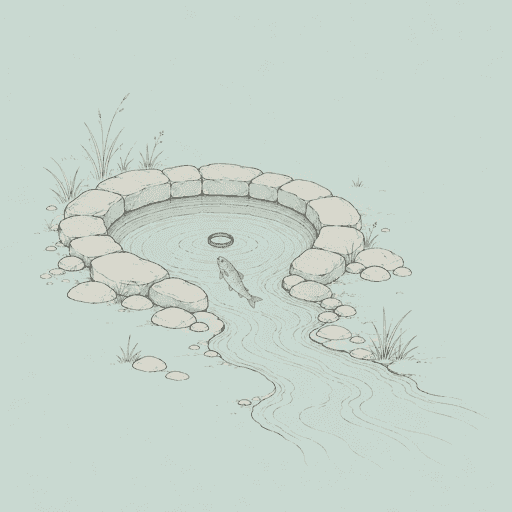
As Tomás rebuilds the cottage, the novel explores the land’s deep history. Generations earlier, a girl named Brith found her vanished father’s ring in the stream flowing from the sacred well. There, a magical fish demanded the ring, which she accidentally swallowed. Years later, Brith was chosen as a sacrifice by her famine-stricken tribe; she was killed near the well and buried with her loyal wolfhound in the surrounding bog, their bodies perfectly preserved by the peat. Centuries passed, and the site became a place of worship and eventually habitation, with the first cottage built by a man and woman who came to the well seeking a cure for infertility. Generations lived and died there until the last family was wiped out during the Great Famine, leaving the ruin that Tomás claims for his own.
Once the house is habitable, the family moves in, and Phina gives birth to a son, Eugene. Life on the peninsula creates fractures: Enda, their older daughter, feels trapped and misses her education, while Liam falls under the sway of Father Joseph, who nurtures his religious piety. Just before Tomás is sent on a mapping commission to a remote island, Liam breaks his leg after a fight with Enda in the copse. To ensure that Tomás travels with an apprentice, Phina helps Enda disguise herself as Liam and take his place. On the island, Enda blossoms, proving a more adept apprentice than her brother and discovering a deep talent for the fiddle, which she learns from the islanders.
The family’s tenuous peninsula life shatters when Phina suddenly dies from a heart condition. Her death deepens the rift between Tomás, who clings to the land’s ancient ways, and Liam, who finds solace in the Church. Pulled by Father Joseph’s influence, Liam resolves to join the Jesuit order. Tomás tries to convince him to leave for Québec instead, using emigration papers that he and Phina secretly arranged for him. Liam declines the offer and departs for the novitiate. Enda, feeling abandoned and seeing no future for herself, cuts her hair, dons Liam’s clothes, and uses his emigration papers to flee to Canada, leaving no word for her family. Not long after, Tomás has a surveying accident and loses his right hand and subsequently learns of Enda’s flight. He becomes a wanderer, searching for the lost valley of his childhood, and is eventually found dead by a roadside. Left alone, Eugene and his older sister Rose are attacked one evening by the local viscount’s son and his friend. After they shoot the family dog, Bran, Eugene kills both men with a spade to save Rose from being raped. The widow helps them cover up the murders, gives them her life savings and Enda’s last known address, and sends them abroad. On the ship, Eugene hands their new puppy to Rose and jumps overboard, unable to bear leaving his homeland.
Years pass, and the scattered siblings live out their separate fates. In Canada, Enda’s money is stolen, and she endures hardship, working as a maid. She falls in love with Anatole, a fellow immigrant and musician, only to discover after his death that he had a wife and children. Pregnant and alone, she finds relief when Rose, who has made her own way to Canada, finds her. The sisters are reunited and raise Enda’s son, Gene, together. Liam, meanwhile, excels as a Jesuit, being sent to Rome, Italy, and then on a mission to Cochin, India. Over time, his faith erodes as he confronts the Church’s hypocrisy amidst extreme poverty. A letter informing him of his father’s death precipitates a final crisis, and he realizes that his vocation was a misguided rebellion against Tomás. After a tense interrogation by his superiors in Calcutta, he renounces his vows and is dismissed. After returning to Dublin, ashamed to face his family as an apostate, he finds work as a surveyor at the Ordnance Survey office. He marries, has children, and attempts to contact his siblings, but his letters are returned, leading him to believe that they’re gone or dead. Eventually, a work assignment takes him back to the peninsula. He finds strangers in the widow’s house and learns that his siblings went abroad. Drawn to his old home, he finds the cottage inhabited and the land well-tended, believing it to be the work of a gruagach, a spirit from local folklore. He makes one last visit to the copse, feels a terrifying presence, and flees for the final time. The cottage’s inhabitant is Eugene, who survived his leap from the ship and returned to live as a silent recluse, secretly supported by the community. It’s Eugene who watches his unrecognized brother in the copse.
One evening, Eugene returns the magical ring he found in the bog to the fish in the well, and he sees a man’s figure run from the water into the hills. Eugene lives out his long life on the land, a quiet custodian of its deep and layered history.

Get in-depth, chapter-by-chapter summaries and analysis from our literary experts.
- Grasp challenging concepts with clear, comprehensive explanations
- Revisit key plot points and ideas without rereading the book
- Share impressive insights in classes and book clubs