Land
Land
A modern alternative to SparkNotes and CliffsNotes, SuperSummary offers high-quality Study Guides with detailed chapter summaries and analysis of major themes, characters, and more.
Summaries & Analyses
Author Insights
Quizzes
NEWReading Tools
Symbols & Motifs
Content Warning: This section of the guide includes discussion of death, animal death, and racism.
Maps
The maps in Land function as a central motif, embodying the novel’s core conflict between imperial power and indigenous identity. Initially, the British Ordnance Survey maps are presented as aggressive tools of colonial subjugation. Working for the British colonial government, Tomás participates in the cultural erasure of Ireland, translating polysyllabic Gaelic place names into reductive Anglicized terms like “Bluff’s Cross” and “Yellowcove.”
This act of renaming overwrites centuries of local history, memory, and spiritual significance, imposing a foreign, administrative reality onto the Irish landscape. The maps represent a violent simplification, flattening a world rich with myth and story into a grid of taxable, controllable property. The theme of Cartography as Colonial Erasure is made explicit as Tomás is forced to erase the tenant holdings decimated by the Great Famine, a historical trauma the British officers prefer to ignore.
Following his spiritual awakening at the holy well, Tomás’s perception of the maps transforms entirely. He rejects them as “enemy tools,” recognizing that their claim to objective truth is a lie designed to assert dominance. His decision to create his own “true map” in Gaelic, which prioritizes mythological sites and pre-colonial landmarks, is the ultimate act of resistance. This counter-map reclaims the land as a sacred site of native history, making cartography a tool for cultural survival and defiance.
The Holy Well (Tobar)
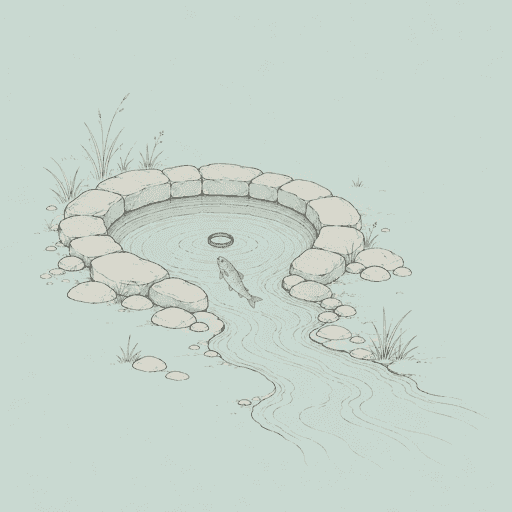
The unmapped holy well, or tobar, is a deep symbol of the lasting spiritual power of the Irish landscape and the deep cultural memory that exists outside colonial logic. Hidden in a dense copse that doesn’t appear on British maps, the well shows a source of mystical insight connected to a pre-Christian, pre-colonial past. It’s a place that can’t be measured by a theodolite or contained by inked lines on a page.
For Tomás, the well is a catalyst, a sacred site where the land’s memory is so potent that it shatters his complicity with the colonial mapping project. His experience there is a violent reawakening to an older, truer knowledge of the land. After drinking from its water, he frantically tries to explain its significance to Liam, calling it “the place where […] everything meets” (26). This description reveals the well as a point of confluence where geology, myth, human history, and spirituality intersect, embodying the theme of Landscape as a Witness to Historical Trauma. The land’s role as a physical archive is reinforced by the preservation of Brith’s body and her gold ring in the bog near the copse, demonstrating that the landscape holds history both spiritually, in the well’s power, and physically, in the earth itself. The well is the heart of Cultural Resilience as Anti-Imperialist Resistance, symbolizing a timeless native spirituality that colonial science can neither find nor erase.
Music and the Fiddle
Music and the fiddle serve as a recurring motif representing an alternative, embodied form of cultural memory and resistance that stands in direct opposition to the rigid, textual world of maps. Primarily associated with Enda, traditional music is portrayed as a living art form passed down through performance and community, preserving Irish culture without relying on literacy or colonial language. While Tomás and Liam engage with the land through measurement and inscription, Enda connects to its history and spirit through the tunes she collects and plays. Her passion is a deliberate act of forging an identity independent of both patriarchal expectations and colonial assimilation.
The narrative frames Enda’s musical dedication as a form of rebellion that ultimately allows her to find her own path. During a key scene on the island, Tomás watches Enda play for the islanders, her hair loose as “the notes flood from her hands,” and Tomás realizes that “she has gone beyond the limits of his paternal reach” (196). In this moment, the fiddle becomes a symbol of Enda’s independence and the power of art to create a world beyond the boundaries set by others. Her music becomes her own unique map, charting a geography of emotion, history, and community, powerfully illustrating the theme of Cultural Resilience as Anti-Imperialist Resistance.
The Wolfhound (Bran)
The recurring figure of the gray wolfhound is a potent symbol that connects the characters across millennia, representing a deep-rooted lineage of loyalty and a protective spirit intrinsically tied to the land itself. The wolfhound first appears in the ancient past as the fierce protector of the sacrificial girl Brith, described as her “companion and protector” (105), establishing an archetypal bond between the dog, a vulnerable girl, and the sacred landscape. Millennia later, this spirit is reincarnated in Bran, the family’s dog, who’s a loyal guardian and an almost supernatural witness to their lives.
Bran is more than a pet; he’s an embodiment of an ancient, instinctual connection to the land that transcends human history and its traumas. His constant presence provides a sense of continuity, linking the family to the same protective force that watched over Brith. The dog’s symbolic weight climaxes in his sacrificial death, where he’s shot while defending Rose from the viscount’s son and his friend. This act of ultimate loyalty directly precipitates Eugene’s violent retribution and the children’s subsequent flight, making Bran a key figure in the narrative’s tragic turning point. His death emphasizes the theme of Landscape as a Witness to Historical Trauma, as this ancient spirit of the land is violated by the casual brutality of the ruling class.

Unlock the meaning behind every key symbol & motif
See how recurring imagery, objects, and ideas shape the narrative.
- Explore how the author builds meaning through symbolism
- Understand what symbols & motifs represent in the text
- Connect recurring ideas to themes, characters, and events