Land
Land
A modern alternative to SparkNotes and CliffsNotes, SuperSummary offers high-quality Study Guides with detailed chapter summaries and analysis of major themes, characters, and more.
Summaries & Analyses
Author Insights
Quizzes
NEWReading Tools
Themes
Content Warning: This section of the guide includes discussion of death and racism.
Cartography as Colonial Erasure
In Land, map-making is stripped of scientific neutrality and recast as an instrument of colonial subjugation. The novel argues that the British Ordnance Survey’s revision of Irish maps in the 19th century was a violent campaign to erase an indigenous reality and impose an imperial one. Through the work of its protagonist, the surveyor and translator Tomás, the narrative demonstrates how anglicizing Gaelic place names and redrawing boundaries to reflect colonial control effectively overwrites centuries of history and memory. Yet O’Farrell also explores how this very tool of oppression can be subverted, as Tomás ultimately rejects the colonial project to create a new kind of map rooted in resistance, honor, and historical truth.
The novel initially establishes the British mapping project as an exercise in linguistic and historical simplification. Employed by the British colonialists, Tomás’s primary value lies in his ability to translate the land for them. He parses complex, polysyllabic Gaelic place names, which often contain stories of local events, folklore, or natural features, and reduces them to English equivalents like “Bluff’s Cross” and “Yellowcove,” which prove more manageable for the colonial officers to read. This process is more than translation; it’s a form of erasure that severs the deep, historical connection between the people and the names they use for their own landscape. By overwriting the native toponymy, the British army imposes a foreign, simplified grid onto a land rich with ancestral meaning, rendering its indigenous history illegible to the new rulers and, eventually, to its own people.
While participating in this colonial project, Tomás simultaneously engages in a private act of cartographic resistance. A significant part of his task is to update maps to reflect the devastation of the Great Famine, erasing the hundreds of tenant cottages and entire villages that have been emptied and dismantled. The British officers prefer to ignore this history, but Tomás is determined that his maps “will bear an account of what happened, what was lost” (6). This quiet vow positions him as a conflicted figure: a collaborator who aids the colonial project but also a secret archivist who uses its tools to preserve the very trauma his employers wish to forget. His work becomes a palimpsest where the official, sanitized version of the landscape barely conceals the ghost-like presence of a decimated population.
This internal conflict culminates in a complete rejection of the colonial endeavor after Tomás’s transformative experience at a sacred well. He comes to see the official maps as nothing more than “enemy tools” and begins creating his own, radically different chart. This new map is an act of deep cultural reclamation. Written in Gaelic, it prioritizes sites of native historical and spiritual significance, such as “Hill Fort,” “dolmen,” and “evicted village,” over the Anglicized names and landlord boundaries of the British survey. When Father Joseph, a figure of the assimilated church, views this new creation, he’s bewildered, declaring it to be in the “wrong language.” His reaction emphasizes the success of the colonial mindset, which has rendered the land’s own native tongue alien. For Tomás, however, this “wrong” language is the only one that can tell the truth, transforming cartography from a tool of erasure into an act of deep honor and cultural survival.
Landscape as a Witness to Historical Trauma
The Irish landscape in Land functions as a living, breathing entity that absorbs and archives millennia of history and trauma. O’Farrell portrays the natural world, from its bogs that preserve ancient bodies to its wells that hold spiritual power, as a part of conscious witness to human suffering. This deep, geological memory persists in the soil and water, offering a form of truth and continuity that directly counters the erasures attempted by colonial cartography. The land itself becomes the ultimate repository of a past that refuses to be forgotten, bearing the physical and psychic scars of everything from pre-Christian sacrifices to the unhealed wounds of the Great Famine.
The novel depicts the landscape as a physical container for layered histories of violence. This is most vividly illustrated through the story of Brith, a young girl sacrificed in ancient times whose body is perfectly preserved in the bog on the same hillside where the 19th-century characters walk. Her story physically embeds a deep, pre-colonial past into the very ground beneath their feet. This ancient trauma echoes the more recent catastrophe of the Great Famine. When the young boy Liam enters a copse, he mistakes moss-covered mounds for “tiny graves,” a moment that explicitly links the natural environment to the unhealed wounds of the starved and dispossessed. For survivors like the widow, the land is haunted; she sees a mass grave beneath a crossroads tree and the ghosts of evicted famine victims in the town square, demonstrating how historical trauma becomes an inescapable part of the physical world.
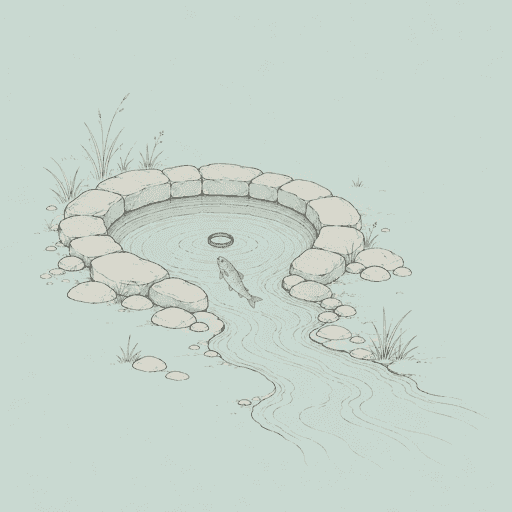
Certain locations within this landscape function as sacred nexuses where the veil between past and present thins, allowing characters to access the land’s deep memory. The unmapped copse and the holy well are chief among these sites. Hidden from the British surveyors, the well is a place of immense spiritual power that exists outside of colonial control. It’s here that the surveyor Tomás undergoes a crisis that’s also a revelation. After drinking from the well, he feels that he’s at a place “where everything meets” (26), a confluence of time, myth, and geological memory. This encounter shatters his rational, empirical worldview and immerses him in the land’s deep consciousness, compelling him to abandon the colonizer’s map in favor of one that honors the land’s sacred and traumatic history. The well acts as a portal, initiating him into a pre-colonial understanding of place that is mystical rather than merely scientific.
The land’s role as a witness makes it an active force of resistance against colonial amnesia. The British maps attempt to create a clean, orderly, and ahistorical version of Ireland, one stripped of its Gaelic past and the raw evidence of famine. However, the landscape itself rebels against this sanitization. Its haunted quality, its preserved bodies, and its sacred wells all testify to a deeper, more complex truth. By portraying the environment as an active participant in history, one that remembers, mourns, and reveals, the novel suggests that the truest account of a place is written in the lasting memory of the land itself.
Cultural Resilience as Anti-Imperialist Resistance
Land asserts that indigenous culture, though battered by colonial subjugation, possesses a deep resilience that allows it to survive and resist assimilation. The novel demonstrates that this survival is achieved through the steadfast preservation of cultural memory. By clinging to traditional music, pre-Christian myths, and an intimate spiritual connection to the earth, the characters engage in potent acts of defiance. These practices ensure that a native Irish identity persists as an essential undercurrent, nourishing the community even as its language is suppressed and its history is systematically erased by British imperial forces.
The novel champions non-literate, communal art forms, particularly music, as important channels for cultural transmission. This idea is embodied by Enda, whose life becomes dedicated to her fiddle. From her childhood skipping songs to her focused collection of traditional tunes on a remote island, Enda becomes a living archive of oral culture. When she plays for the islanders in a shepherd’s cabin, she participates in a communal act of remembrance, keeping alive melodies that exist outside the colonizer’s written records. Her music shows a form of knowledge and history that cannot be mapped or controlled by the British, ensuring its survival from one generation to the next.
The embrace of a mythic worldview, rooted in folklore and a spiritual reverence for the land, is depicted as another powerful form of resistance. The novel contrasts the rational, empirical logic of the British surveyors with an older, more intuitive way of knowing. This is most evident in Tomás’s transformation. His mystical conversion after visiting the holy well is also a breakthrough into a native consciousness. He rejects the sterile, Anglicized maps of the British and begins creating a new one based on Gaelic myth, folklore, and pre-Christian landmarks like the “dolmen” and “Hill Fort.” This turn from colonial science to indigenous spirituality is a defiant act that reclaims the landscape, imbuing it with a sacred history that predates and supersedes the authority of the colonizer.
Ultimately, the novel redefines true knowledge of a place, suggesting it belongs to the seanchaí, the traditional storyteller and custodian of lore. After his epiphany, Tomás concludes that a good surveyor must be the “seanchaí of the land” (55). In Gaelic tradition, the seanchaí is the historian and genealogist of the community, preserving its collective memory through oral recitation. By merging the role of surveyor with that of the storyteller, Tomás subverts the colonial hierarchy that prizes empirical data over traditional wisdom. He argues that to truly map a place, one must understand its stories, ghosts, and sacred layers. In doing so, he transforms his profession from a tool of empire into a practice of cultural preservation, ensuring that the soul of the land, and its people, endures.

Unlock every key theme and why it matters
Get in-depth breakdowns of the book’s main ideas and how they connect and evolve.
- Explore how themes develop throughout the text
- Connect themes to characters, events, and symbols
- Support essays and discussions with thematic evidence