Satantango
Satantango
A modern alternative to SparkNotes and CliffsNotes, SuperSummary offers high-quality Study Guides with detailed chapter summaries and analysis of major themes, characters, and more.
Summaries & Analyses
Quizzes
NEWReading Tools
Part 1, Chapters 1-3Chapter Summaries & Analyses
Content Warning: This section of the guide includes discussion of illness, addiction, and substance use.
Part 1: “The First Part”
Part 1, Chapter 1 Summary: “News of Their Coming”
On a rainy October morning at a dilapidated rural estate, an aging man named Futaki wakes to the sound of mysterious bells. He’s having an affair with his neighbor Mrs. Schmidt and resolves to leave the decaying community. Their morning is interrupted by the unexpectedly early return of Mrs. Schmidt’s husband, Schmidt, who was supposed to be away rounding up the community’s cattle with a partner, Kráner, to drive them west to the farm byres. Futaki has an injury that makes walking difficult and, remembering that he has left his stick in the garden, worries that Schimdt will suspect him. Then, Futaki realizes that the two men were planning to steal the proceeds and flee, so he confronts Schmidt. Schmidt, caught out, reluctantly agrees to split the money three ways, acknowledging that Kráner is already part of the arrangement.
Their conspiracy is cut short when a neighbor, Mrs. Halics, arrives with an urgent rumor. A bus driver has seen Irimiás and Petrina, two men from the estate who were believed to have been dead for 18 months, walking back toward the community. Schmidt insists that it must be a trap designed to thwart their plan, but Futaki and Mrs. Schmidt begin to believe the news, realizing that the only source for the men’s deaths was the unreliable “Horgos kid.” Soon after, Mrs. Kráner arrives to relay her husband’s message: Kráner has already set out for the bar and sent her to inform the Schmidts, abandoning their escape plan. Defeated, Schmidt agrees to accompany Futaki through the storm to the bar to see for himself, while Futaki, newly hopeful, proclaims that it’s the start of a “real golden age” (22).
Part 1, Chapter 2 Summary: “We Are Resurrected”
The narrative shifts to Irimiás and his companion, Petrina, who are waiting in a bleak government building. They were served a summons the previous night and, after mistakenly entering the Registry of Prostitutes, are brought to the correct office. A captain threatens them with prison if they fail to comply with his orders. He tells them to report to him the next morning; later in the confrontation, when Irimiás invokes their former handler, the captain reveals that Szabó has retired and that he has taken over the files.
Furious, the pair goes to a local bar. There, Irimiás terrifies the patrons with a loud, theatrical rant, vowing to blow up the entire town. Among those present is a large man in a bus driver’s cap who quietly finishes his drink and says nothing. Afterward, Irimiás and Petrina set out for the estate in the driving rain, with Irimiás confirming that their plan is to take the villagers’ money. On the road, they meet the Horgos boy, who had spread the news of their deaths 18 months prior. He reveals that he did so on their instructions in exchange for Irimiás’s promise to fix him up with Mrs. Schmidt. The boy confirms that the bus driver Kelemen has already told everyone on the estate that he saw them alive in town. As dawn breaks, the three arrive at the estate’s bar.
Part 1, Chapter 3 Summary: “To Know Something”
The doctor, who has an addiction to alcohol, lives in isolation, meticulously observing the estate from his window and recording its slow decay in a journal. His routine is disrupted when his provisioner, Mrs. Kráner, quits, explaining that the autumn rains have made the roads to town impassable. Running low on pálinka (Hungarian brandy made from fruit) and feeling increasingly ill, the doctor is forced to brave the storm to go to the bar himself. He shelters in an abandoned mill, where he finds the two Horgos sisters—the elder and Mari, the younger—who are sex workers, waiting for clients. The elder sister mentions that she expects Schmidt and Kráner to arrive soon with a large sum of money. She then quickly waves the subject aside when the doctor asks about it.
Outside the bar, the doctor encounters the youngest Horgos child, a girl named Esti, who clings silently to his coat. He strikes her arm to free himself, stumbles on the mud scraper, and falls full-length in the mud. Frightened by his fall, Esti runs off into the night. The doctor tries to follow but is too weak and collapses in a muddy ditch, losing consciousness and feeling a sharp pain in his chest. When he comes to, he’s stunned to see Irimiás, Petrina, and the Horgos boy walking past, but he’s too ill to react. The following day, Kelemen finds the doctor delirious on the road to town and hauls him onto his cart.
Part 1, Chapters 1-3 Analysis
Futaki’s waking vision of time as a “frivolous interlude in the much greater spaces of eternity” establishes a philosophical framework in the novel (4), in which human endeavor is overshadowed by immense, impersonal forces. These opening chapters immerse the reader in the theme of Decay as an Unstoppable Force, portraying a world in which this is the primary reality. The physical landscape of the estate—a “stinking yellow sea of mud” under “mercilessly long autumn rains” (3)—is an active antagonist, with its decay and rot mirroring the social collapse. This environment reflects the social and economic collapse of the post-collectivization Hungarian countryside, a historical context of systemic failure. The decay is omnipresent and internal: Mildew covers walls and clothes in a regularly cleaned cupboard, while cutlery develops “a coating of rust” in weeks (7). Krasznahorkai’s long, labyrinthine sentences flow without paragraph breaks for pages, formally illustrating this oppressive atmosphere. The unbreaking, imposing syntax mirrors the incessant rain, trapping the reader in the same suffocating, inescapable present as the characters. This stylistic choice reinforces the sense that both the natural and human worlds are succumbing to an irreversible dissolution, a theme the doctor later explores through his geological readings about inner Hungary sinking into the sea.
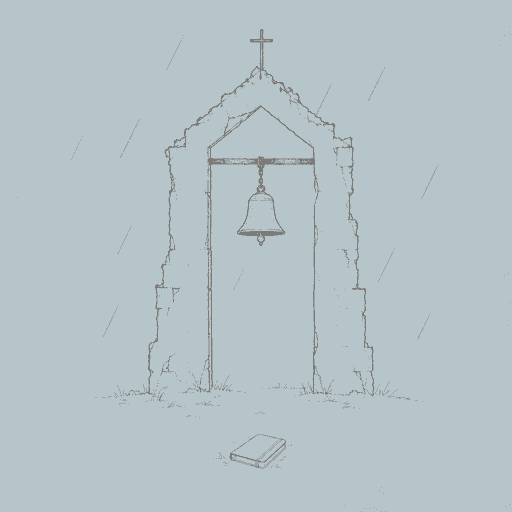
The first chapter opens with Futaki hearing mysterious bells, a motif that introduces a sense of prophetic expectation into the bleak landscape. With no logical source, the bells function as a supernatural herald, priming the villagers for a miraculous event that can rupture their stagnant existence. The lives of the villagers are defined by petty betrayals and hopeless schemes, such as Schmidt and Kráner’s aborted plan to steal the community’s shared funds and Futaki’s affair with Mrs. Schmidt. In this environment of deep social and moral stagnation, where characters are trapped in stifling cycles of infidelity and mutual suspicion, any disruption is perceived as a potential sign of deliverance. The rumor of Irimiás’s return from the dead is seized upon with immediate, desperate credulity by Futaki and Mrs. Schmidt, who instantly abandon their own plans to escape. Futaki’s sudden, euphoric declaration that a “real golden age” is beginning adheres to the theme of Desperation as Fertile Ground for False Prophets (21), showing how desperate Futaki is for any kind of change, no matter how absurd. The villagers’ deep misery makes them susceptible to the idea of a charismatic savior, investing their hope in a figure who can impose meaning on their chaotic lives, regardless of his actual nature or intentions.
The abrupt change in perspectives between the chapters is a narrative choice that illustrates the tension between the competing forces in the story. While the estate residents await a messianic return, the narrative reveals Irimiás to be a small-time informant caught in the gears of a decaying state bureaucracy. The change in narrative perspective suggests that Irimiás isn’t the messiah the villagers believe him to be. The sterile, anonymous government office—where clocks show different times and officials are faceless—is very different from the spiritual realm that Irimiás, according to the villagers, is supposed to inhabit. Irimiás’s grand pronouncements in the bar, threatening to “blow them up one by one” (41), are exposed as the impotent rage of a man who has just been dressed down by a provincial captain and reminded of his subservient role. He does not want to lead the villagers to a new Eden; instead, he wants simply to “take their money” (44). This juxtaposition demystifies Irimiás, exposing him as another product of the same corrupt, failing system that the villagers hope he will deliver them from. The chapter title “We Are Resurrected” is thus deeply ironic (23); Irimiás and Petrina are not resurrected saviors. They are ghosts of a failed political project, returning to prey on those even more helpless than themselves.
In Chapter 3, the doctor embodies a futile, rationalist attempt to impose order on the chaos. His life is a meticulous, almost pathological system of observation designed to “fend off the sinister, underhanded process of decay” by recording every minute detail of the estate’s collapse in his notebooks (56). His obsessive arrangements and self-punishment for “one superfluous movement” represent a private, desperate parody of the systematic control that was promised but never delivered by the socialist state (52). Yet his intellectual fortress is fragile, propped up by alcohol and undone by the very forces he seeks to understand. His collapse in the mud outside the bar is a symbolic failure of the intellect needed to halt physical and moral entropy. His geological reveries, which describe the land itself sinking and rising over eons, frame human history as a minor spasm within a vast, indifferent timeline. The doctor, like the geologists, is hoping to comprehend and understand this minor spasm through documentation and examination. This reinforces the theme of The Cyclical Nature of History and Suffering, suggesting that the estate’s collapse is one iteration of an endless pattern, an idea that’s reinforced by the ending of the novel. The doctor’s attempt to find a fixed vantage point is ultimately as doomed as the villagers’ search for a savior; both are swept away by forces far beyond their control.
The structure of these opening chapters establishes a non-linear, looping narrative that formally reflects the characters’ entrapment. The narrative time of Chapter 1, which ends with Futaki and Schmidt heading to the bar at dawn, overlaps with the end of Chapter 2, where Irimiás arrives at the same bar on the same dawn morning. Chapter 3, meanwhile, covers the entire preceding day and night from the doctor’s isolated perspective, culminating in his collapse just as Irimiás passes him on the road. This technique of circling back to view the same events from different viewpoints fragments any sense of forward momentum and destabilizes the internal chronology of the narrative, trapping the reader in the same kind of repetitive loop as the characters. The sense of inertia and expectation is compounded by the constantly delayed arrival of Irimiás.

Get in-depth, chapter-by-chapter summaries and analysis from our literary experts.
- Grasp challenging concepts with clear, comprehensive explanations
- Revisit key plot points and ideas without rereading the book
- Share impressive insights in classes and book clubs