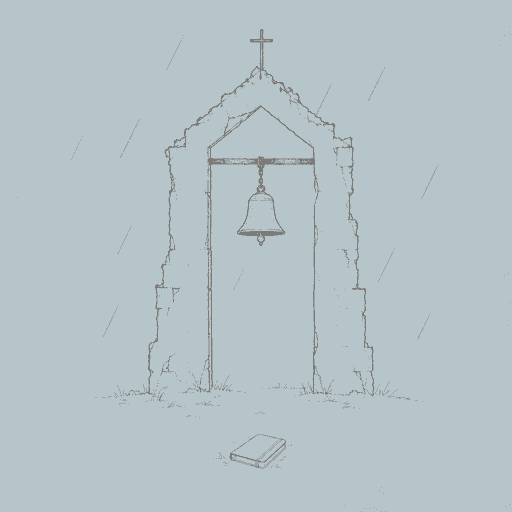
Satantango
Satantango
A modern alternative to SparkNotes and CliffsNotes, SuperSummary offers high-quality Study Guides with detailed chapter summaries and analysis of major themes, characters, and more.
Summaries & Analyses
Quizzes
NEWReading Tools
Themes
Content Warning: This section of the guide includes discussion of death by suicide, child death, emotional abuse, and addiction.
Desperation as Fertile Ground for False Prophets
In Satantango, Krasznahorkai portrays a community so broken by systemic failure, poverty, and isolation that its residents become willing disciples of a charismatic but fraudulent savior. The return of Irimiás, a man they believed to be dead, exposes how collective desperation creates a psychological vacuum that manipulative figures can fill, not with genuine salvation but with a new, more sophisticated form of control. The villagers’ willing submission suggests that in a world devoid of purpose, the illusion of a grand plan is preferable to the crushing reality of meaninglessness. Krasznahorkai uses this dynamic to explore the vulnerabilities of a populace left behind by a collapsing social and political order, ready to pledge allegiance to any authority who promises an escape.
The villagers’ immediate reaction to the news of Irimiás’s return reveals their deep need for an external messiah. That they so quickly accept his return after an 18-month absence demonstrates their desperation, but the ease with which they blur together the possibility that reports of his death were mistaken with the possibility that he was supernaturally resurrected shows their desire to believe that Irimiás is their anointed savior. Before this rumor surfaces, characters like Futaki and Schmidt have their own concrete, if amoral, plan for escape: to steal the community’s collective earnings and flee. However, the moment they hear that Irimiás is alive, these plans are instantly abandoned. Their personal agency evaporates, replaced by a passive faith in his power. Futaki tells a reluctant Schmidt that if Irimiás is truly back, “[he] won’t be able to escape Irimiás anyway” (19), a statement that frames the prophet as an omnipotent, inescapable force. This swift surrender of autonomy demonstrates a community conditioned to look for saviors from above rather than solutions from within, making them perfect targets for exploitation.
Once he arrives, Irimiás exploits the community’s grief and guilt. He begins by transforming the tragedy of Esti’s death into an opportunity to establish his moral authority. In a long, hypnotic speech at the bar, he reframes the child’s suicide as a direct consequence of their collective sin and spiritual decay. He absolves the villagers of individual responsibility, only to impose a shared guilt on them by asking, “[A]re we not all to blame?” (168). He then positions himself as their sole path to redemption, offering a vague but captivating vision of a new “model economy” on a remote estate. By manipulating their despair into devotion, he convinces them to hand over their entire savings, not as a transaction but as an act of faith. They eagerly give him their money because he has successfully sold them a narrative in which their suffering has meaning and their sacrifice will lead to deliverance. What Irimiás sells them is purpose, rather than any specific project.
However, the novel reveals this prophetic performance to be a cynical sham. Away from the estate, Irimiás is shown to be a low-level government informant, a cog in the machinery of a faceless bureaucratic state. In a bleak government office, he and Petrina are reprimanded by a captain who assigns them a mission. The idea that their plan for the villagers is a grassroots salvation project is revealed to be a lie. In actuality, the plan is a state-sanctioned exercise in surveillance and control, with the captain recruiting Irimiás to set up the villagers as a network of informants. This revelation exposes Irimiás as an agent of the exact kind of oppressive, decaying system the villagers hope to escape. His power derives from his ability to mimic the language of hope while serving an apparatus of control, making him a perfect prophet for a government ruling over desperate and abandoned people.
The Cyclical Nature of History and Suffering
Krasznahorkai’s Satantango employs a circular narrative structure to argue that human existence is trapped in a loop of hope and disillusionment, where all attempts at linear progress are ultimately futile. The novel’s numbering of chapters, which mimics the forward-and-backward steps of a tango, mirrors the characters’ journey: They move, they struggle, and they expend enormous energy, only to end up where they began or in a state functionally identical to their starting point. This cyclical pattern suggests that suffering is a permanent condition, rather than something to be overcome, and that history is less a line of advancement than an endless, confining repetition. The villagers’ belief in a coming salvation is repeatedly shown to be a delusion within this inescapable structure.
The novel’s most explicit structural device—its chapter numbering—frames the narrative as a dance of non-progression. The table of contents shows Part 1 containing chapters numbered “I” to “VI,” while Part 2 reverses the order, moving from “VI” back to “I.” This formal choice imposes a cyclical logic on the plot itself, denying the possibility of a traditional resolution or escape. The characters take six steps forward, full of hope for the arrival of their savior Irimiás, only to take six steps back into new forms of entrapment and despair. Early in the novel, Futaki has a vision of time as “a frivolous interlude in the much greater spaces of eternity, a brilliant conjuring trick to produce something apparently orderly out of chaos” (4). This perspective reinforces the novel’s core idea that human efforts and historical events are just fleeting, repeating patterns within a vast, unchanging void.
The villagers’ supposed escape from the estate serves as the central turn in this cycle, revealing itself as a redistribution into new, equally constrained forms of existence. After they surrender their money and their will to Irimiás, he doesn’t lead them to the promised “model economy” at Almássy Manor. Instead, at a desolate train station, he disperses them to various menial jobs in different towns. The Schmidts are sent to a butcher, the Kráners to a laundry, and the Halicses to a rectory. This isn’t a new life of freedom and dignity; it’s the same old life of labor and dependency, just atomized and spread across new locations. The cycle of hope, faith, and betrayal is complete, demonstrating that changing one’s physical location doesn’t break the fundamental pattern of servitude.
The book’s final chapter, “The Circle Closes” (267), creates a narrative loop, trapping the story itself in an eternal recurrence. In the end, the isolated and paranoid doctor, left alone on the abandoned estate, decides to write down the story of what happened to fend off his own decay. The words he begins to write are the exact opening words of the novel itself, as he feels that his narration has the power to manipulate the actions of his subjects. This metafictional twist transforms the entire book into a self-contained, inescapable system. The story doesn’t end; it begins again, implying that these events are doomed to repeat forever. Even the act of observing and recording history, as the doctor attempts, offers no escape; it merely becomes another part of the endless, suffering-filled cycle.
Decay as an Unstoppable Force
In Satantango, decay is a totalizing, elemental force that relentlessly breaks down the physical environment as well as the social fabric, human bodies, and the very possibility of hope. Krasznahorkai uses the ceaseless autumn rain, the omnipresent mud, and the crumbling architecture to create a world where entropy is the only governing principle. This physical decay functions as more than merely a backdrop; it serves as a metaphor for the moral and ideological collapse of a society left to rot, mirroring the state of the Hungarian plains in the declining years of the communist regime. The novel suggests that human efforts to build, maintain order, or escape are ultimately futile against these inexorable processes of disintegration.
The novel’s setting is dominated by rain and mud, which function as active agents of decay, isolating the community and physically manifesting its state of stagnation. The book opens with the onset of “the mercilessly long autumn rains” that turn the soil into a “stinking yellow sea of mud” (3), rendering the outside world inaccessible. Krasznahorkai employs pathetic fallacy, as this oppressive weather system mirrors the characters’ trapped condition, turning their home into an inescapable mire. The decay is external and internal. Futaki tastes death on his tongue, a sourness that signifies the decay within his own body. This pervasive entropy suggests a world where the foundations—both literal and metaphorical—have washed away, leaving only rot.
The doctor’s obsessive project to document decay highlights its universal scope. At the same time, his own physical and mental deterioration shows that observation offers no immunity. He believes that he can resist disintegration by meticulously recording its progress, trusting his memory to “fend off the sinister, underhanded process of decay” (56). However, his paranoia and alcohol addiction render him a prisoner in his own filthy, neglected room. Weeds grow inside his house, and a “strong sour stench” fills the air (55). His intellectual attempt to master entropy only leads to his own psychological and physical collapse, demonstrating that no one can stand outside the all-consuming process. His eventual decision to write the story of the estate becomes another form of submission, a documentation of a ruin he’s already a part of.
The recurring motif of spiders and their webs symbolizes an insidious, organic form of decay that persistently overwhelms human attempts at order. The two chapters titled “The Work of the Spider” are central to this theme (79, 135). The landlord of the bar wages a constant, losing battle against the cobwebs that cover everything as soon as he stops cleaning. This struggle is futile; the webs represent a quiet, natural, and unstoppable force of reclamation. The imagery of the spiders and their webs culminates powerfully at the end of Part 1, when the drunken, sleeping villagers are covered in webs: “They wove over the faces, hands, and feet of the sleepers too” (160). This image shows decay literally consuming the characters, marking them as part of the ruins. Their final destination, the supposedly utopian Almássy Manor, is also a ruin, confirming that there is no escape from this all-covering force.

Unlock every key theme and why it matters
Get in-depth breakdowns of the book’s main ideas and how they connect and evolve.
- Explore how themes develop throughout the text
- Connect themes to characters, events, and symbols
- Support essays and discussions with thematic evidence