Satantango
Satantango
A modern alternative to SparkNotes and CliffsNotes, SuperSummary offers high-quality Study Guides with detailed chapter summaries and analysis of major themes, characters, and more.
Summaries & Analyses
Quizzes
NEWReading Tools
Part 2, Chapters 3-1Chapter Summaries & Analyses
Content Warning: This section of the guide includes discussion of physical abuse, emotional abuse, gender discrimination, addiction, and cursing.
Part 2, Chapter 3 Summary: “The Perspective, as Seen From the Back”
At the dilapidated manor, the villagers awaken to a rainy dawn and realize that Irimiás hasn’t returned as promised. Feeling trapped and betrayed, their despair turns to anger. Kráner declares that they’ve been conned, and an enraged Schmidt blames Futaki for persuading him to trust Irimiás. The confrontation escalates until Schmidt violently kicks Futaki in the face, knocking him unconscious. At that moment, Irimiás appears. He scolds the group for their infighting and lack of faith, explaining that he was delayed while overcoming obstacles for their sake. He announces a change of plans, claiming that their project at the manor has attracted unwanted attention. To avoid scrutiny, they must disperse to different towns and act as his vigilant observers of these new communities.
After loading the villagers into a borrowed truck and driving them to a nearby town, Irimiás gives each family a new assignment and a thousand forints from their shared funds. The Schmidts are sent to a butcher in Elek, the Kráners to a tailor in Keresztúr, and the Halicses to a rectory in Póstelek. The headmaster is dropped at Streber Street and told to wait in The Ipar, where Irimiás will return for him in about an hour. Futaki pre-emptively tells Irimiás not to bother with him, saying that he knows where to go and will find his own night watchman work; Irimiás nonetheless directs him to a building next to the Golden Triangle and gives him a thousand forints, and Futaki departs alone. As Irimiás drives the others away on a truck, Petrina asks why they need a man named Páyer and mentions “guns and explosives” (257), but Irimiás angrily silences him.
Part 2, Chapter 2 Summary: “Nothing but Work and Worries”
Two clerks in an office are tasked with transcribing a crudely written report into formal, professional language. The document is an assessment of a “workforce,” seemingly written by Irimiás, and the clerks struggle to find euphemisms for its vulgar descriptions. The report characterizes Mrs. Schmidt with crude terms including “stupid, big-mouth and cow,” which the clerks render as “intellectually weak female person primarily concerned with her sexuality”; they separately translate “cheap whore” as “a woman who offers her body freely” (260). Mrs. Kráner becomes a “transmitter of unreliable information” (261), and Halics becomes an “elderly alcoholic of small stature” (262). The author also notes that Futaki is “dangerous but useful” and more intelligent than the others (265). After a long and exhausting day, one of the clerks types Irimiás’s name at the bottom of the finished document. They file the report away, lock up the office, and go home. When asked by their wives about their day, both men dismiss it as unremarkable.
Part 2, Chapter 1 Summary: “The Circle Closes”
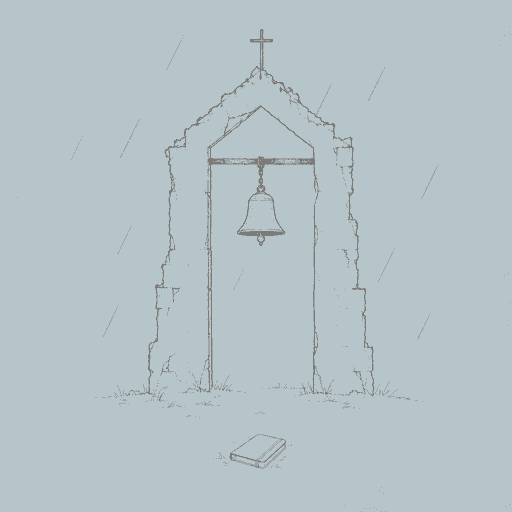
The doctor returns from the hospital to find the estate deserted. He presumes that the other villagers are inside their houses, not knowing about Irimiás’s scheme. Resuming his observations, he hears the mysterious church bells again and develops the conviction that he has gained the power to control the villagers’ actions simply by writing them in his notebooks. Believing that the bells are a signal related to this new power, he follows the sound to a ruined chapel on the old Hochmeiss estate. Inside, he discovers a tiny, terrified old man who leads him to the crumbling bell tower. There, the doctor’s belief shatters: The source of the “Great Bells of Heaven” is the old man (279), who is frantically ringing a small bell with an iron bar while screeching what the doctor takes for a garbled cry of “The Turks are coming” (278).
Horrified by the mundane reality of the sound, the doctor flees back to his house. He nails his door shut from the inside, sealing himself off from the world. Disappointed that his earlier notebook entries were “all wrong” but feeling back on track, he takes out a new notebook and begins to write the story from the beginning, continuing his attempt to master events through words, starting with the novel’s opening sentence: “One morning near the end of October not long before the first drops of the mercilessly long autumn rains began to fall […]” (279).
Part 2, Chapters 3-1 Analysis
Irimiás’s return to the manor at the precise moment when the villagers’ despair erupts into violence demonstrates his mastery of manipulation. He arrives as an authority figure quelling an insurrection rather than as a messianic figure, immediately reframing his absence as a necessary sacrifice made on their behalf. His ability to turn their fear of abandonment into a renewed, if more sinister, sense of purpose exemplifies the theme of Desperation as Fertile Ground for False Prophets. By claiming that their project has attracted unwanted attention, Irimiás manufactures an external threat that justifies his new plan: dispersing the families to separate towns. This act atomizes the community, breaking the bonds that, however frayed, allowed them to briefly challenge his authority. Their new role involves “unceasing, vigilant observation” (246), which transforms them from passive followers into active participants in a system of surveillance, a dark parody of communal effort that echoes the state apparatus of late-communist Hungary, where citizen informants were a key tool of social control. The brief, chilling mention of “guns and explosives” by Petrina reveals the coercive force underpinning Irimiás’s messianic rhetoric (257), showing that his power relies on the implicit threat of violence rather than just rhetoric.
The narrative’s abrupt shift to an anonymous office in Chapter 11 reveals the bureaucratic machinery behind Irimiás’s charisma. As two clerks painstakingly translate his crude and vulgar assessments of the villagers into sanitized officialese, the true nature of his work becomes clear. The villagers are not partners in a utopian project. Under his direction, they have become subjects of a report, their complex lives and desperate hopes reduced to data points for an unseen authority. The clerks’ task of turning phrases like “stupid, big-mouth and cow” into “intellectually weak female person primarily concerned with her sexuality” is more than a dark joke about jargon (260); it’s a depiction of systemic dehumanization. This process of transcription mirrors the way authoritarian systems absorb and neutralize individual identity, making Irimiás’s rhetoric more amenable to the bureaucracy. The report confirms that he’s an informant, a cog in the very system of control from which he promised to help the villagers escape. The chapter exposes the mundane reality of the oppression he represents, which is carried out by bored functionaries who file away human misery before going home to unremarkable lives, rather than overt tyrants.
The doctor’s journey in the final chapter provides a parallel narrative of disillusionment that focuses on the collapse of internal, metaphysical hope. His burgeoning belief that he can control the villagers’ actions by writing them down is a delusion of authorial omnipotence, a desperate attempt to impose order on a chaotic world. He interprets the recurring motif of the bells as a divine confirmation of his newfound power, a “lost melody of hope” calling him to a higher purpose (275). His quest to find the source of this transcendent sound leads him to a squalid, absurd reality: a terrified, non-verbal old man frantically striking a small bell with an iron bar in a ruined chapel. This discovery is a moment of deep deflation, shattering the symbol that sustained his fantasy. The “Great Bells of Heaven” are exposed as the product of fear and decay (279), a meaningless noise in a desolate landscape. This demystification mirrors the villagers’ own journey, where the promise of a new Eden leads only to further exploitation and control.
After confronting the pathetic reality behind the bells, the doctor returns home, nails his door shut, and begins to write the story of the estate from its beginning. His decision to start with the novel’s own opening words—”One morning near the end of October not long before the first drops of the mercilessly long autumn rains began to fall […]” (279)—brings the narrative full circle. This act cements the theme of The Cyclical Nature of History and Suffering. By enclosing himself and recasting the entire story as his own manuscript, the doctor attempts to regain control through narrative, but his self-imprisonment merely reflects the inescapable trap of the villagers’ existence. This meta-narrative turn, explicitly signposted by the chapter title “The Circle Closes” (267), formally signifies the novel’s philosophical pessimism. The structure evokes the motif of the tango dance structure, with its pattern of forward and backward steps. The villagers’ journey—from the estate, to the manor, and back to dispersed, controlled lives—is a choreography of false progress and inevitable retreat. The doctor’s final act of writing ensures that the dance begins again, trapping the characters—and, by extension, the reader—in a closed loop where there’s no escape, only the endless repetition of the same bleak performance.

Get in-depth, chapter-by-chapter summaries and analysis from our literary experts.
- Grasp challenging concepts with clear, comprehensive explanations
- Revisit key plot points and ideas without rereading the book
- Share impressive insights in classes and book clubs