Satantango
Satantango
A modern alternative to SparkNotes and CliffsNotes, SuperSummary offers high-quality Study Guides with detailed chapter summaries and analysis of major themes, characters, and more.
Summaries & Analyses
Quizzes
NEWReading Tools
Symbols & Motifs
Content Warning: This section of the guide includes discussion of emotional abuse and addiction.
The Bells
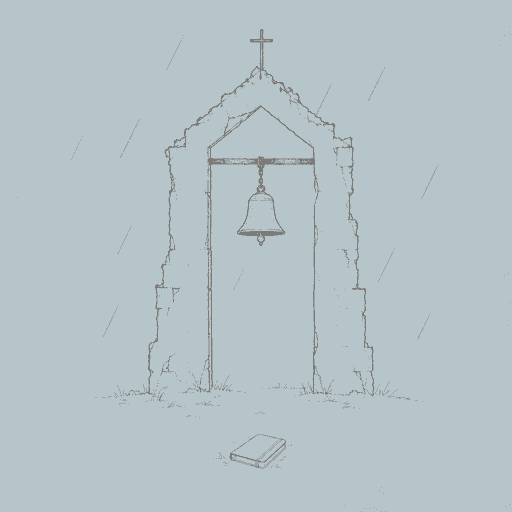
The mysterious tolling of bells that opens and closes the novel is a symbol of false hope and the desperate human tendency to project meaning onto a meaningless world. For the villagers, mired in decay and stagnation, the inexplicable sound suggests a divine promise of salvation or a dramatic shift in their fortunes. When Futaki first hears the bells, their “triumphal clangor” seems to announce a momentous arrival, preparing the community’s psyche for a savior. This initial interpretation primes the villagers for Irimiás’s return, demonstrating how Desperation as Fertile Ground for False Prophets is a central theme. The bells create a spiritual vacuum that Irimiás, with his messianic posturing, is perfectly positioned to fill. The villagers are so eager for a sign that they imbue the random noise with deep significance, showing their vulnerability to manipulation.
The symbol’s meaning is fully realized at the end of the novel when the doctor, in his quest for order, investigates the sound. He discovers that the source isn’t a divine signal but a “filthy tramp! A madman on the run from the asylum” erratically striking a small bell in a ruined chapel (279). This discovery is a moment of deep disillusionment; the heavenly promise is revealed to be the product of disorder and decay. The collapse of this symbol of hope drives the doctor to retreat into his room and begin writing the narrative that the reader has just read, an act that traps the story in a perfect loop. The bells, therefore, symbolize the emptiness of the villagers’ hope but also serve as the catalyst for the novel’s structural sleight of hand, reinforcing the theme of The Cyclical Nature of History and Suffering by bringing about the very story that documents their inescapable despair.
Rain and Mud
The incessant, oppressive rain and the “stinking yellow sea of mud” that it produces form the novel’s dominant motif (3), representing the pervasive physical, moral, and spiritual decay and the theme of Decay as an Unstoppable Force. More than just a setting, the relentless downpour is an active agent of entropy that isolates the community, dissolves the landscape, and mirrors the characters’ internal state of paralysis. The mud physically entraps the villagers, rendering “footpaths impassable and put[ting] the town too beyond reach” (3), which symbolizes their inability to escape their hopeless circumstances. This physical stagnation reflects their psychological inertia; they’re as mired in their own petty grievances, alcoholism, and despair as their boots are in the thick, clinging mud. Every character’s journey, whether it’s a short walk to the bar or a desperate flight from the estate, is a struggle against this all-consuming muck.
The motif extends beyond a mere physical obstacle to represent a universal condition. The doctor, who attempts to chronicle the progress of decay, recognizes it as a force that ruins “houses, walls, trees and fields […] and all human bodies, desires and hopes” (56). The rain washes away distinctions, and the mud homogenizes the environment into a bleak, undifferentiated mire. This process mirrors the degradation of the characters, whose individual ambitions and identities are slowly eroded by the community’s collective hopelessness. The rain and mud are thus the literal atmosphere of decay, a constant, suffocating presence that ensures that nothing can be built, nothing can be cleansed, and no one can truly escape the overwhelming process of ruin that defines their world.
Spiders and Webs
Spiders and their webs are a recurring motif representing the insidious and inescapable networks of both natural decay and human conspiracy. Explicitly foregrounded by the chapters titled “The Work of the Spider” (79, 135), this motif illustrates how the characters are trapped by environmental entropy and also by calculated manipulation. In the bar, the landlord wages a futile war against the cobwebs that constantly reappear, symbolizing the theme of Decay as an Unstoppable Force and showing how it operates on a microscopic, persistent level, covering everything in a “light tissue of webs” that defies order and cleanliness (160). This physical manifestation of decay is a tangible parallel to the more sinister, metaphorical webs being woven around the villagers.
The motif’s full power is revealed when Irimiás explicitly identifies his manipulative scheme as a spiderweb. He boasts of “the network, that enormous spiderweb, as woven and patented by [him]” (218), casting himself as the spider and the villagers as his prey. This connection transforms the motif from a simple image of decay into a symbol of predatory control, linking it directly to the theme of Desperation as Fertile Ground for False Prophets. Just as a spider traps unsuspecting flies, Irimiás ensnares the desperate villagers in a web of false promises, exploiting their hope to drain them of their money and autonomy. The web thus shows a dual entrapment: the passive, natural decay of their world and the active, malevolent conspiracy that preys upon their vulnerability, ensuring that no escape is possible.

Unlock the meaning behind every key symbol & motif
See how recurring imagery, objects, and ideas shape the narrative.
- Explore how the author builds meaning through symbolism
- Understand what symbols & motifs represent in the text
- Connect recurring ideas to themes, characters, and events