Satantango
Satantango
A modern alternative to SparkNotes and CliffsNotes, SuperSummary offers high-quality Study Guides with detailed chapter summaries and analysis of major themes, characters, and more.
Summaries & Analyses
Quizzes
NEWReading Tools
Part 1, Chapters 4-6Chapter Summaries & Analyses
Content Warning: This section of the guide includes discussion of death by suicide, child death, animal cruelty and death, sexual harassment, emotional abuse, substance use, and cursing.
Part 1: “The First Part”
Part 1, Chapter 4 Summary: “The Work of the Spider I”
In a dilapidated bar during a relentless autumn downpour, a farmer named Kerekes argues with the landlord. Another patron, Halics, watches as the landlord, threatened by Kerekes, hides in the stockroom. When Kerekes deliberately drops his money, Halics subserviently retrieves it for him. The tense atmosphere is broken by the arrival of a driver, Kelemen, who is soaked and angry after a long journey by horse and cart on the “old track.” Soon after, Mrs. Halics bursts in, clutching a Bible and shouting, “RESURRECTION!” The landlord retreats to his storeroom, anxiously recalling how he heard from the Horgos boy that Irimiás was dead. He worries about the money that Irimiás owes him, deciding that even if Irimiás has somehow returned, he will still have to pay his debt.
Back in the bar, Kelemen explains that he has just seen the supposedly dead Irimiás and his companion, Petrina. He adds that he heard secondhand, from the younger Tóth boy, that Irimiás had met with Steigerwald, a gun dealer who went broke. Mrs. Schmidt arrives and is overcome with joy when she hears of Irimiás’s return, fantasizing about escaping with him to a new life. As the patrons drink and wait, Kerekes wakes from a drunken slumber to demand that the stove be lit. Later, Mrs. Schmidt detects a peculiar odor, declaring that it’s an “earth smell.”
Part 1, Chapter 5 Summary: “Unraveling”
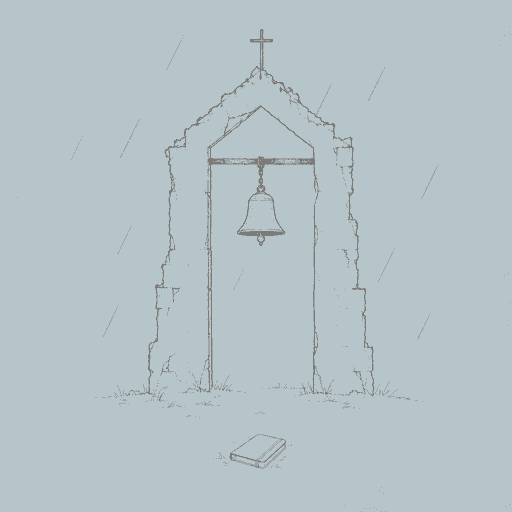
The narrative shifts to Esti Horgos, a young girl who has an unspecified mental-health condition. Her cruel older brother, Sanyi, recently tricked her into burying her life savings by a canal, claiming that it would grow into a “money tree.” Desperate to prove that she’s strong and capable of “winning” her brother’s respect, Esti traps the family cat, Micur, in the attic. She terrorizes the cat until it’s helpless and defecates in fear. Enraged by this perceived weakness, Esti fills a dish with food, milk, and rat poison. She then forces the cat’s face into the mixture until the cat lies motionless. Afterward, Esti can’t tell whether she has drowned Micur or whether the cat is merely pretending to be dead. Carrying the corpse, Esti goes to the canal to find Sanyi but discovers that the hole where they planted her meager savings is empty. He has already stolen the money. She finds her brother, who mockingly admits that the money tree was a lie. He discovers the bag of rat poison in her cardigan pocket, accuses her of having stolen it from the barn, cruelly taunts her with it, and abandons her. After an encounter with the doctor who seems to impatiently want to be rid of her, Esti walks through the rain to the ruins of Weinkheim Castle, still carrying the dead cat. As dawn breaks, she consumes half of the remaining poison. She then lies down to die, with Micur on her right and the poison bag on her left, certain that her “guardian angels” are coming for her.
Part 1, Chapter 6 Summary: “The Work of the Spider II (The Devil’s Tit, Satantango)”
Back in the bar, the patrons continue to wait for Irimiás. Futaki argues with Schmidt, insisting that Irimiás is their only hope. The landlord secretly turns up the heat, hoping that Mrs. Schmidt will remove some clothing. Like several of the male villagers, he has lusted after Mrs. Schmidt for a long time. While the headmaster, Halics, and the landlord desire Mrs. Schmidt, she ignores them, consumed by her fantasies of Irimiás. A drunken Kráner sexually harasses Mrs. Schmidt and is loudly berated by his wife. Futaki becomes ill, stumbles outside into the rain, and sobers up after the landlord finds him unconscious in the mud and shakes him awake. Mrs. Horgos arrives looking for her children, including Esti, whom she calls “the little one” (152), and complains about their absence before leaving. When Kráner notices that the horizon is getting lighter, Mrs. Kráner demands the accordion, and a wild party begins. To stave off sleep as they wait for Irimiás, Kerekes plays a tango. Halics dances with and kisses Mrs. Kráner, while the headmaster dances with Mrs. Schmidt, kisses her neck, and is pulled back toward her by Mrs. Schmidt herself. By dawn, everyone has passed out drunk except for Kerekes. He gathers the remaining wine, drinks it, forces himself to vomit, and then begins playing a sad tune on the accordion. As he plays, spiders emerge and cover the entire bar and the sleeping patrons in thick cobwebs. Irimiás and Petrina finally enter, stopping in silent astonishment at the scene. Only Kerekes notices their arrival.
Part 1, Chapters 4-6 Analysis
The news of Irimiás’s supposed resurrection exposes the deep desperation of the estate’s residents, whose individual hopes and anxieties coalesce around his mythic figure. Upon hearing of his return, Mrs. Schmidt is immediately consumed by fantasies of escape, imagining a new life of “soft furs cool to the touch, brilliantly lit hotels, lavish breakfasts, grand shopping trips and nights” (104). She longs for more than just Irimiás himself. She longs for what he represents, namely a deliverance from her squalid reality. Similarly, the landlord is less concerned about the miracle of a man returning from the dead than he is about the practical matter of a financial debt. Futaki, meanwhile, sees Irimiás as the only force capable of restoring order. This collective projection demonstrates how the theme of Desperation as Fertile Ground for False Prophets operates; Irimiás becomes a blank canvas onto which the community paints its disparate, unrealizable desires for escape, money, and organization. Their immediate and unquestioning belief in his return, despite its impossibility, highlights the psychological void left by the collapse of their social and economic world. In the context of late-stage Hungarian communism, where state-sponsored utopian promises have failed, the villagers’ turn toward a charismatic, quasi-messianic figure reflects a broader societal yearning for meaning and salvation in an ideological vacuum, as well as the poverty of imagination caused by years of decline. The only salvation they can imagine, the novel suggests, comes from a miraculous outsider rather than from themselves.
The narrative’s switch into Esti Horgos’s perspective in Chapter 5 functions as a destructive microcosm of the community’s moral and psychological decay. Desperate to earn the respect of her cruel brother, Sanyi, Esti traps and terrorizes the family cat, Micur, in a misguided attempt to prove her own strength. Her internal logic, shaped by Sanyi’s predatory worldview, convinces her that she must win a battle to be worthy. Rather than a product of innate evil, the violent act is a tragic performance of the only value system she knows—one where power and dominance are the sole measures of worth. When Sanyi later mocks her for believing in his “money tree” scam, he articulates the cynical philosophy that has corrupted her: “People here make a mess of everything, it’s one mess after another, but we know how to straighten things out, don’t we, retard?” (119). Esti’s subsequent murder-suicide is the horrifying conclusion of this lesson. Having been systematically stripped of hope by her family and community, she enacts a final, terrible assertion of control; her belief in “guardian angels” is a pathetic echo of the community’s own faith in a false savior. Her story shows how the community’s larger state of decay poisons its most vulnerable members, perpetuating a cycle of abuse and despair.
Framed by the chapter titles “The Work of the Spider I” and “The Work of the Spider II” (79, 135), this section uses the recurring motif of spiders and webs to symbolize the inescapable nature of the villagers’ entrapment. The landlord’s futile, ongoing battle against the cobwebs in his bar mirrors the residents’ own inability to escape their stagnant existence. The motif culminates in the final moments of Chapter 6 as the drunken villagers lie unconscious and spiders emerge to cover them, their belongings, and the entire room in a fine, complex network of thin cobwebs. The prose describes this work with an almost scientific precision, noting how every object is connected so that the spiders “should be properly advised of every slight tremor, each microscopic shift” (160). This image powerfully visualizes the theme of Decay as an Unstoppable Force. The web is an organic extension of the environment, woven from the residents’ own inertia, alcohol use, and false hopes. When Irimiás and Petrina finally arrive, they find their targets already immobilized, cocooned in a web of their own making. Krasznahorkai’s long, labyrinthine sentences trap the reader in a continuous flow of description that formally mirrors this sense of entanglement, making the experience of reading itself an act of being caught in a textual web.
The wild, chaotic party that erupts just before dawn is a grotesque parody of celebration, embodying the futility inherent in the motif of the tango dance structure. Spurred on by Mrs. Kráner’s demand for music, the villagers throw themselves into a desperate, drunken frenzy. The chapter numbers count up to six, mimicking the steps of the dance. The dance and the chapter numbers reach a zenith as the villagers dance themselves into delusion and delirium before news of Esti’s death and their removal of the town counts back down to reality. Halics’s comical dance with the much larger Mrs. Kráner and the headmaster’s lustful tango with Mrs. Schmidt are expressions of frantic, last-ditch hedonism. The dance is a forward movement that leads only to collapse, as one by one the participants succumb to exhaustion and pass out. This sequence mirrors the steps of a tango, in which every advance is countered by a retreat. The villagers’ brief explosion of energy resolves into a deeper stupor, reinforcing The Cyclical Nature of History and Suffering by showing that any attempt to break from their static misery only returns them to it more forcefully. The party is less a celebration of Irimiás’s impending arrival than a final, convulsive dance before the end, the titular satantango that exhausts all remaining vitality and leaves the community entirely passive and vulnerable for its new leader.

Get in-depth, chapter-by-chapter summaries and analysis from our literary experts.
- Grasp challenging concepts with clear, comprehensive explanations
- Revisit key plot points and ideas without rereading the book
- Share impressive insights in classes and book clubs