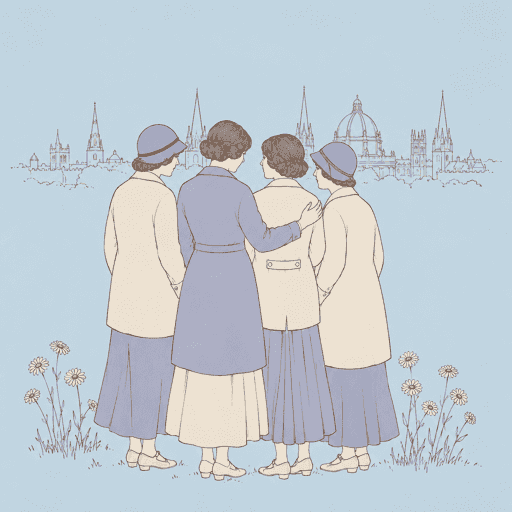
The Eights
The Eights
A modern alternative to SparkNotes and CliffsNotes, SuperSummary offers high-quality Study Guides with detailed chapter summaries and analysis of major themes, characters, and more.
Summaries & Analyses
Author Insights
Quizzes
NEWReading Tools
Joanna Miller on The Eights
In her own words: quotes and insights from the author.Why she wrote it
A century-old photograph and a forest floorThe novel began with a single Oxford University social media post in 2020, marking a hundred years since women were first admitted. Miller saw the photographs and was stopped not by the historical milestone but by something far more immediate: the faces.
The images were grainy and the faces solemn, but I instantly wanted to know who these pioneering women were, and what hurdles they had faced to get there.
Knowing she wanted to write about those women was one thing; knowing what story to tell required a framework. While researching the period, she came across Harold Macmillan’s phrase for postwar Oxford, and it gave her the emotional axis the novel needed.
Harold Macmillan described Oxford after the Great War as a ‘city of ghosts’ and I soon realised that a novel set in 1920 would need to consider the impact of the war on its characters.
Miller also noticed a gap in the historical record that no fiction had yet filled. Oxford had produced centenary research, articles, and blog posts about its first women students, but those women remained absent from novels. Once she began reading the archive, the story’s engine became clear.
Once I realized how strict the rules were for women and how their presence was resented by some men, I knew I had the makings of a story.
That gap mattered to her. She was drawn specifically to the years before the roaring twenties arrived, a period she felt fiction had overlooked in favor of the decade that followed, and to the women who had left no public record at all.
How she wrote it
Fifty visits, four colored fonts, one scrapped titlePlace was not background for Miller: it was source material she collected in person, across more than four years of writing. The Bodleian Library renewed her reader’s card after thirty years and gave her access to hundreds of documents; she also spent a night at St Hugh’s College, the novel’s setting, reading firsthand accounts by 1920s students written in blue ink. But the most consistent practice was simpler.
I visited Oxford over fifty times in the course of writing The Eights, often with my dog, Dickens, in tow. I never left without something useful to add to the novel.
The first draft carried all of that research visibly, to the novel’s detriment. Revision required a hard decision about where the weight of the book should actually fall.
Never let research and historical accuracy get in the way of telling a good story.
Four points of view, each with distinct verbal habits and imagery, created a structural problem she solved with a system that was deliberately visual. For a debut novelist managing that much interiority at once, the practical apparatus mattered as much as the prose.
I kept a tally of the various points of view and assigned each person a different coloured font so I could check that nobody disappeared for too long.
The novel’s title arrived after it had already sold, replacing one Miller had been proud of. Her original title, The Bee Orchid, named a flower whose colors matched the suffrage movement and which self-pollinates without male assistance. It was apt, but unpronounceable in conversation. During a late revision spent correcting all the ‘staircases’ to ‘corridors’ to match St Hugh’s actual layout, she noticed how insistently the number eight had threaded itself through the text: Oxford’s eight-week terms, the famous Eights Week rowing regatta. Her agent described the eventual title as ‘perhaps a little bit iconic.’ [paraphrased from audio]
Miller described the book in a podcast interview as being about ‘courage and cowardice, about trauma and recovery, as well as about friendship and about life in Oxford in 1920.’
That thematic compression came partly through her mentorship on the Escalator Talent Development Scheme with novelist Michael Donkor, who worked with her on dialogue, exposition, and characterization, and pushed her to take risks with the material.
The Escalator programme changed more than her technique. Miller had spent roughly a decade before the novel writing thousands of commissioned poems for her gift business, a practice that trained her ear for syllable count and her instinct for the telling detail. But craft alone wasn’t what she needed most.
Looking back, Escalator is the time when I stopped being apologetic about my writing.
What she wants us to sit with
The ordinary women nobody recordedMiller anticipated that some readers might find the hostility the four women face at Oxford difficult to accept as historical fact rather than authorial exaggeration. She wanted to address that directly, because the archival record behind the novel is precise.
I think it might help readers to know that the misogyny faced by the women in The Eights actually happened. Oxford’s first women students were thrown out of lectures, mocked, refused entry to societies and punished for fraternising with men without chaperones.
The book’s argument isn’t only about institutional misogyny, though. Running alongside the documented hostility is a set of questions about interiority and moral life that Miller considered throughout the writing: Otto’s shame at abandoning her nursing post, Dora’s grief built on a lie, Marianne concealing her identity entirely to earn an education she has every right to claim.
I also thought a lot about the relationship between courage and cowardice, and how a society recovers from war.
The choice to center ordinary women rather than famous ones was deliberate and foundational. Miller could have built the novel around figures who left a public record, who gave speeches or wrote memoirs. She chose the opposite, and named exactly who she meant.
My aim was always to paint an authentic and accurate picture of life for Oxford’s first women — not the exceptional women like Vera Brittain, but the ordinary ones that she refers to in Testament of Youth as ‘The lower millstone.’
That commitment to the unrecorded is why she closed the novel with an extensive author’s note separating fact from fiction, explaining which characters were historical and which invented, and tracing what the actual timeline of women’s admission at Oxford looked like. She felt she owed it to the women in those grainy 1920 photographs whose story no one had yet told in fiction.