Land
Land
A modern alternative to SparkNotes and CliffsNotes, SuperSummary offers high-quality Study Guides with detailed chapter summaries and analysis of major themes, characters, and more.
Summaries & Analyses
Author Insights
Quizzes
NEWReading Tools
Maggie O'Farrell on Land
In her own words: quotes and insights from the author.Why she wrote it
A portrait hidden in a map’s marginThe book began with a family myth O’Farrell had carried since childhood: that an ancestor had drawn the first maps of Ireland. When she finally went to the Dublin archives to find him, she discovered that Irish workers for the British Ordnance Survey were forbidden from signing their own work. His name appeared on wage ledgers, not maps. The breakthrough came unexpectedly close to home, in the Scottish archive about a mile from her Edinburgh house, where he had been allowed to sign. But it was a hand-drawn map that had hung in her parents’ house for decades, made by his son, that stopped her cold. She had walked past it thousands of times before picking up a magnifying glass.
In the corner there was a miniature portrait, invisible to the naked eye, of my great-great-grandfather, standing behind a red-coated British soldier, looking through a theodolite. It was electrifying – he had been hiding in plain sight.
That hidden portrait, a son tucking his father into the margins of colonial work neither of them could refuse, handed her the novel’s moral and emotional center before she had written a word.
The ancestral material was rich but structurally inert until O’Farrell was on a train from Belfast to Dublin, looking out at the countryside. A single sentence arrived, and it did what all her opening sentences must do: it unlocked sequence, character, and tone simultaneously. She described the moment to the BBC.
I was on a train and the first sentence of the book just came into my head – it was, ‘His father was ever a man of few words.’
She wrote the outline of the entire novel before the train reached Dublin.
The ancestral story alone might have produced a historical novel about mapmaking. What widened the book’s scope was a statistic O’Farrell encountered while reading. She had been sitting with a question no book she had read fully answered: what happened to the survivors of the Famine who neither died nor emigrated? The number she found put their endurance into scale she could not ignore.
About four or five years ago I read that the population of Ireland has only now reached pre-Famine levels. So it’s taken 170 years just for the population to recover. [paraphrased from audio]
Her father’s insistence on reading only Irish mythology to his children, which she resisted fiercely as a girl, turned out to be the deepest root of all. He refused Pippi Longstocking. He refused the Moomins. By the time O’Farrell understood what he had given her, she was well into her career as a novelist.
My father would only ever read Irish myths to us when we were children. I used to beg him to read Pippi Longstocking or the Moomins, he never would. He only ever read Irish myths. But in a way, it annoyed me at the time, but now I’m kind of glad that happened, because the Irish myths are my kind of storytelling DNA. [paraphrased from audio]
How she wrote it
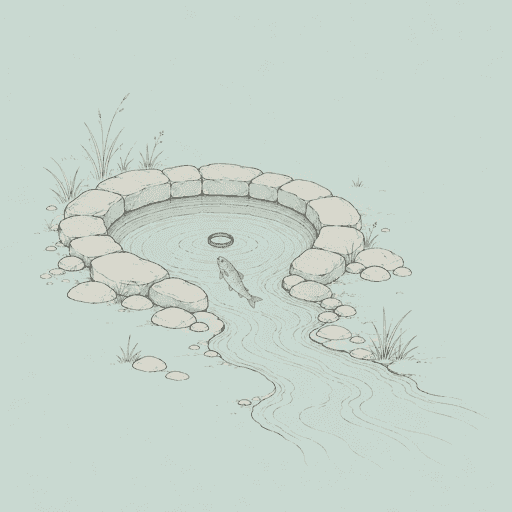
Secateurs, field notebooks, and what to withholdO’Farrell’s physical research for the novel was unusually hands-on. She traveled to Grosse Île, the quarantine island in Canada’s St. Lawrence River where hundreds of thousands of Irish immigrants were processed, and to Ellis Island. She also made a dedicated trip to Ireland with her son to find the pre-Christian sacred springs, called holy wells, that become the novel’s supernatural hinge. Many were overgrown. She brought the right tool for the job.
I would click through all these brambles, and shout to my son, ‘Here it is. I found it!’
The Famine is the novel’s gravitational center, and O’Farrell treated it with a discipline she applied to no other element. She built the fictional accounts from documentary ones, keeping herself accountable to what survivors had actually recorded. At the same time, she felt the weight of doing the subject justice rather than simply invoking it.
It’s so important to take something as difficult and tragic as that and to do it justice, to write about it properly. A lot of the stories that are in the novel are based on first-person accounts.
The single most consequential structural decision was also the most counterintuitive: O’Farrell removed the names of the country, its people, and its colonizer from the entire text. The words “Ireland,” “Irish,” “Britain,” and “British” do not appear. The peninsula at the novel’s heart is never named. The reasoning was not evasion but expansion.
I wanted readers to feel a sense of rootlessness. It’s almost impossible for us to imagine a time before uniform maps, especially now we all have GPS. I wanted to take readers back to when you navigated by the stars, memory and stories. And I wanted it to feel universal – a general meditation on colonisation and occupation.
That erasure mirrors, with careful irony, what the Ordnance Survey itself did to Irish place names: renamed them, anglicized them, made the land legible to the colonizer rather than to the people who lived on it.
The novel’s timeline reaches from the Ice Age to the early twentieth century, all filtered through one Atlantic peninsula. O’Farrell described to the Barnes & Noble audience the moment she found the clause that takes the story back before any human presence at all. Beyond the Famine material, the structure demanded she give equal weight to the land’s geological patience, which required writing time in an entirely different register from the scenes set during human lives.
I was really interested in the possibility of telling the whole story of a country... but all via one plot of land.
The personal thread
A ghost-self on both sides of the waterO’Farrell was born in Coleraine, Northern Ireland, grew up in Wales and Scotland after her family left during the Troubles, and has spent her adult life in Edinburgh. Her sense of Irish identity has always been complicated by the accent she carries, which reads as British to Irish ears. She described the condition to The Nerve not as confusion but as permanent doubling.
Very important: it’s kind of central to who I am. But here I am with my British accent. I think if you don’t grow up where you were born, you always have a kind of ghost-self inside you. I feel quite Irish in Britain, and in Ireland I feel quite British.
Tomás, the novel’s protagonist, is modeled in part on O’Farrell’s great-great-grandfather: a man whose labor built the British Ordnance Survey of Ireland while his own name was barred from the finished maps. But his silence is also something O’Farrell shaped from the inside, as a writer working out what it costs a person to survive what cannot be spoken. She described his arc to NPR in terms of a specific transformation.
Tomás has lived through things that he finds is literally unspeakable. And the well ends that. It cracks him open, and he becomes the opposite of a man of few words.
The holy well, a pre-Christian sacred spring that predates any colonial cartography, is the instrument of that transformation. O’Farrell spent an afternoon hacking through brambles to find one. It was the right kind of research.
What she wants us to sit with
The land that outlasts everyone who claims itO’Farrell framed the novel’s deepest ambition in a single sentence to the BBC: to tell the whole of a country’s history through one plot of ground. The geological timeline she insists on, running from the Ice Age forward, is not ornament. It repositions the human dramas, including the Famine, inside a duration that makes every claim of ownership look brief.
The landscape is the supreme power — with animals second and humans really a low third. The natural world is in charge, and it can curse or it can bless human life.
The Irish mythological tradition her father pressed on her as a child gave the book something no archive could supply: a cosmology in which the nonhuman world has agency. O’Farrell returned to that inheritance deliberately when she needed the novel’s landscape to function as something more than setting.
[The book] is also very influenced by the Irish myths that I was read as a child. In those myths, the land itself, the rocks and stones and trees, are animate. There’s a very clear sense of the humans being at the mercy of the land, and I wanted to have that kind of pagan animism running through the book.
Stripping the country’s name from the text was a formal choice, but O’Farrell’s stated intention for it was political. She wanted the novel’s meditation on mapping and dispossession to reach readers whose own countries have been measured, renamed, and claimed by an outside power. Ireland is the lens, not the limit.
I wanted readers to feel a sense of rootlessness. It’s almost impossible for us to imagine a time before uniform maps, especially now we all have GPS. I wanted to take readers back to when you navigated by the stars, memory and stories. And I wanted it to feel universal – a general meditation on colonisation and occupation.
A reader in any country whose rivers and mountains were renamed by a colonial surveyor will recognize the mechanism. That recognition was the point.
Against the Famine’s catastrophic population loss, the question O’Farrell set herself was not about the dead or the emigrants. It was about the survivors who rebuilt ordinary life from inside an ordinary field, on an ordinary peninsula, without monuments or records. The 170-year road back to pre-Famine population levels is the measure she kept returning to.
The narratives of the people who emigrated...are quite familiar to us. But what interested me in writing Land is the people who stayed, the people who survived, and how they picked themselves up, how they kept living.