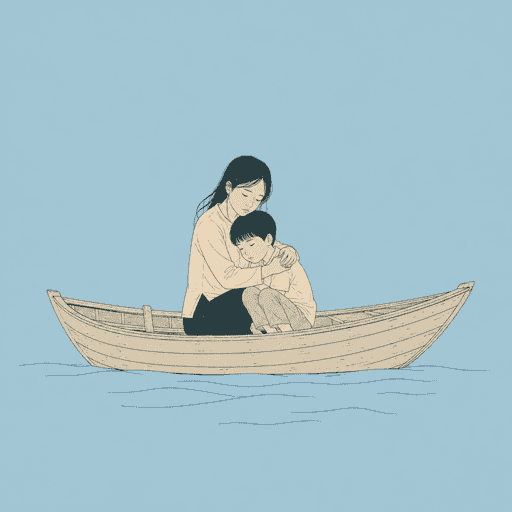
The Boat
A modern alternative to SparkNotes and CliffsNotes, SuperSummary offers high-quality Study Guides with detailed chapter summaries and analysis of major themes, characters, and more.
Summaries & Analyses
Quizzes
NEWReading Tools
Background
Content Warning: This section of the guide includes discussion of graphic violence, death, and child death.
Authorial Context: Nam Le and the Iowa Writers’ Workshop
Nam Le’s biography provides a lens through which to read The Boat, particularly its opening story, “Love and Honor and Pity and Pride and Compassion and Sacrifice.” Born in Vietnam in 1978, Le and his family fled the country as refugees when he was an infant, eventually settling in Australia. After graduating from the University of Melbourne with a law degree and working briefly as a corporate lawyer, Le changed careers to pursue writing. In 2004, he enrolled in the prestigious Iowa Writers’ Workshop, a highly selective creative writing program in the United States known for producing many celebrated contemporary authors (Williams, Michael. “When the Boat Comes In.” The Age, 31 May 2008).
These biographical details closely parallel those of the fictional narrator in the collection’s opening story, a young Vietnamese Australian writer named Nam attending the Iowa workshop. Like Le, the narrator struggles with the pressure to write an “ethnic story,” suggesting that his background is his greatest marketable asset. By blurring the line between autobiography and fiction, Le invites readers to question how much an author’s identity should determine the stories they are expected to tell.
This context also helps explain the broader structure of the collection. While the opening story directly engages with questions of identity and representation, the six stories that follow deliberately move beyond the author’s own biography, spanning countries as diverse as Colombia, Iran, Japan, and Australia. In doing so, Le rejects the notion that writers should be confined to their own experiences, instead presenting empathy and imagination as equally essential foundations of fiction. Understanding this authorial context illuminates the collection’s recurring concerns with memory, authenticity, and the responsibilities of storytelling itself.
Historical Context: The Vietnam War and the “Boat People” Crisis
The Vietnam War and its aftermath provide essential historical context for several stories in The Boat, particularly “Love and Honor and Pity and Pride and Compassion and Sacrifice” as well as the title story. Following the Fall of Saigon on April 30, 1975, Vietnam was reunified under Communist rule. In the years that followed, hundreds of thousands of former South Vietnamese soldiers, government officials, and perceived political opponents were imprisoned in so-called “reeducation camps,” where many endured years of forced labor, political indoctrination, disease, and harsh living conditions despite promises of brief detention. In the title story, Mai’s father returns from one of these camps permanently blind, illustrating the lasting physical and psychological consequences of the war even after fighting had ended.
The political and economic instability that followed reunification also triggered one of the largest refugee crises of the 20th century. Although estimates vary, between the mid-1970s and the 1990s, over 800,000 people fled Vietnam, often in small, overcrowded vessels, with estimates between 200,000 and 400,000 dying at sea from dangers including storms, starvation, and piracy (“The Writing on the Wall.” National Archives Foundation). The United Nations High Commissioner for Refugees (UNHCR) estimates that between 200,000 and 250,000 people died at sea. “The Boat” offers a visceral, moment-to-moment depiction of this perilous journey, immersing the reader in the fear, desperation, and fragile hope of those who undertook it.
The collection also draws upon an earlier chapter of the war through the Mỹ Lai Massacre of March 16, 1968. On that day, US Army soldiers murdered hundreds of unarmed South Vietnamese civilians, including women, children, and the elderly, in the hamlet of Mỹ Lai. Estimates of the dead often number over 500 (“Mỹ Lai Massacre.” History.com, 28 May 2025). This atrocity informs the backstory of the narrator’s father in “Love and Honor and Pity and Pride and Compassion and Sacrifice,” who is a survivor of the massacre. His horrific memories of witnessing the slaughter shape his identity and his fractured relationship with his son. Together, these historical events ground The Boat in the realities of war, displacement, and intergenerational trauma, portraying how history continues to shape individual lives long after the events themselves.
Historical Context: The 1999 Iranian Student Protests and Ashura
The story “Tehran Calling” is set against two significant forces in modern Iranian society: the aftermath of the July 1999 student protests and the annual religious observance of Ashura. The protests began on July 8, 1999, after the government shut down a reformist newspaper, Salam. Peaceful demonstrations at Tehran University quickly spread beyond the campus before police and plainclothes vigilante groups, such as the Ansar-e Hezbollah, violently suppressed them. The crackdown, which involved attacking student dormitories, led to several deaths, widespread arrests, and a lasting atmosphere of political fear, while also becoming one of the most significant public challenges to Iran’s government since the 1979 Islamic Revolution. This climate of surveillance and repression forms the backdrop for the activists’ constant anxiety throughout “Tehran Calling.”
At the same time, the story unfolds during Ashura, a holy period for Shia Muslims. Ashura commemorates the martyrdom of Imam Hussein, the grandson of the Prophet Muhammad, at the Battle of Karbala in 680 CE after refusing to submit to what he viewed as an unjust ruler. Annual commemorations include public mourning processions, passion plays, and rituals that emphasize sacrifice and resistance to tyranny. Because Ashura carries such religious and cultural significance, it provides both an opportunity and a risk for political activists seeking to gather large crowds without immediately drawing suspicion.
Le intertwines these historical and religious contexts throughout “Tehran Calling.” Parvin and Mahmoud’s political group plans to use the cover of the religious processions to stage a play for their own pro-democracy rally, hoping to connect their movement with the holiday’s enduring themes of sacrifice and resistance. Their strategy also places them in direct conflict with both state authorities and hardline religious groups, illustrating how political dissent, religious tradition, and personal conviction intersect in contemporary Iran. This historical context leads to an atmosphere of anxiety and uncertainty, while revealing the complex historical forces shaping its characters’ decisions.

Get in-depth, chapter-by-chapter summaries and analysis from our literary experts.
- Grasp challenging concepts with clear, comprehensive explanations
- Revisit key plot points and ideas without rereading the book
- Share impressive insights in classes and book clubs