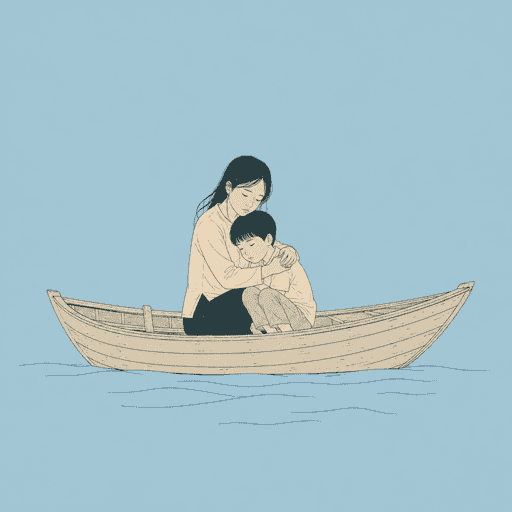
The Boat
A modern alternative to SparkNotes and CliffsNotes, SuperSummary offers high-quality Study Guides with detailed chapter summaries and analysis of major themes, characters, and more.
Summaries & Analyses
Quizzes
NEWReading Tools
Important Quotes
Content Warning: This section of the guide includes discussion of graphic violence, illness, death, child death, death by suicide, animal death, and sexual content.
“Like a shape in smoke, the poem blurred, then dissolved into this new, cold, strange reality: A wind-blown, rain-strafed parking lot; a dark room almost entirely taken up by my bed; the small body of my father dripping water onto hardwood floors.”
(Story 1, Page 4)
The opening simile, “[l]ike a shape in smoke,” captures the fleeting nature of the narrator’s artistic inspiration as it dissolves beneath the demands of reality. The abrupt shift from poetic imagination to concrete physical description establishes the story’s central conflict between the insulated world of art and the intrusive, demanding presence of family history. The father’s small, dripping form introduces The Burden of Familial Legacy, suggesting that the narrator’s inherited history will prove far more difficult to ignore than the poem he was trying to write.
“‘There’s a lot of polished writing around,’ one of them said. ‘You have to ask yourself, what makes me stand out?’ She tag-teamed to her colleague, who answered slowly as though intoning a mantra, ‘Your background and life experience.’”
(Story 1, Page 9)
This quote from literary agents satirizes the publishing industry’s cynical perspective. They reduce a writer’s worth to their marketable identity, encouraging the narrator to commodify his heritage rather than develop his craft. Their rehearsed, almost ritualistic dialogue highlights the external pressure to produce “ethnic literature,” making personal history a product to be packaged and sold. This exchange emphasizes storytelling and art as a motif in the collection that struggles to capture true trauma and experience.
“‘Only you’ll remember. I’ll remember. They will read and clap their hands and forget.’ For once, he was not smiling. ‘Sometimes it’s better to forget, no?’”
(Story 1, Page 24)
The father’s words challenge the narrator’s artistic ambition, suggesting that the public consumption of trauma is fleeting and superficial. He questions the value of memory and storytelling, proposing that forgetting can be a mercy. This perspective emphasizes the unbridgeable gap between experiencing trauma and merely writing about it for an audience.
“In Cartagena, Luis says, the beach is gray at dawn. He points to the barrel of his G3 when he says this, steel gray, he says. He smiles. The sand is white, he says, this color, tapping his teeth.”
(Story 2, Page 29)
The juxtaposition of Cartagena’s idyllic landscape with the rifle and Luis’s teeth immediately fuses beauty and violence into a single image. Although Cartagena represents hope and escape across the ocean, Luis can only describe it through the objects that dominate his life as a sicario. This imagery reinforces the theme of The Illusion of Escape, as even his dreams remain shaped by the violence that he longs to leave behind.
“Handheld grenades, he says, picking them up, weighing them in his palm like they are pieces of fruit.”
(Story 2, Page 31)
The simile comparing deadly grenades to fruit illustrates how the boys have normalized violence in their lives. Objects designed solely for death and destruction are handled with the same casual familiarity as everyday food, highlighting the extent of their desensitization. This moment reinforces the theme of The Sacrifice of Innocence for Survival by showing how their childhood has been replaced by habits of violence.
“Killing has never been the business of the gallada, unless things have changed with that too, in the four months I have been away. Maybe they are seeking to impress me, now that I have my office job. Or maybe that is why they asked me to come with them.”
(Story 2, Page 33)
Ron’s internal monologue reveals his growing alienation from the friends he once considered equals. The irony of referring to contract killing as his “office job” exposes how thoroughly violence has become normalized in his life. At the same time, his speculation that the boys now seek his approval suggests that his own change has helped reshape the gang’s moral boundaries, foreshadowing El Padre’s dissatisfaction with his work.
“I am a sicario, a hit man, an assassin. I have been a sicario for four months, although my agent, El Padre, says that in truth I am a soldado, fighting for a cause. It is no cause, however, but my own hands that have brought death to fourteen people for certain, and perhaps another two.”
(Story 2, Page 37)
This declarative statement establishes Ron’s clear-eyed understanding of his identity, contrasting it with the romanticized narrative his boss creates. The distinction between sicario (hired killer) and soldado (soldier) highlights the moral conflict at the story’s core. Ron rejects the pretense of fighting for a cause, acknowledging the stark, personal reality of his violent work and its quantifiable human cost.
“I almost demolished this apartment so we could both get our perve on. It took a binder full of expert appraisals and zoning permits before I was allowed to knock out the wall, put in a steel frame and glass-brick the whole thing back up.”
(Story 3, Page 68)
Henry’s recollection reveals the intensity of his relationship with Olivia through vivid architectural imagery. The glass-brick wall emphasizes both intimacy and separation, reflecting the private world he constructed with his lover while simultaneously isolating himself from his family. The description of the renovation underscores how completely he reshaped his life around the affair, making his eventual estrangement from Elise feel like the lasting consequence of choices he willingly made.
“Hingess is one of the most expensive gastro men in town and this is why I pay him: for his straight-shooting, no-holds-barred, expert opinion: ‘You will very likely develop colorectal cancer,’ he says, ‘if you haven’t done so already.’”
(Story 3, Page 74)
The doctor’s blunt diagnosis interrupts Henry’s often sardonic narration with an undeniable physical reality. The stark, clinical language strips away his attempts at humor and self-deception, forcing him to confront his mortality. Henry’s deteriorating health also mirrors the emotional decay that has defined his life, embodying the festering guilt and regret from abandoning his family.
“I don’t want to see you. Please meet Jason backstage after the concert (show this note) to discuss a payment plan for the Guadagnini.”
(Story 3, Page 88)
Elise’s note is the story’s emotional climax, finalizing the 17-year estrangement. By reducing their connection to a “payment plan,” she rejects him as a father and reduces his grand gesture—the expensive cello—to a mere financial debt. The note’s cold, transactional language starkly communicates the complete failure of reconciliation and Henry’s isolation.
“You couldn’t buy that feeling. Still, his dad. Seated in the front row with the other guests of honor—unimpressed as ever. His smile as stiff as his suit.”
(Story 4, Page 94)
This quote establishes Jamie’s core conflict. The juxtaposition of the school’s roaring approval with his father’s stoic demeanor reveals that external validation cannot resolve his internal need for paternal acceptance. The simile comparing his dad’s smile to a “stiff” suit highlights the emotional distance and rigid expectations that define their relationship.
“‘What’s the saddest place you know,’ she said, ‘this is mine.’”
(Story 4, Page 112)
Alison speaks this line at the ruined courthouse, a place of historical failure and personal meaning for Jamie. Her question introduces an unexpected melancholy to her character, subverting her popular-girl persona and hinting at a deeper dissatisfaction. This moment of vulnerability foreshadows the emotional complexities and eventual disappointments of their relationship.
“She bent over and picked up the gull with both hands and laid it on a flat rock. Then she sucked her lips into her mouth, lifted one of her Blundstones, and stomped down on the gull’s head, once, hard.”
(Story 4, Page 137)
This flashback is a key memory shaping Jamie’s sense of inadequacy. His mother’s brutal, decisive action to end the bird’s suffering stands in stark contrast to his own hesitation and his father’s insistence on a rigid test of masculinity. Her act defines a traumatic benchmark of failure for Jamie. At the same time, however, rather than celebrating violence, the scene explores the difficult distinction between cruelty and mercy, challenging society’s (and Jamie’s) assumptions about what genuine strength requires.
“‘It means he doesn’t go in hard. For the fifty-fifties.’ A fresh agitation in his dad’s voice, laying open the folds of his feeling. ‘I’m not saying he’s gutless—but he freezes.’”
(Story 4, Page 148)
Overhearing his father’s assessment, Jamie confronts the core of his self-doubt. The nickname “Loose Ball Jamie” transcends football, becoming a damning verdict on his courage. This painful confirmation of his father’s disappointment strips away any remaining pretense and directly fuels his desperate decision to finally confront Dory.
“Here was Dory, who, despite everything—his emptiness—seemed uninterested, or incapable, of holding Jamie’s hate. Michael, who still could. Alison. Watching from within her immaculate uniform. Only Lester’s face brimmed with epiphany—a line had been crossed—and nothing had changed.”
(Story 4, Page 161)
In the aftermath of the fight, Jamie has a moment of clarity, realizing the confrontation provided no catharsis. This passage deconstructs the town’s masculine archetypes, exposing Dory’s violence as empty and the social ritual as futile. The final observation that “nothing had changed” rejects the traditional coming-of-age narrative, emphasizing the story’s bleak resolution about the inescapable cycles of behavior.
“I lie dead on the ground, looking into the deep blue sky, overwhelmed with a glorious feeling of happiness.”
(Story 5, Page 167)
The juxtaposition of death and “glorious” happiness reveals the extent to which wartime propaganda has shaped the narrator’s imagination. During an innocent childhood game, she embraces the ideal of heroic sacrifice without understanding its true cost, illustrating the theme of the sacrifice of innocence for survival. The dramatic irony, where the reader knows something that the characters do not, lies in the reader’s awareness that the story’s imagined deaths will soon be replaced by unimaginable real-world destruction.
“Then everything turns white and the left side of my face is warm. Don’t blink, says the man with the rabbit teeth. Don’t worry, says Father. He laughs at me. Don’t blink. Look here.”
(Story 5, Page 177)
The story’s climax merges past and present as the memory of a camera’s flash is fused with the detonation of the atomic bomb. The repeated imperative “Don’t blink. Look here,” uses the familiar language of photography to combine both events, while the vivid sensory imagery dissolves the boundary between memory and immediate experience. This convergence gives the story its devastating conclusion, emphasizing Mayako’s innocent understanding of the events.
“She looked mysterious, glowing—there was a different sun here, somehow; more impersonal. Incandescent. Well, this was what she wanted, wasn’t it? She was in the desert now.”
(Story 6, Page 183)
In the hotel room, Sarah’s reflection reveals her growing sense of estrangement from both her surroundings and herself. The “impersonal” sun and unfamiliar desert landscape create imagery of emotional distance, suggesting that she has entered a place where her usual identity no longer feels secure. This moment reinforces the theme of the illusion of escape, as Sarah initially imagines that a radically different environment might allow her to leave behind the pain of her former life.
“Sarah let go of her breath. This was why she’d come—to see exactly this—the city as it was—the proof of this place unthinkably outside herself.”
(Story 6, Page 188)
Witnessing the Ashura procession, Sarah’s initial reaction reveals a tourist’s desire for an authentic, consumable experience. Her wish for an external “proof” emphasizes her feeling of internal hollowness and her hope that the intensity of Tehran can fill her personal void. This perspective establishes an important contrast with her later experiences, as she gradually changes from a detached observer ignorant of the violence to someone personally affected by the realities of political oppression.
“She was capable of velocity but not depth—there wasn’t enough to her. It was Paul, when she met him—as gradually she got to know him—who seemed to suggest the possibility of a deeper, truer life. He could anchor her.”
(Story 6, Page 195)
This reflection on her past relationship reveals Sarah’s core insecurity and the true motivation for her trip to Tehran. Her self-perception as a person lacking “depth” contextualizes her escape as a flight from personal failure. Her belief that Paul could “anchor” her further emphasizes her search for stability outside herself, reinforcing the theme of the illusion of escape by revealing that her dissatisfaction existed long before she left the United States.
“‘I told them,’ he said, ‘I told them I was the son of my father.’”
(Story 6, Page 224)
Mahmoud’s encapsulates one of the story’s central ironies. By invoking his powerful cleric father’s name, he sacrifices his revolutionary ideals for their immediate survival. This act highlights the painful paradox of his position, where the power he rejects is also his only protection, illustrating the theme of the burden of familial legacy.
“Hugging a beam at the top of the hatch, Mai looked out and her breath stopped: The boat had heeled so steeply that all she saw was an enormous wall of black-green water bearing down; she shut her eyes, opened them again—now the gunwale had crested the water—the ocean completely vanished—and it was as though they were soaring through the air, the sky around them dark and inky and shifting.”
(Story 7, Page 230)
This passage uses vivid, disorienting imagery to portray the ocean as a monstrous, reality-bending force. The personification of the water as a “wall […] bearing down” and the surreal sensation of “soaring through the air” emphasize the refugees’ complete loss of control, presenting nature as an indifferent and overwhelming power.
“And now she realized where they were—where they must be. Everyone had heard about these places. They had ventured into the fields of the dead, those plots of ocean where thousands had capsized with their scows and drowned.”
(Story 7, Page 233)
This quote transforms the ocean from a physical space into a psychological and historical one—a literal graveyard. The realization that they are in the “fields of the dead” suggests their journey is haunted by the collective trauma of those who failed before them. This moment reinforces the theme of the illusion of escape by showing that the pursuit of freedom is perilous, haunted by the lives and losses of those who came before.
“‘Why send Child away? Child obeyed Ba.’ Her mind sparked off the words in terrific directions. ‘Child could have waited for Ba to get better.’ They had promised each other. He had left for ten days and returned, strange and newly blind, after two years. A thought connected with another: ‘It was Ba who left Child.’”
(Story 7, Page 253)
Mai’s fragmented internal monologue reveals the emotional turmoil that has remained buried beneath the determination to survive. The repetition of “child” and the disjointed progression of her thoughts reflect her dehydration and exhaustion while exposing feelings of abandonment she has never fully acknowledged. By reversing her father’s explanation—“It was Ba who left Child”—Mai views her family’s sacrifice as personal betrayal, illustrating the burden of familial legacy and the lasting emotional wounds created by separation.
“They stood together in silence, the spray moistening their faces as they looked forward, focusing all their sight and thought on that blurry peninsula ahead, that impossible place, so that they would not be forced to behold the men at the back of the boat peeling the blanket off, swinging the small body once, twice, three times before letting go, tossing him as far behind the boat as possible so he would be out of sight when the sharks attacked.”
(Story 7, Page 272)
The destructive image which juxtaposes the promise of land with the burial at sea of Truong’s body captures the emotional complexity of the refugee’s arrival. By deliberately focusing on the distant peninsula rather than the child’s body, Mai and Quyen reveal the psychological necessity of looking toward the future in order to endure the present. This devastating final image reinforces the theme of the sacrifice of innocence for survival, underscoring the loss required to achieve the promise of safety.

Unlock every key quote and its meaning
Get 25 quotes with page numbers and clear analysis to help you reference, write, and discuss with confidence.
- Cite quotes accurately with exact page numbers
- Understand what each quote really means
- Strengthen your analysis in essays or discussions