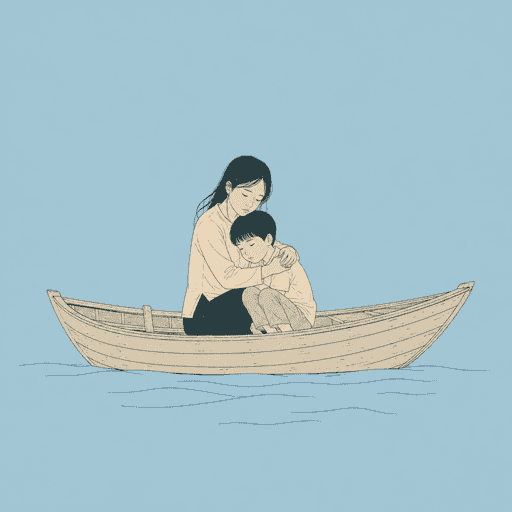
The Boat

Nam Le

The Boat

Nam Le
59 pages1-hour read
Fiction
Short Story Collection
Adult
Published in 2008

A modern alternative to SparkNotes and CliffsNotes, SuperSummary offers high-quality Study Guides with detailed chapter summaries and analysis of major themes, characters, and more.

Story 1Chapter Summaries & Analyses

Content Warning: This section of the guide includes discussion of graphic violence and death.

Story 1 Summary: “Love and Honor and Pity and Pride and Compassion and Sacrifice”

Nam, a student at the Iowa Writers’ Workshop, is surprised by the unannounced early arrival of his father, whom he has not seen in three years. The visit comes at a difficult time: Nam is struggling with writer’s block, facing an imminent deadline, and feeling pressured by his instructors and peers to write an “ethnic story.” As his father settles into the apartment, Nam hurriedly hides evidence of his personal life, including a bottle of Scotch and a photo of his girlfriend, Linda. Their relationship remains strained, shaped by memories of his father’s strict, often harsh discipline and emotional distance. He remembers overhearing his father recount the trauma of surviving the Mỹ Lai massacre, during which his mother shielded him with her body.


That night, Nam begins writing a story based on his father’s experiences. The next day, Linda reads part of the manuscript at a coffee shop and accuses him of romanticizing his father’s past to excuse the pain he caused their family, a characterization Nam rejects. Later, he interviews his father over drinks. He recounts surviving the massacre at Mỹ Lai, serving in the South Vietnamese army, enduring imprisonment and torture in a reeducation camp after the war, and eventually organizing his family’s escape from Vietnam.


Inspired, Nam writes through the night, only to discover the next morning that his father has taken the manuscript. Nam searches for his father and finds him by the Iowa River, where he has just burned the pages in a fire drum belonging to an unhoused man. The narration then shifts into retrospective reflection as Nam admits that, in his anger, he said things he would later regret, including that his father’s actions were unforgivable and that he was “no father to me” (28). The story ends with Nam watching the river as its surface begins to freeze, contemplating both his outburst and the fragile distance between memory, storytelling, and reconciliation.

Story 1 Analysis

A friend’s glib suggestion, “Just write a story about Vietnam” (8), establishes the central tension of the narrative, introducing the motif of storytelling and art as a fraught, ethically complex practice. From its opening pages, the story operates on a meta-fictional level, scrutinizing its own existence as a piece of “ethnic literature.” Nam, a writer at the Iowa Writers’ Workshop, finds himself pressured by instructors and literary agents who view his background as a marketable commodity. His initial resistance to this pressure is evident in his eclectic, non-autobiographical work about “lesbian vampires and Colombian assassins, and Hiroshima orphans” (10), subjects chosen precisely because they refuse to fit the market’s assumptions about him. Because this conflict closely parallels Nam Le’s own biography, the story also serves as a critique of a publishing culture that encourages writers of color to package heritage and trauma for consumption. Nam’s writer’s block stems less from an inability to produce fiction than from uncertainty over what kind of writer he wants to become. He questions whether authenticity requires drawing on his own history or whether allowing others to define that history is already a compromise. Even the long, Faulknerian title itself—“Love and Honor and Pity and Pride and Compassion and Sacrifice”—serves as an ironic commentary, invoking the grand “old verities” of Western literature while underscoring the pressure that Nam feels to translate his own experiences into those familiar terms.


The unannounced arrival of Nam’s father immediately foregrounds a relationship shaped by distance and concealment. Upon waking to find his father in the doorway, Nam’s first impulse is to hide the artifacts of his life: the Johnnie Walker, the photo of his girlfriend Linda, the messy apartment. Rather than greeting his father openly, he hurriedly constructs a version of himself he believes will meet his father’s expectations. This impulse reflects years of strict discipline and emotional restraint. Even the simple observation that it feels strange to be “speaking Vietnamese again” after a three-year separation emphasizes the linguistic and emotional gulf that separates them (3). Their interactions are stilted, mediated by his father’s habit of “speaking in Vietnamese proverbs” (4), a form of communication that simultaneously imparts wisdom and maintains emotional distance. This dynamic exemplifies The Burden of Familial Legacy, in which the father’s unspoken traumas and rigid expectations have created a fractured relationship with his son. Nam has attempted to build a separate life in a new country, but his father’s physical presence forces a confrontation with this legacy, making it impossible to maintain the separation between his present self and his inherited past.


The story also gives significance to the act of writing, particularly through the image of the Smith Corona typewriter. Nam’s initial dream centers on “the dull thluck thluck of a typewriter’s keys punching out the letters” (3), emphasizing creation rather than inspiration. He later buys an old Smith Corona, believing that the inability to delete will free him from his writer’s block. This machine, which “buzzed like a tropical aquarium” (8), becomes an emblem of his desire for a more authentic, un-erasable mode of expression. Choosing a device that preserves every mistake reflects his desire for a more permanent and honest form of expression, especially after abandoning the morally flexible world of corporate law. Yet that ideal immediately collides with reality when he uses it to type the cynical heading “ETHNIC STORY.” In that moment, the same typewriter that promised artistic freedom records an act of conscious self-compromise. The contradiction lies at the heart of Nam’s dilemma. He resents being pushed toward an “ethnic” narrative, yet he willingly depicts his father’s experiences in exactly those terms, revealing how easily artistic ideals become entangled with ambition.


As Nam begins writing his father’s story, questions of ownership become just as important as questions of authenticity. He openly admits that “[i]f I write a true story […] I’ll have a better chance of selling it” (24), confirming that he views his family’s trauma as a potential career move. This decision places him in an ethically ambiguous position as he shapes another person’s trauma into a narrative that serves his own artistic and professional goals. Linda recognizes this conflict immediately, accusing Nam of “romanticizing his past,” in order to “make sense of the things you said he did to you” (18), challenging not only the manuscript but also the emotional purpose behind it. Writing becomes an attempt to reinterpret both his father and himself, blurring the line between understanding, justification, and exploitation. The story therefore asks whether painful family histories can ever truly belong to a single person, or whether turning them into art inevitably alters—and in some ways appropriates—the experiences of everyone involved.


The father’s climactic act of burning the manuscript in a fire drum is a radical assertion of agency over his own life and memory. By destroying his son’s work, he rejects the notion that his suffering can be captured, understood, or redeemed through art. His quiet warning that readers will simply “read and clap their hands and forget” is a powerful critique of the superficial empathy elicited by such stories and is a direct rebuke to Nam’s commercial justifications (24). The fire is a refusal to allow his past to be appropriated, sanitized, and consumed as a spectacle of suffering. This gesture introduces the theme of The Illusion of Escape, suggesting that certain traumas, like surviving the Mỹ Lai Massacre, cannot be processed or transcended through storytelling. They remain a permanent part of a person’s being, and the father chooses to protect the sanctity of that experience rather than see it diluted into a narrative. The final image of the river “on the brink of freezing,” its surface holding a “perfect and crystalline world” that “could be shattered by a small stone” (28), encapsulates this unresolved state—a fragile peace built over an abyss of memory, mirroring the delicate and ultimately broken connection between father and son.

blurred text
blurred text
blurred text

Get in-depth, chapter-by-chapter summaries and analysis from our literary experts.

  • Grasp challenging concepts with clear, comprehensive explanations
  • Revisit key plot points and ideas without rereading the book
  • Share impressive insights in classes and book clubs