The Boat
A modern alternative to SparkNotes and CliffsNotes, SuperSummary offers high-quality Study Guides with detailed chapter summaries and analysis of major themes, characters, and more.
Summaries & Analyses
Quizzes
NEWReading Tools
Symbols & Motifs
Content Warning: This section of the guide includes discussion of illness, death, and child death.
The Ocean
The ocean is a powerful symbol in The Boat, representing the uncertain boundary between hope and destruction. It symbolizes both the possibility of freedom and the immense personal cost of escape required to pursue it, reinforcing the theme of The Illusion of Escape. Throughout the collection, crossing water offers characters the promise of a new beginning while simultaneously confronting them with the dangers, memories, and losses that accompany displacement. It highlights the precarious space between past and future, where survival and death exist side by side.
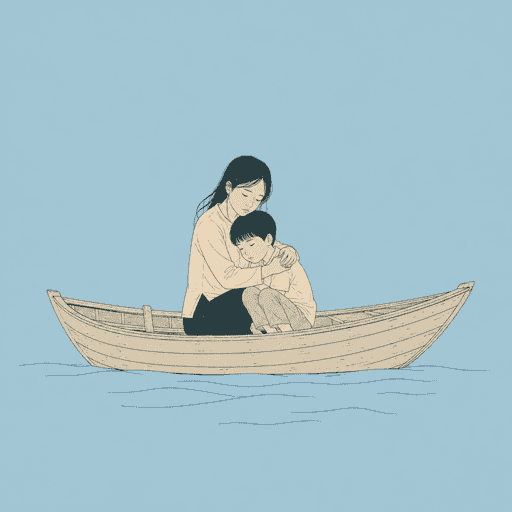
In the title story, the sea is an active antagonist, serving as the refugees’ greatest threat on their only path to safety. During a storm, Mai sees “an enormous wall of black-green water bearing down” (230), a force of nature capable of bringing death without warning. Later, as the boat drifts into the “fields of the dead” (233), the whispered voices of those who drowned before them suggest that the water preserves the memories of countless failed journeys. However, this same ocean is their only route to a new life. The ocean highlights the physical danger of their journey as well as the collective trauma carried by generations of refugees.
The symbol appears differently in other stories while still emphasizing the idea of freedom and opportunity. In “Cartagena,” the Caribbean is an idealized dream of peace for the young assassins trapped in Medellín. Luis describes the dawn there as a “slow-motion explosion like in the movies” (29), presenting the coast as an almost mythical landscape untouched by the brutality of the boys’ daily lives. For Luis and Ron, however, the Cartagena remains forever out of reach, emphasizing the possibility of freedom as well as their inability to attain it. In “Hiroshima,” the sea is associated with home and continuity rather than escape. Mayako’s father is a fisherman, and the family’s life is closely tied to the coastal city that the children long to return to throughout the story. Although the ocean itself offers no protection from the devastation that follows, its presence reinforces what Mayako has lost as the landscape of home becomes a world destroyed by war. Across the collection, the sea symbolizes the transition, uncertainty, and the fragile hope that life can begin again, even as the past and present continue to shape those who cross it.
Storytelling and Art
The motif of storytelling and art explores the complicated relationship between creativity, memory, and personal identity throughout the collection. Writing, painting, music, and other forms of artistic expression repeatedly emerge as characters attempt to understand, preserve, or reshape their experiences. Ironically, however, these creative acts often expose the limitations of art, raising questions about whether suffering can ever be truthfully represented or transformed into something meaningful. The motif reinforces the theme of The Burden of Familial Legacy, as artistic expression frequently becomes a means of confronting inherited stories fraught with trauma that resist simple retelling.
In “Love and Honor…,” the narrator struggles with the pressure to write an “ethnic story,” feeling that his father’s traumatic past is being commodified for a literary market. His conflict culminates in his father burning his manuscript, an act that rejects the use of personal suffering as a consumable narrative. This act serves as a rejection of the idea that lived trauma can be easily translated into literature without losing something essential. In “Meeting Elise,” Henry’s inability to paint following Olivia’s death mirrors his frozen emotional state, while his eventual return to sketching reflects a tentative willingness to confront memories he has long avoided. In both stories, artistic creation becomes inseparable from the characters’ attempts to understand themselves and those closest to them.
The motif also appears in “The Boat” through Truong’s haunting performances of traditional folk songs. Although too young to have experienced the events described in the music, he preserves the emotional memory of earlier generations, allowing cultural grief to survive through oral tradition rather than written history. Across the collection, storytelling and art repeatedly preserve memory, challenge silence, and connect generations, while also exposing the ethical and emotional limits of representing experiences that may ultimately defy interpretation.
Photographs
The recurring motif of photographs explores the fractured nature of memory, identity, and loss. Throughout the collection, photographs preserve moments as tangible but ultimately inadequate links to a past that characters cannot fully reclaim. As a result, the motif frequently reinforces the theme of the burden of familial legacy, preserving connections between generations while also highlighting everything that has been lost or left unsaid.
In “Hiroshima,” Mayako possesses a family photograph taken to be sent to her soldier brother, a man she cannot remember. The photo is a precious artifact of a family unit that no longer exists, its forced composition for the camera failing to capture the impending fragmentation of war. By the story’s conclusion, the photograph becomes one of the few surviving links to a world that is about to disappear, preserving an image of home and history that can no longer survive. Similarly, in “Tehran Calling,” a five-year-old Polaroid allows Sarah to identify Mahmoud as Parvin’s trusted friend. In this way, it serves as tangible proof of a relationship formed years earlier, validating their friendship and comforting Sarah. Although it establishes trust, it is powerless to bridge the vast ideological and emotional distance that has grown between the two women during their years apart. In “Love and Honor…,” the narrator hides a “glamour shot” of his American girlfriend from his Vietnamese father. The photograph reflects the narrator’s deliberate control of his identity, revealing how much his life has changed and how large the divide has grown with his father. In this way, the narrator curates his identity to navigate these complex familial expectations. Across the stories, photographs repeatedly preserve moments, relationships, and identities while simultaneously reminding characters that the past cannot be fully recovered. They capture what once existed, but they cannot restore what time, distance, or history has changed.
Weapons
Weapons are a recurring symbol of violence’s power to reshape identity, symbolizing the moral and psychological consequences of living in societies defined by conflict. Guns, grenades, and rifles emphasize the ways violence becomes embedded within everyday life, forcing ordinary people—particularly children—to confront choices that innocence was never meant to endure. Their repeated presence reinforces the theme of The Sacrifice of Innocence for Survival, highlighting how conflict changes victims into reluctant participants.
In “Cartagena,” firearms define Ron’s life as a teenage sicario. The new Glock pistols and AR-15 he receives from El Padre are emblems of his professional ascent and skill. However, they also signify his gradual surrender to a violent system that offers him survival only through continued participation in killing. The casual presence of these weapons, such as when young Pedro insists on carrying grenades “just in case” (32), highlights the chilling normalization of extreme violence in their community. The guns represent a loss of humanity, turning a child into a sicario and forcing him to betray his closest friend.
The symbol also appears in “Love and Honor…,” where the father’s memories of American soldiers carrying M16 rifles during the Mỹ Lai massacre become the defining trauma of his life. Years later, the narrator’s observation of neighborhood children playing with their “faux-wood air rifle” creates an unsettling parallel between their play and historical violence (10), underscoring how easily weapons blur the boundary between innocence and brutality. Even in “Halflead Bay,” where physical violence is largely unarmed, the threat of aggression functions in much the same way, reminding Jamie that violence can shape identity even without firearms. Throughout The Boat, weapons repeatedly symbolize the destructive systems that perpetuate fear, trauma, and cycles of violence across generations.

Unlock the meaning behind every key symbol & motif
See how recurring imagery, objects, and ideas shape the narrative.
- Explore how the author builds meaning through symbolism
- Understand what symbols & motifs represent in the text
- Connect recurring ideas to themes, characters, and events