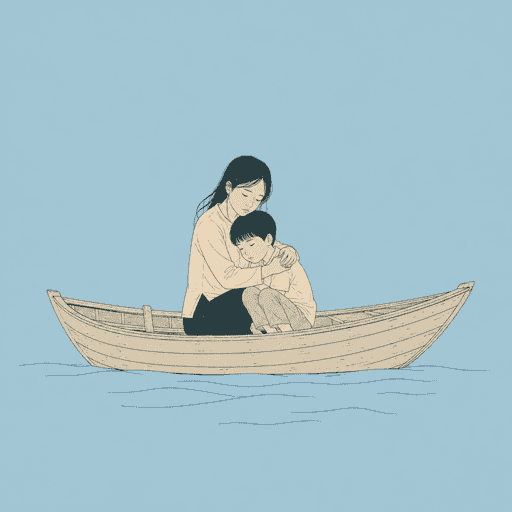
The Boat
A modern alternative to SparkNotes and CliffsNotes, SuperSummary offers high-quality Study Guides with detailed chapter summaries and analysis of major themes, characters, and more.
Summaries & Analyses
Quizzes
NEWReading Tools
Story 7Chapter Summaries & Analyses
Content Warning: This section of the guide includes discussion of illness, death, and child death.
Story 7 Summary: “The Boat”
A violent storm batters a refugee boat, throwing Mai among the other passengers trapped in the dark. After the storm passes, she finds her new acquaintance, Quyen, on deck, where someone had strapped her to a spar, saving her life. As the boat drifts into a fog-filled stretch of ocean known as the “fields of the dead” (233), the refugees hear ghostly whispers they believe belong to those who drowned attempting the same crossing.
Flashbacks reveal the beginning of the voyage. Traveling alone, Mai befriends Quyen and her quiet six-year-old son, Truong, during the first days of the voyage. Before leaving Vietnam, Mai’s mother secretly arranged her escape after her father returned blind from years in a Communist reeducation camp. Mai grows particularly attached to Truong after she discovers that he is the one singing an old Vietnamese folk song she associates with her mother—not the apparently sleeping Quyen. Truong’s haunting voice awakens memories of her family and childhood.
After the storm, the boat’s engines fail, their remaining food spoils, and fresh water rapidly runs out. The respected leader, Anh Phuoc, carefully rations the remaining water as disease, thirst, and death spread among the passengers. Desperate, Mai drinks seawater and falls into a feverish delirium. She awakens two days later to discover that Truong had watched over her until the fever broke, but the boy himself has now become gravely ill.
As Truong’s condition worsens, Quyen has a breakdown and accuses Mai of trying to steal her son. However, she then reveals the truth: Truong is her child, whom she secretly left to be raised by her aunt in Da Lat after marrying another man. Her husband, who escaped earlier and is waiting in a Malaysian refugee camp, knows nothing about Truong’s existence. Unable to abandon him in Vietnam, Quyen abducted the boy before fleeing the country, hoping to reveal the truth only after they reached safety. Overcome with guilt, she fears her son’s suffering is punishment for her own choices.
Truong’s fever finally breaks, and he asks Mai to sing the folk song that has connected them throughout the voyage. The next morning, on the 13th day at sea, the passengers finally sight land. As hope spreads across the boat, Mai returns below deck to discover that he has died during the night. She helps the devastated Quyen carry his body to the stern, then leads her to the bow so that she cannot witness the burial. As the men swing the small body out over the water and release it into the sea, sharks immediately attack beneath the surface. Mai and Quyen remain facing the approaching shoreline, looking only toward the future while leaving their grief behind them.
Story 7 Analysis
The story opens with a violent storm that immediately establishes the ocean as both setting and antagonist. As the boat heels to the oncoming storm, the sea becomes a conscious and hostile entity. The chaos outside is mirrored within the hold, where human bodies are a single, writhing mass of “thighs and ribs and arms and heads” (230). This establishes the boat as a crucible where individuality is subsumed by collective suffering. The narrative uses this claustrophobic, visceral setting to introduce the symbol of the ocean as an embodiment of the refugees’ precarious state. This idea reinforces the theme of The Illusion of Escape, as the refugees’ physical escape from Vietnam leaves them vulnerable to new and violent dangers.
Amid this collective suffering, Mai’s specific connection to Truong provides the narrative’s emotional anchor. While other families largely keep to themselves, Mai is drawn to him, feeling “astonishingly, his heartbeat through his trunk—an electric flurry racing through the concavities of his back, stomach and chest” (235). This intimate, physical perception of his life force establishes a bond that feels more elemental than social. It stands in stark contrast to the dehumanizing crush of bodies in the hold. However, the same conditions that create this bond also threaten to destroy it. When Truong falls ill, his mother Quyen experiences a psychological breakdown, lashing out at Mai with the paranoid accusation, “He’s my son! Not yours—mine!” (266). Her subsequent confession—that Truong is her son whom she abducted to escape—reveals the immense personal secrets and sacrifices that lie beneath the surface of this collective crisis. The story demonstrates how survival may unite passengers through shared hardship, but it also forces buried fears, secrets, and guilt to the surface, testing even the relationships that provide comfort and support.
The motif of storytelling and art emerges as a vehicle for cultural memory and inherited grief, primarily through the character of Truong. Mai is stunned to discover that the source of an old folk song, a “soldier’s wife’s lament” (236), is not Quyen but her six-year-old son. The song directly links Mai to her own past, as her mother sang it while her father was away at war and, later, in a reeducation camp. Through his preternaturally sorrowful singing, Truong—described as “an old man crushed into the rude shape of a boy” (235)—becomes an unlikely vessel for an adult history of loss he could not have personally experienced. This characterization explores The Burden of Familial Legacy as a pervasive cultural atmosphere that imprints itself even on the young. Truong’s art becomes a channeling of collective trauma, giving voice to the unspoken grief that defines his community’s past and present. Mai’s deep attraction to him is rooted in this recognition of a shared, inherited pain that transcends their brief acquaintance.
The story’s destructive conclusion juxtaposes the promise of arrival with the finality of loss, offering a brutal commentary on the nature of survival. On the 13th day at sea, land is sighted, a moment that should signify deliverance. This hope, however, is immediately undercut by the discovery that Truong has died during the night. The story’s final action is a conscious choice: Mai leads the shattered Quyen to the prow, compelling her to focus “all their sight and thought on that blurry peninsula ahead” while, behind them, men dispose of Truong’s body (272). This physical act of turning away from the horror in order to face the future is a pragmatic necessity, emphasizing how suffering has been normalized and even arrival at their destination is not a true escape. Ultimately, the story suggests that survival carries its own enduring burden, requiring those who live to move forward while bearing memories that can never truly be left behind.

Get in-depth, chapter-by-chapter summaries and analysis from our literary experts.
- Grasp challenging concepts with clear, comprehensive explanations
- Revisit key plot points and ideas without rereading the book
- Share impressive insights in classes and book clubs