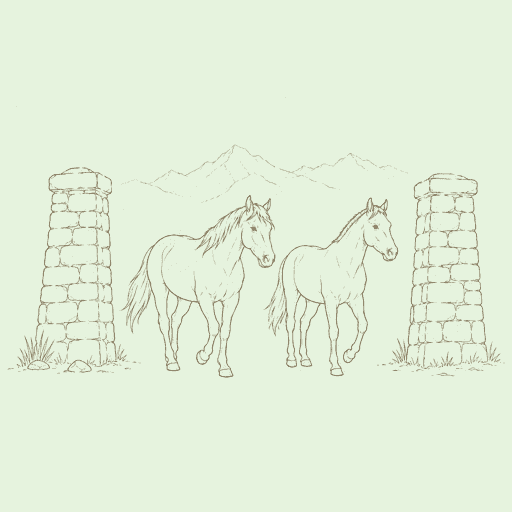
Tom's Crossing
Tom's Crossing
A modern alternative to SparkNotes and CliffsNotes, SuperSummary offers high-quality Study Guides with detailed chapter summaries and analysis of major themes, characters, and more.
Summaries & Analyses
Quizzes
NEWReading Tools
Background
Content Warning: This section of the guide includes discussion of graphic violence and racism.
Genre Context: Westerns and Modern Interpretations
The Western is one of the United States’s foundational narrative genres, originating in 19th-century dime novels and crystallized by Owen Wister's The Virginian (1902), widely regarded as the first Western novel. The genre achieved its cultural apex through Hollywood, where directors like John Ford codified its visual and thematic vocabulary in films such as Stagecoach (1939) and The Searchers (1956). Central tropes include the lone, morally resolute hero; the lawless frontier as a testing ground for individual character; confrontations between civilization and wilderness; and the horse as both practical instrument and symbol of freedom.
As historian Richard Slotkin argues, the cowboy became a vessel for narratives of American exceptionalism, regeneration through violence, and manifest destiny (Slotkin, Richard. Gunfighter Nation: The Myth of the Frontier in Twentieth-Century America. Macmillan, 1992). Television amplified this influence: Gunsmoke (1955–1975) ran for 20 seasons, embedding Western mythology deep in the national consciousness. Globally, Sergio Leone's "spaghetti Westerns," particularly The Good, the Bad and the Ugly (1966), reinterpreted frontier mythology for international audiences. Leone's films, themselves shaped by the cross-pollination between American Westerns and Japanese director Akira Kurosawa's samurai cinema, demonstrated the genre's remarkable cultural portability.
By the mid-20th century, revisionist film Westerns began interrogating these mythologies from within. Sam Peckinpah's The Wild Bunch (1969) laid bare the brutality that earlier entries had romanticized, while Clint Eastwood's Unforgiven (1992) dismantled the heroic gunslinger archetype by depicting its devastating human cost. In literature, Cormac McCarthy's Blood Meridian (1985) replaced frontier optimism with a nihilistic vision of the American West as a theater of meaningless carnage, and Charles Portis's True Grit (1968) filtered the Western quest through a sharp-tongued young female narrator who challenged the genre's masculine conventions.
In the 21st century, neo-Westerns have continued the genre's reinvention by updating its thematic concerns for contemporary audiences. Taylor Sheridan's movie Hell or High Water (2016) and the television series Yellowstone (2018–2024) center disputes over land, legacy, and corporate power in a modern American West still shaped by frontier dynamics. Authors such as Paulette Jiles and Patrick deWitt have broadened the genre's literary register, while Colson Whitehead's The Underground Railroad (2016) reclaimed frontier narratives from perspectives the genre historically excluded.
Mark Z. Danielewski's Tom's Crossing declares its generic allegiance through the subtitle "A Western," yet simultaneously reinvents the genre's conventions. Its 1982 Orvop, Utah, setting preserves the Western's preoccupation with land disputes, generational feuds, and horse culture, with the Porches and Gatestones locked in a rivalry reminiscent of the Earps and Clantons. Kalin March's quest to free Navidad and Mouse evokes the genre's mythic riders, yet the novel subverts the Western's foundational reliance on armed heroism. When Kalin's mother warns, "you but touch a gun and what you love most will forsake you for the rest of your life" (46), the narrative reframes the Western's defining instrument of power as a source of ruin rather than justice. The communal, digressive narration, filtered through dozens of named Orvop residents, further reimagines the Western as a collective, contested, and ongoing act of memory.
Literary Context: Mark Z. Danielewski’s Ergodic and Metafictional Style
Mark Z. Danielewski established himself as one of contemporary literature's most formally inventive writers with House of Leaves (2000), a labyrinthine novel about a family discovering an impossible, constantly shifting space within their home. The text unfolds through multiple unreliable narrators, footnotes that spiral into independent narratives, and typographic experiments in which the physical layout of the page mirrors the disorientation of its characters. Pages may contain only a few words, text may run in spirals or require rotation, and appendices house coded passages and collages. The novel exemplifies what scholar Espen Aarseth termed "ergodic literature": works demanding nontrivial effort from readers to traverse their structures (Aarseth, Espen. Cybertext: Perspectives on Ergodic Literature. JHU Press, 1997). House of Leaves became a cult phenomenon, inspiring online communities dedicated to decoding its puzzles and debating the reality of its nested stories.
Danielewski continued these explorations across subsequent works. Only Revolutions (2006) presents a dual love story spanning more than two centuries of American history, with each narrator's text beginning at opposite ends of the physical book and converging in the middle. The Fifty Year Sword (2005, revised 2012) is a gothic novella structured as a ghost story told through five voices distinguished typographically by differently colored quotation marks. His most ambitious undertaking, The Familiar (2015–2017), was conceived as a 27-volume serialized novel featuring multiple global narrators, each assigned a distinct typographic signature; only five volumes were published before the publisher discontinued the series, though those volumes pushed Danielewski's experiments with fonts, layouts, and embedded images to their most extreme expression. The Little Blue Kite (2019), a compact meditation on loss and resilience, marked a striking departure toward formal simplicity and emotional directness, suggesting a new phase in the author's career.
Across this body of work, consistent preoccupations emerge. Danielewski treats narrative as a constructed artifact, foregrounding acts of transcription, compilation, and interpretation. Metafictional framing devices, competing and often irreconcilable accounts of the same events, and elaborate paratextual elements are hallmarks of his practice. His narrators are frequently unreliable, and his texts actively resist singular, definitive readings. Tom's Crossing builds on several of these preoccupations while departing from others in revealing ways. Its copyright page describes the text as an "abridgment" that is "shattered, scattered, recollected, and rearranged" (ii). Authorship of the novel is attributed to the mysterious "E.L.M.," with Danielewski credited only as transcriber, echoing the layered authorship of House of Leaves. The communal narration channels dozens of named Orvop residents who contribute competing fragments of memory into the voice of a singular narrator later revealed to be a prominent character in the story. This narrative technique extends the polyphonic ambitions of The Familiar into a distinctly oral register. However, the novel represents a notable departure from Danielewski’s previous works in accessibility and tone. Where House of Leaves and The Familiar demanded active decoding through radical typographic play, Tom's Crossing employs a warm, vernacular storytelling voice and a relatively conventional page layout, channeling experimental instincts into narrative voice and communal structure rather than visual form.

Get in-depth, chapter-by-chapter summaries and analysis from our literary experts.
- Grasp challenging concepts with clear, comprehensive explanations
- Revisit key plot points and ideas without rereading the book
- Share impressive insights in classes and book clubs