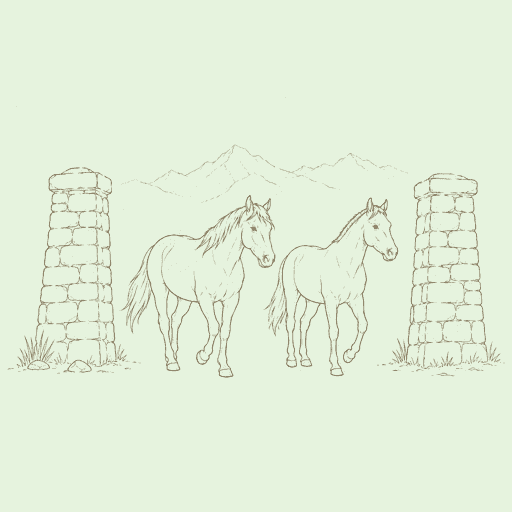
Tom's Crossing
Tom's Crossing
A modern alternative to SparkNotes and CliffsNotes, SuperSummary offers high-quality Study Guides with detailed chapter summaries and analysis of major themes, characters, and more.
Summaries & Analyses
Quizzes
NEWReading Tools
Part 3, Chapter 24-From the TranscriberChapter Summaries & Analyses
Content Warning: This section of the guide includes discussion of graphic violence, death, illness, and addiction.
Part 3: “The Gun”
Part 3, Chapter 24 Summary: “Pillars Meadow”
Just before noon, Kalin retrieves the Colt Peacemaker from its pouch, loads all six chambers, cleans the gun, and scouts the meadow. The Porch men have pulled back to the creek bed between him and the gateposts at Tom’s Crossing. He strips to boots and Stetson, makes a shallow forearm cut so it bleeds, and straps the loaded Colt along his left forearm with strips of Navidad’s reins. He ties the horses, then asks Tom to ride visibly to the Crossing. Tom, increasingly faded and bound to the horses, crosses the meadow with Ash and uses the branding iron to signal Kalin’s destination.
Down at the creek, Hatch, Egan, Kelly, Billings, and others have arrived on foot. Old Porch bribes his pilot, Kevin Moffet, to radio police once Kalin appears. When Moffet steps away, Egan reveals he shot and killed Landry. Old Porch, worried about forensics, quickly fabricates a counterstory: Hatch saw Kalin throw Landry’s body from a bluff. Hatch, outnumbered, gives minimal corroboration. Francis alone insists Kalin is coming.
Elsewhere, Sondra and Allison, still bleeding from the church lot attack, stop at Holt’s drug store. Clerk Lindsey Holt gives them supplies and offers the dollar he has owed Kalin since losing the impromptu horse-riding contest; Allison asks him to return it when Kalin comes back. She then takes Sondra to an ancient grove near Mud Lake, which she considers her own church. There, they discuss their differing notions of faith and grief; Allison asserts that it is better not to hope in anything, but to live in wonder of everything that happens in the present. Sondra finds this hard to accept, finding comfort in the promise of seeing her dead family again in the afterlife. Allison finds comfort in her lack of importance.
Kalin walks naked into the meadow, hands raised, the Colt concealed. As Moffet turns to radio the police, Old Porch shoots him, then declares Kalin did it and throws Kalin the 9mm; Kalin refuses to take it. When Old Porch swings his shotgun toward Navidad, Kalin releases the Colt and shoots Old Porch, then Egan. In the ensuing firefight, he kills Kelly, Sean, Billings, and Shelly. Kelly’s errant shot fatally wounds Francis; Woolsey bleeds out after being hit by Shelly. Kalin denies to the dying Francis that he killed Russel; Francis believes him.
Hatch rises from the mud to arrest Kalin; Old Porch recovers the 9mm and kills Hatch. Kalin returns, evades Old Porch’s gunfire, cuffs and hog-ties Old Porch, then goes to release Mouse and Navidad, who bolt through the gateposts. Tom reports Russel has come on Cavalry with dogs. He soon vanishes with Ash. When Kalin tries to mount Jojo to go to Landry, the stallion bucks him off and soils him.
Part 3, Chapter 25 Summary: “The Ride”
Landry survives Egan’s shot, having laughed when the rifle fired; the bullet passes cleanly through both cheeks without striking teeth or tongue. Knocked from the bluff, she manages to wedge herself between the rock face and trees growing vertically along the cliff wall. After steadying herself, she climbs back to the top using branches as rungs.
Following hoofprints down Coyote Gulch, she realizes from the sun that she was unconscious for hours. She drinks from snowmelt, wary of the Porches, and finds Jojo near the bottom searching for her. Reunited, she notices the Colt missing from the saddlebag and rides into Pillars Meadow. She sees the bodies, spits on Egan’s open eyes, and finds Old Porch alive, cuffed and feverish. While searching, she finds the discarded Colt but leaves it in the mud. Old Porch claims Kalin has gone back to Hell; she laughs and tells him they are already there.
Landry locates Kalin face down in mud and manure, barely breathing, his bandage soaked through. She threads cut rope through his sleeves and uses his belt as a compression strap, then coaxes Jojo to kneel so they can haul Kalin into the saddle. They ride out of the gulch.
Their arduous journey takes them through the Heathen-Slade Canyon in darkness, covering the last miles on Orvop’s empty streets on Halloween. Jojo charges through the hospital’s sliding doors, delivering Kalin and the blood-drenched Landry to the trauma team.
Epilogue Summary: “Some of What Happened After”
Kalin remains unconscious for weeks, handcuffed to his hospital bed under arrest. Landry’s cheek surgery succeeds, though she battles fevers for three days.
Old Porch survives. Before flatlining, Kalin tells staff Old Porch is still alive on Pillars Meadow; a night pilot finds the grounded helicopter, Old Porch is airlifted out, and two surgeons save him. Within two weeks, Old Porch, clearheaded, pushes a false narrative: The teenagers ambushed the Porches; Landry wielded the Colt; Kalin fired the 9mm that killed Ranger Kelson and Kevin Moffet; and the Porches came only to recover stolen horses. Stake President Havril Enos serves as a character witness, and local media amplify the story.
Detective Peters, with help from the FBI, methodically dismantles the Porches’ alibi using a wealth of material evidence. No charges are brought against Kalin for the Pillars Meadow shootings; self-defense is decisive. Old Porch is tried twice, once for Russel’s death and once for Hatch’s murder. Both trials end in hung juries; Old Porch walks free. Four Summits collapses as investors withdraw. Years later, Texas authorities convict Old Porch for the 1973 murder of Cameron Eakins and sentence him to life without parole.
Sondra and a film producer establish Phains Haven, a 40,000-acre horse sanctuary on the Katanogos massif’s east face. Both Sondra and Allison work there for the rest of their lives. Kalin and Landry marry, have three children, and work at Phains Haven. No horse at the sanctuary ever accepts Kalin’s affection; all shy or kick at his approach. He attends Alcoholics Anonymous for decades, using it to manage his relationship to violence rather than alcohol. In her aging voice, Landry recounts Kalin’s death beneath a rare elm, with their daughter witnessing a black horse lying beside him. Landry dies four years later and is met by Jojo beyond death. Revealing herself as the narrator, Landry claims she is still carrying and refusing to surrender the fully loaded Colt Peacemaker.
From the Transcriber Summary
The transcriber notes that the novel’s place names are anagrams or near-anagrams of real Utah locations where author Mark Z. Danielewski grew up: Orvop for Provo, Rome for Orem, and Isatch for Wasatch. The Katanogos massif and Pillars Meadow are invented. Tom’s Crossing, however, the transcriber insists, is real, and invites anyone who has been there to confirm it by asking for a story.
Part 3, Chapter 24-From the Transcriber Analysis
The novel’s conclusion retroactively shifts the narrative framework, revealing that the entire account has been delivered by Landry from beyond the grave. This revelation solidifies the theme of Storytelling as a Tool for Vengeance and Justice. Landry, having been a direct participant in the events relayed throughout the narrative, is easily the most authoritative voice to speak among the conflicting polyphony of accounts and voices. Yet Landry herself undermines her own narratorial authority when she indicates that she can no longer “reprise” the abilities that her young self had, implying a gap between her memory in the present and the events as they transpired. What matters to her is how the story can settle the injustice perpetuated by Old Porch, even as he continued to push a false narrative blaming Kalin for the massacre and Landry for wielding the Colt. While the material evidence helps to bring resolution to the conflict by undermining Old Porch’s claims, the facts of history, as Landry reveals them, see Old Porch walking free in spite of the many deaths he caused with his greed and ego. This resolution therefore underscores the battle for historical authority, which Landry is fighting with her narration. By framing the history as a contested artifact assembled from physical evidence and spectral memory, the text underscores that control over a story is the ultimate authority in shaping reality.
During the confrontation at Pillars Meadow, Kalin’s tactical choices subvert the traditional mechanics of the American Western shootout. Rather than approaching the armed men with stoic bravado, Kalin strips down to his boots and hat, concealing the revolver along his arm using thin strips of cut rein. This vulnerability disarms the Porch men, who mock his physical weakness instead of recognizing him as a threat. The text notes that holding the weapon alters Kalin, “his golden lightness catalyzed to a leadenin of spirit that both dulled him and armored him” (1023). While Kalin’s fluid execution of the Porch brothers reflects a mastery of violence, this act represents a tragic departure from the novel’s thematic focus on Redefining Masculinity Through Friendship. Throughout the narrative, Kalin’s strength resided in his gentle connection to animals, rather than in physical force. By wielding the Colt to secure the horses’ freedom, he permanently severs that gentle connection, fulfilling his mother’s curse. He has defined himself as a hero by sacrificing his connection to the horses in order to save them, yet he also aligns himself to the archetypal violence of the Western protagonist. His lifelong devotion to Phains Haven, where every horse shies or kicks at his approach, becomes a devastating form of penance for choosing to resort to bloodshed.
When Kalin releases the horses through the gateposts, Tom’s ghost, previously bound to the animals, vanishes alongside his horse, Ash. The Crossing operates as a spatial rupture where the animals are finally separated from human corruption and ownership. This moment resolves the tension surrounding Navidad and Mouse, who represent an untamed authenticity meant to exist outside the industrialized commodification of Porch Meats. Following their release, their untamed spirit lives on, leading directly into Landry’s survival. Having survived Egan’s bullet because she was laughing, a testament to Tom’s joyful influence, Landry enables the liberation of the land from the feud between the Gatestones and the Porches, bringing Kalin back home and speaking truth to power. The subsequent establishment of the Phains Haven horse sanctuary by Sondra Gatestone institutionalizes the ideals of the Crossing and Landry’s desperate ride. By converting the contested terrain of the Katanogos massif into a protected refuge, Sondra creates a permanent sanctuary that honors Tom’s original vision. The untethered space of the Crossing ultimately overtakes the rigid property lines that fueled the generational violence.
Kalin’s trajectory in the epilogue underscores the theme of The Impact of History on Identity, cementing his choices in the story as a crucial part of his self-perception. After using the Porches’ weapon against them, Kalin spends years in addiction recovery, repurposing the Alcoholics Anonymous model to heal his relationship with violence. The narrative suggests that while historical patterns of brutality can dictate human behavior, characters must actively construct their own systems of discipline to survive the weight of that legacy.

Get in-depth, chapter-by-chapter summaries and analysis from our literary experts.
- Grasp challenging concepts with clear, comprehensive explanations
- Revisit key plot points and ideas without rereading the book
- Share impressive insights in classes and book clubs