Tom's Crossing
Tom's Crossing
A modern alternative to SparkNotes and CliffsNotes, SuperSummary offers high-quality Study Guides with detailed chapter summaries and analysis of major themes, characters, and more.
Summaries & Analyses
Quizzes
NEWReading Tools
Part 3, Chapters 22-23Chapter Summaries & Analyses
Content Warning: This section of the guide includes discussion of death, mental illness, bullying, physical abuse, and child death.
Part 3: “The Gun”
Part 3, Chapter 22 Summary: “A Snowball Fight”
The novel jumps forward to February 29, 2000. The Time Gallery in Houston hosts an exhibit commemorating the 1982 events on Katanogos. The show’s attendees are mostly Church members; hence, there is no alcohol or caffeinated drinks at the organizers’ request. Though much of the art arrived already sold, the gallery’s art-school-trained staff privately mock the pieces as amateurish.
The early guests retreat to the back patio, rather than engage with the five exhibit spaces, called Chambers. One exception, Alisa Groesbeck, returns from Chamber Three in tears, saying the art stirs memories, though those memories have nothing to do with the artworks’ subjects.
Music begins on the patio, playing songs that reference Kirk’s Cirque, Katanogos, campfires, and the story’s main figures. This drives more conversation about Pillars Meadow and the 1982 events. Food inspired by Sondra Gatestone’s and Ginny Ward’s (Old Porch’s estranged daughter) recipes is served, including the same canned peaches and beans consumed on Katanogos.
As midnight approaches, the dismissed gallery staff lingers, absorbed by the work. Cal Carneros, the gallery’s sociable owner, tours all five Chambers with art handler Shasta Roulette and Rico G. Chamber One covers events through October 27, 1982: Acrylics and napkin sketches depict a hatless boy and a taller, black-hatted boy with horses. Cal is deeply shaken by artist Joanne Willden’s mixed-media work showing Kalin March in a rainy parking lot, as well as by her campfire scene including Kalin, Russel, Landry, and a visible emptiness seated among them. Chamber Two (October 28) depicts Kalin and Landry ascending an impossibly steep slope. A small painting called “Unholy Us” shows the bloodied Porch brothers alongside Billings Gale. Chamber Three (October 29) includes replicas of trail gear and a display case holding what is claimed to be Old Porch’s thumbnail with dried blood. Chamber Four (October 30) features a bronze of Old Porch. Portraits of Navidad, Mouse, and Jojo appear across each of the Chambers. In Chamber Five (October 31), a painting called “Morning Landscape” shows a tiny Landry on a cliff with a small mist of red beside her head. When Shasta asks whether it is blood, Cal is overwhelmed. Shortly after, Rico collapses because he recognizes Billings Gale from “Unholy Us” as his own long-estranged half-brother.
Cal rushes to give a speech, but the gathering has dissolved. He speaks briefly with artist Pinegar Nelson, who painted a simple lemon cake from memory; her remark that she would not have painted it without the 1982 events deflates him. The next morning, there is a break-in at the gallery, though none of the art has been stolen. Cal decides to extend the show and plans a national tour. On March 1, the Time Gallery burns to the ground in a fire believed to be caused by damage from the break-in, destroying all the artworks inside.
A flash-forward to 2031 brings an elderly Cal to a new, high-tech exhibit in Portsmouth, New Hampshire entitled Untoppled Pillars. The show reproduces the original art from the 2000 show on screens and holograms, but features something absent from Cal’s exhibit: The ghost of Tom Gatestone is inserted into many of the works. A very old woman, called “The Wizard” by onlookers, guides Cal through the exhibit. She tells him that not everything lost stays lost. On the day of his own death, Cal dreams the artworks gallop free from the flames as horses.
Back on Sunday, October 31, 1982, Allison and Sondra arrive at the Grandview chapel. The first speaker delivers a sermon on Cain and Abel that devolves into a pointed glare at both women. Stake president Havril Enos follows with a warmer address. Listening, Allison privately accepts that Kalin has become his own unknowable person and grants him absolute forgiveness. Sondra suddenly experiences a mental health crisis and flees outside; on the curb in the slush, Allison tells her that their children are beyond them and that all they can do is wait.
In the church parking lot, teenager Darren Blicker, furious over being excluded from the Porch family’s helicopter trip, hurls an ice-and-rock projectile that strikes Allison in the back of the head. A second projectile strikes Sondra in the forehead. Neither woman retreats; Allison swats a third projectile away. Other boys, drawn in by the spectacle, throw more snow, laughing. Adults end the assault at 10:38 a.m. in what becomes known as the Grandview Church Snowball Fight. The painter Elsa Sarantopoulo later captures the moment in a work called “Accused,” which hangs in the Time Gallery until the fire destroys it.
That same morning, Old Porch receives confirmation that the Four Summits Ski Resort land deal has gone through. He cancels plans to attend church, instructs his remaining sons to arm themselves, and lies to his pilot that Kalin and Landry froze to death, so that they can fly the family over their new property instead. Separately, Egan, Hatch, Kelly, and Billings take snowmobiles around Katanogos’s back side. From a ridge, Egan alone spots Landry through binoculars and, without alerting his brothers, fires his rifle. Billings confirms that Landry was hit and knocked from her perch. When Hatch confronts Egan, the others deny any shot was fired, leaving Hatch disoriented. Old Porch then radios from the helicopter: He has spotted Kalin and the horses descending Coyote Gulch and is landing at Pillars Meadow.
Part 3, Chapter 23 Summary: “Kalin’s Choice”
After Landry falls from her perch, Tom’s ghost urges Kalin to retreat. Kalin forces himself to his feet and prepares the horses for descent, intending to free them at the Crossing and then find Landry’s body.
As they work down through Coyote Gulch, Kalin asks Tom to find out from Pia Isan if Landry is still alive. Tom relates that Pia Isan hardly ever gets answers to her own questions; the only time she got an answer back, it was to the question of whether there was anyone who deserved to be trusted: only the horses. Kalin is seized by a bone-deep chill. When he tells Tom he must face what is pursuing him on his own terms, Tom understands that Kalin’s worst decision still lies ahead.
Tom tells Kalin the story of Navidad: Her three sustaining memories are her mother’s muzzle steadying her first steps, Mouse’s arrival filling the darkness, and the day Kalin rode her bareback and demanded nothing from her. This last moment freed her from lifelong pain and let her feel, for the first time, as though she had wings. Tom explains that Navidad now senses Kalin’s growing burden and knows his fullness of purpose will ultimately separate them.
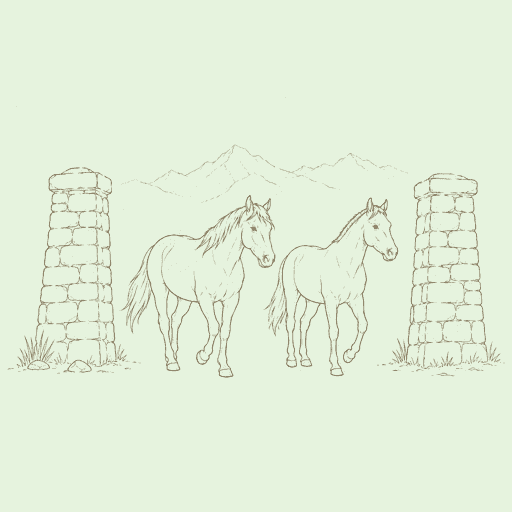
In the woods bordering Pillars Meadow, Kalin dismounts and removes the saddles and horseshoes from Navidad and Mouse. He checks all the horses carefully and feeds them the last of the oats. He scouts the meadow alone and finds the 10 Porch men, including Old Porch, moving toward the two gateposts of the Crossing. Knowing Old Porch will slaughter the horses the moment he sees them, Kalin makes his decision. He shares long, quiet farewells with each horse, then walks to Jojo and draws from Landry’s saddlebag the velvet pouch containing Old Porch’s 1873 Colt Single Action Army Peacemaker.
Part 3, Chapters 22-23 Analysis
Chapter 22 introduces a structural interruption that elevates the metafictional framing of the story, mediating the narrative events through divergent artistic renditions. The amateur artworks of the 1982 events, both in 2000 and 2031, visually eschew the notion of an objective telling of events by having each member of the community render their perspective as something beautiful to behold. Though the pedantic, removed gallery staff mock the artwork, community patrons like Alisa Groesbeck have a visceral response to the work, emphasizing the importance of subjectivity in storytelling. This is compounded by the fact that the 2031 exhibit comes across as an homage to the 2000 exhibit, featuring only the change of Tom’s ghostly presence, as if to suggest that the supernatural elements of the story have now become commonly accepted as fact. By filtering the narrative through curated physical and digital artifacts rather than objective reporting, the text foregrounds how communal memory is continually constructed, revised, and received. These evolving artworks highlight the theme of Storytelling as a Tool for Vengeance and Justice. This postmodern framing forces a critical engagement with mythmaking in the American West, suggesting that the objective truth of the frontier is inaccessible, requiring collective narrative reconstruction to process grief and approach historical justice.
The emotional reactions to the events in 1982 are contrasted against the feelings of animosity the community displays in the moment. The Orvop community enacts its own unprompted hostility during the Grandview Church snowball fight. Teenagers, spurred by tribal loyalties to the Porches, assault Allison and Sondra with ice and rocks in the chapel parking lot, escalating the aggressive rhetoric the mothers faced within the space of the church. This attack illustrates how deep-seated historical enmity infects the broader social fabric, transforming private grief into vicious public spectacle. The community’s eager participation in the assault mirrors the violent origins of the Utah frontier. The deterministic force of the region’s bitter history dictates these social responses, entrapping characters within cycles of inherited retribution that overwhelm individual innocence.
Against this systemic hostility, Kalin’s private interactions with the animals propose an alternative paradigm, illuminating the theme of Redefining Masculinity Through Friendship. In Chapter 23, after witnessing Landry’s apparent death in the avalanche, Kalin eschews immediate retaliation in favor of meticulously tending to the animals. Tom’s ghost recounts the story of Navidad, revealing that the scarred mare’s most sustaining memory is the day Kalin rode her bareback and “demanded nothing from her” (1012), granting her a profound sense of winged freedom. By speaking for Navidad, Tom evokes the moment from the Iliad where Xanthos, the immortal horse, speaks to Achilles about his future, in turn evoking Dallin’s call for “Grace.” Mouse and, in particular, Navidad function as living repositories for the gentle connection Kalin has with them; they are untamed spirits existing outside Orvop’s corrupt systems. By removing the horseshoes and offering lingering farewells instead of surrendering to an aggressive rampage, Kalin demonstrates that fortitude stems from intuitive compassion. His unique capability to soothe the terrified animals amidst a landscape of death emphasizes a manhood rooted in sensitivity, countering the brute dominance exhibited by Old Porch. The spiritual stakes of this frontier conflict are amplified by the spectral presences accompanying Kalin. As Kalin descends Coyote Gulch, Tom’s ghost communicates with the spirit of Pia Isan, who asserts that the only entities deserving of any trust are the horses. This extends itself to Kalin, who has proved himself trustworthy by gaining their loyalty.
Kalin’s final choice at the canyon floor complicates his nonviolent ethos, bringing the narrative to its critical, climactic juncture. Acknowledging that he cannot secure the animals’ passage through passive endurance, Kalin draws the antique Colt Single Action Army Peacemaker from Landry’s saddlebag. If Tom’s Crossing represents an idealized sanctuary entirely free from property lines and generational lawfare, then access to this freedom requires navigating the violent determinism that governs the Isatch Range. Kalin’s decision to retrieve the revolver signifies a tragic compromise: To honor his oath and protect the horses, he must adopt the instruments of destruction he previously abhorred, effectively excluding himself from the sanctuary of Tom’s Crossing.

Get in-depth, chapter-by-chapter summaries and analysis from our literary experts.
- Grasp challenging concepts with clear, comprehensive explanations
- Revisit key plot points and ideas without rereading the book
- Share impressive insights in classes and book clubs