Tom's Crossing
A modern alternative to SparkNotes and CliffsNotes, SuperSummary offers high-quality Study Guides with detailed chapter summaries and analysis of major themes, characters, and more.
Summaries & Analyses
Quizzes
NEWReading Tools
Important Quotes
Content Warning: This section of the guide includes discussion of cursing, child death, and graphic violence.
“Some say the universe bends toward Justice, but when it don’t, stories mend the trajectory. […] Stories are the lexical fashionins of vengeance. At least the good ones are.”
(Prologue, Pages 30-31)
Evoking the words of Tom’s ancestor, the narrator explicitly defines storytelling as a corrective, and even vengeful, force against historical injustice, a counterpoint to the guns that typically drive the action in Westerns. This foreshadows the end and the purpose of this story, indicating that some injustice will take place, specifically Old Porch’s hung juries, that requires the narrator to speak up to amend the record. This metafictional comment frames the entire novel as an act of retribution, driving the theme of Storytelling as a Tool for Vengeance and Justice.
“Don’t you forget the curse, Kalin March: you but touch a gun and what you love most will forsake you for the rest of your life. […] so Love will be lost to you.”
(Part 1, Chapter 1, Page 47)
The “curse” that governs Kalin’s relationship with guns establishes the central tension of his character. By creating this quasi-mythic prohibition and putting his relationship with horses (“Love”) at stake, the narrative elevates Kalin’s internal conflict beyond a simple choice against violence. This turns Kalin into an unconventional Western hero, a protagonist who must overcome his enemies without using weapons.
“For the horses, you numskull. I don’t wanna see that evil old cuss you’re forced to recognize as your father do you harm on our account. […] I’ll write out the bill of sale for the two ponies on the back side by Mr. Jackson here and date it and sign it too.”
(Part 1, Chapter 3, Page 116)
In this scene, Landry Gatestone attempts to resolve the conflict with Russel Porch through a simple, commercial transaction. This act of child-like justice, writing a bill of sale on a $20 banknote, starkly contrasts with the violent, deceptive world of the adults. The moment underscores the children’s attempt to operate within a moral framework that the Porch family’s subsequent actions shatter.
“That right there is the darkness of a ghost’s mind. That there is Tom, darkness and distance incarnate, beholden to forces beyond the reach of calculation, not to mention speculation, the ne plus ultra past which all returns are rendered impossible.”
(Part 1, Chapter 4, Page 147)
The narrator uses abstraction to define the nature of Tom’s ghostly consciousness, setting a boundary for the characters’ understanding of Tom’s continued presence after death. The prose shifts from its colloquial, Western tone (“That right there”) to a more formal, philosophical register (“the ne plus ultra”), emphasizing Tom’s transition from a human character to a supernatural force whose motivations are beyond human comprehension.
“Kalin could just make out what was maybe the visitor kiosk and from there a sliver of parkin lot, bright now with a confusion of flashin blue-and-red lights.”
(Part 1, Chapter 6, Page 202)
The “confusion of flashin blue-and-red lights” signals that the stakes have been violently escalated far beyond stolen horses, transforming Kalin’s journey into a desperate flight from the law. Positioned at the end of a chapter focused on navigating natural obstacles, this image creates suspense by suggesting that the manhunt orchestrated by Old Porch is an even greater threat than the mountain itself.
“Yesterday, he continued, I had eight boys. Today I got seven. Some are already up there, lookin to make right what was made wrong last night. You best brace yourself for how this is gonna end. One way or another, your boy will be found, and when he is, he won’t have no life left to live. I guarantee it.”
(Part 1, Chapter 7, Page 221)
Orwin “Old Porch” Porch establishes himself as the primary antagonist by presenting a fabricated, fatalistic version of events as fact. His closing phrase, “I guarantee it,” is an assertion of power, implying he has the will and means to control the outcome regardless of the truth. Porch’s clinical accounting of his sons frames his loss as an imbalance that requires violent correction, reinforcing the theme of The Impact of History on Identity as he acts to enforce his family’s patriarchal dominance over the Gatestones and their allies.
“Morgue don’t lie, Bowlin Ball.”
(Part 1, Chapter 8, Page 246)
This terse line of dialogue efficiently characterizes Egan Porch, who weaponizes a half-truth to psychologically torment Landry, showcasing his cruelty and the manipulative nature of the family’s manufactured narrative. The use of the dehumanizing nickname “Bowlin Ball” reinforces the personal animosity between the Porch and Gatestone families.
“The Porch house would never amount to more than an idea its own reality could never match, and so to Old Porch it always felt unsatisfactory, maybe even shameful, like a marriage gone dead. He had even come to accept that the only finishin line he’d ever know here was when he sold this dungheap and built fresh in Indian Hills the mansion the Four Summits business would finally pay for.”
(Part 2, Chapter 16, Page 473)
This quote provides a moment of deep interiority for Old Porch, using the symbol of his perpetually “unfinished” house to reflect his internal state of profound dissatisfaction. The simile comparing the house to a “marriage gone dead” reveals a personal sense of failure that fuels his ruthless ambition to build a new reality that can match his idealized self-image.
“We have a choice, their father said to them. Either we spend the rest of our lives talkin about what we should’ve done or we shut up now and get what needs to be done done. Our little Russel’s gone, and until them that done this to him are fer sure gone, and I mean fer sure!, buried good and deep, we must not stop.”
(Part 2, Chapter 16, Page 603)
Standing before his son Russel’s casket, Old Porch manipulates his other sons’ grief into a call for violent retribution. He constructs a false binary, pitting ineffectual talk against decisive action, to frame vengeance as a necessary and honorable duty. This moment illustrates how Porch masculinity is defined by retributive violence, reinforcing the theme of Storytelling as a Tool for Vengeance and Justice.
“It matters because if the dead are mistreated in their remembrance, they come back to mistreat us.”
(Part 2, Chapter 18, Page 646)
Sondra Gatestone’s statement in this passage functions as both an aphoristic folk warning and a direct articulation of the novel’s narrative motivation, underscoring the theme of Storytelling as a Tool for Vengeance and Justice. The line posits that narrative truth and memory are forces that have tangible consequences on the living and the dead. The aphorism suggests that stories have the power to either honor or desecrate the past, with the dead returning as literal or figurative “hauntings” to correct narratives that have wronged them.
“It ain’t good enough to wanna be free […]. Every dang livin thing wants to be free. It’s elemental I reckon. But like my momma taught me, and it’s how I see things too: to matter you gotta set free someone that ain’t you. That’s all that matters.”
(Part 2, Chapter 20, Page 776)
As he prepares to lead Navidad up the final, most dangerous section of the headwall, Kalin explains his core motivation to a terrified Landry. The articulation of the belief passed down from his mother frames Kalin’s quest as a mission of self-definition. The principle of finding meaning by liberating another being connects to the theme of Redefining Masculinity Through Friendship, positioning Kalin’s strength in empathy and sacrifice, rather than dominance.
“Now here's what Kalin saw: at the very same moment that Landry started to slip backwards, Tom lunged for his little sister, grabbin hold of her wrist, and Landry somehow felt that hold, or at least the pull, and in turn grabbed hold of this aidin wrist of wind and spirit, summonin in her strength enuf for the impossible, to get that left foot up on the rock [...]. And, no, Tom never did tell Kalin how at the moment when he grabbed Landry with his right hand, Pia Isan had grabbed his left wrist. To hold him, hold them all.”
(Part 2, Chapter 20, Page 807)
The narrative explicitly blends the physical and the supernatural, as Tom’s ghost intervenes to save Landry from a fatal fall. The authorial choice to have Landry feel the “pull” of a “wrist of wind and spirit” makes the ghostly action tangible, transforming familial love and historical memory into a life-saving force. The final sentence, revealing the ghost of Pia Isan supporting Tom, layers this act of salvation with historical weight, suggesting a chain of spectral aid that binds the characters across generations.
“[...] they stood there incomparably light, so that before they did at last turn, they already knew the hollow in the wind and would find no resistance there, even lingerin fer a moment longer, as effortless as when livin grants even the most difficult livin the chance to become its own beautiful moment beyond life. [...] Moonlight alone beheld horse and boy and maybe in the end moonlight was who it was for.”
(Part 2, Chapter 21, Page 843)
Danielewski employs elevated, lyrical prose and surreal imagery (being "incomparably light" and knowing the "hollow in the wind") to transform a moment of intense physical action into a transcendent experience that exists "beyond life." By stating that "Moonlight alone beheld" the event, the narrative removes itself from the realm of human witness, framing it as a private, almost sacred communion between the children, the horses, and the natural world, reinforcing their mythic connection.
“The hospital room, Kalin, Tom said as the eagle dropped away like a feather born to bronze. I see you beside me! […] My whole life I know from here! Your whole life I know from here! Landry’s too! My whole family’s! Your momma’s! The lives of these horses! All their kin!”
(Part 2, Chapter 21, Page 894)
This moment elevates the narrative from a regional Western to a mythological epic, positioning Tom as an oracle with access to a panoramic, nonlinear view of history, which gives all the novel’s allusions to classical Greek literature a more explicit narrative function. His ability to see the interconnected lives of all characters explicitly reinforces the theme of The Impact of History on Identity. As he gains greater knowledge of the fates of the characters, he also loses his identity, along with all the traits that defined him, replacing his characteristic joy with dread.
“Cover your lenses! Kalin screamed. Though maybe he should’ve screamed Run! or better Drop!, though no utterance by then would’ve mattered. Kalin was already too late, Landry’s mistake too grave. Her dark hair spinnin. The air around her veiled in blood.”
(Part 2, Chapter 21, Pages 910-911)
In this passage, the narrative voice creates a sense of dreadful inevitability, running through Kalin’s futile thoughts before cutting to two stark, imagistic sentence fragments. The authorial choice to render the climax of this section with poetic, detached observations (“Her dark hair spinnin” and “veiled in blood”) removes the visceral immediacy of the violence, creating a paradoxically beautiful moment of horror. This stylistic technique slows time and heightens the tragic impact of Landry’s “grave mistake.”
“You could say that here was Cal Carneros’s artistic criteria: great art starts its life in the aftermath of a burial, because the life of its creation is spent, and now it’s just a matter of findin out whether or not the dust is haunted.”
(Part 3, Chapter 22, Page 926)
This quote, part of the frame narrative set years after the main events, functions as a metaphor for the novel’s exploration of storytelling and memory. The art exhibit, like the novel itself, is presented as a “memorial” of past events. Danielewski uses this metaphor to suggest that the purpose of a story is to determine if the past is “haunted” or if it still holds power and meaning that can affect the present, directly tying into the theme of The Impact of History on Identity.
“To suffer a story and continue to suffer that story in the name of that story because that story just might offer some sort of justice or redemption or just overcome the tribulations of the past, that overwhelming inertia set against the future.”
(Part 3, Chapter 22, Pages 926-927)
This passage, which occurs as gallery owner Cal Carneros reflects on the Orvop community’s presence at the art show, explicitly states the novel’s central argument about Storytelling as a Tool for Vengeance and Justice. The phrasing transforms storytelling from a passive recollection into an active, painful, and necessary endurance (“to suffer a story”). The repetition of “that story” emphasizes its singular importance as a vehicle for achieving justice and breaking the cycle of historical trauma (“overwhelming inertia”).
“Sometimes you got no choice but to face what chases you. The only thing you get to decide are the terms of engagement.”
(Part 3, Chapter 23, Page 1009)
This statement marks a pivotal shift in Kalin’s character, moving from a position of passive endurance to one of active agency. The quote subverts the traditional Western hero’s embrace of violence by framing the choice as a reluctant necessity, rather than as a desire for violence. For Kalin, defining the “terms of engagement” becomes a way to reclaim control over a fate that has been dictated by generational conflict.
“In his emptiness, the boy could remain with Navidad. But in his absolute fullness, he must lose her.”
(Part 3, Chapter 23, Page 1013)
This narrator’s insight comes as Tom’s ghost recounts the horse Navidad’s life story. The text establishes a paradox central to Kalin’s character and the theme of Redefining Masculinity Through Friendship. His “emptiness” represents his empathetic, nonviolent nature, which allows for his profound connection with horses. His “fullness” symbolizes the impending violence he must embrace to fulfill his oath, an act that, according to his mother’s curse, will sever the very connection to horses that gives his life meaning.
“After that, Kalin walked over to Jojo and pulled loose from Landry’s saddlebag the dark velvet pouch wherein waited Old Porch’s 1873 Colt Single 23Action Army Peacemaker.”
(Part 3, Chapter 23, Page 1020)
The action marks the point of no return, signifying Kalin’s acceptance of a violent role and the fulfillment of his mother’s curse. The use of the firearm’s full name deliberately grounds the moment in the conventions of the Western genre, highlighting the weight of Kalin’s choice against the backdrop of the historical and literary legacy he is now choosing to inhabit.
“The only objectionable moment witnessed there involved the acquisition of an inanimate thing of human devisin: barrel, cylinder, trigger, and hammer which conjured in their shiny assembly a repulsin ripple of menace.”
(Part 3, Chapter 24, Page 1022)
This moment demonstrates the “curse” placed on Kalin by his mother, which warned that using a gun would alienate horses from him. The narrator directly engages with and dismisses alternative, rational explanations for the horses’ behavior, including the gun’s physical qualities to ground the curse in the ambiguity of realism. Though the horses cannot perceive human morality, their perception of the gun’s parts creating a “repulsin ripple of menace” establishes the weapon as a threatening, malevolent force.
“Kalin gave his left arm a jerk like so, while anglin his hand like so […]; an ideal tumble of grip over barrel now in motion, with Kalin lowerin hisself at the same time in order to match the weapon’s descent […]. And no, there ain’t gonna be no complete divulgence now of how this particular trick or technique or work of art, take your pick, was carried out, namely because there ain’t no one worthy of its consequences.”
(Part 3, Chapter 24, Page 1086)
The narrator’s deliberate choice to withhold the mechanics of the “trick” elevates Kalin from a boy with a gun to a mythic figure possessed of an unknowable skill, completing his transformation into a heroic agent of violence. This narrative omission reinforces the novel’s ideas around storytelling by highlighting the narrator’s power to shape the legend, consciously curating what the reader is allowed to know and preserving the mystique of the event.
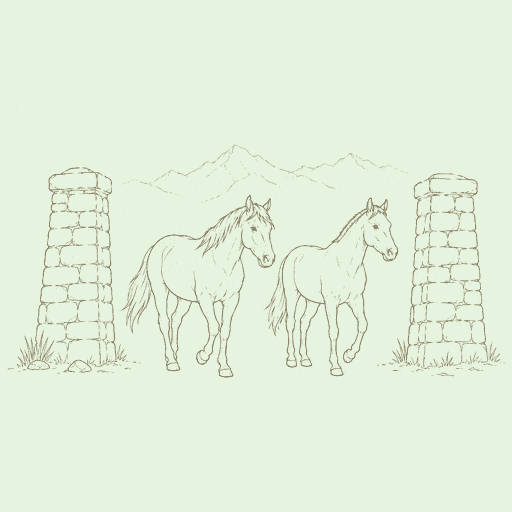
“Kalin undid Navidad’s halter-bridle next, and she too avoided his touch. Like Mouse, she too cast behind her an immense shadow as she passed between them gateposts. And whatever great pain stabbed through Kalin’s right side, it weren’t nothin compared to what Navidad’s departure did to him.”
(Part 3, Chapter 24, Page 1097)
This moment marks the completion of the journey Kalin set out to fulfill at the start of the novel. The bittersweet mood of this moment comes as the horses reject his touch, fulfilling the prophecy of Allison’s curse. The physical pain of Kalin’s gunshot wound is explicitly contrasted with the greater emotional pain of the horses’ departure, emphasizing that the spiritual loss is his most grievous injury.
“Landry, see, was somethin else: you might say as possessed as Kalin had been up there on Pillars Meadow. Here she was carryin out this impossible ride from start to finish without so much as a hitch, never a hint of givin up or ever laggin, her unearthly focus born of a place I can’t in all fairness reprise let alone imagine.”
(Part 3, Chapter 25, Pages 1128-1129)
During the climactic ride to the hospital, the narrator abruptly shifts from a distanced third-person perspective (“Landry”) to first-person (“I”), a significant stylistic choice that hints at the narrator’s true identity. Key to this revelation is the verb “reprise,” suggesting that an older Landry is going back into her personal experience to inhabit a version of herself she no longer is. This complicates the narrative frame, asserting her narratorial status as a direct participant in the events being depicted. At the same time, Landry admits the gap she feels from her younger self, suggesting that she no longer possesses that full authority with the vantage of hindsight.
“For, yes, again in my belt, I carry that very same Colt Peacemaker, fully loaded too, all six chambers, six chambers I cannot empty, and I’ve tried many, many times.
But I shall not unhand it.
Ever.
Enuf is enuf.”
(Epilogue, Page 1228)
The novel’s final lines find Landry still carrying, even into the afterlife, the gun that catalyzed the story’s violent conflict. The loaded gun symbolizes the inescapable weight of history and trauma, a burden Landry has chosen to carry into eternity for the sake of preventing more violence. The final, defiant declaration, “Enuf is enuf,” serves as a conclusive judgment on the events and a final assertion of her narrative authority.

Unlock every key quote and its meaning
Get 25 quotes with page numbers and clear analysis to help you reference, write, and discuss with confidence.
- Cite quotes accurately with exact page numbers
- Understand what each quote really means
- Strengthen your analysis in essays or discussions

Featured Collections
Books on Justice & Injustice
View Collection
Books that Feature the Theme of...
View Collection
Challenging Authority
View Collection
Colonialism & Postcolonialism
View Collection
Coming-of-Age Journeys
View Collection
Fear
View Collection
Friendship
View Collection
Good & Evil
View Collection
Grief
View Collection
Mortality & Death
View Collection
Nature Versus Nurture
View Collection
Power
View Collection
Revenge
View Collection
Safety & Danger
View Collection
Teams & Gangs
View Collection
The Future
View Collection
The Past
View Collection
Truth & Lies
View Collection
Valentine's Day Reads: The Theme of Love
View Collection