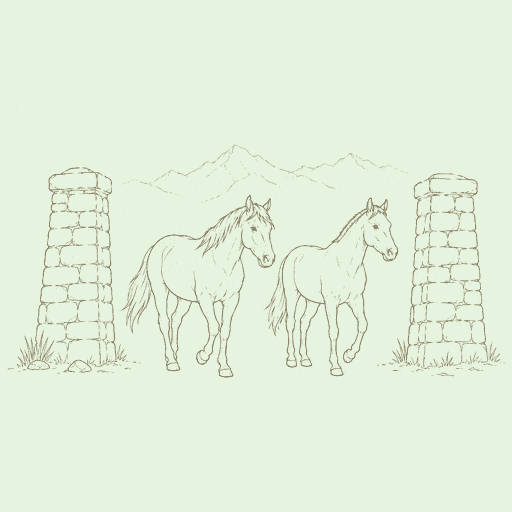
Tom's Crossing
A modern alternative to SparkNotes and CliffsNotes, SuperSummary offers high-quality Study Guides with detailed chapter summaries and analysis of major themes, characters, and more.
Summaries & Analyses
Quizzes
NEWReading Tools
Character Analysis
Content Warning: This section of the guide includes discussion of illness, death, animal cruelty and death, child abuse, child death, addiction, and bullying.
Kalin March
As the novel’s protagonist, Kalin March is a dynamic and round character who evolves from an outcast into the reluctant hero of a mythic quest. His primary defining trait is his profound and intuitive connection with horses, a skill that contrasts sharply with the aggressive dominance displayed by other characters. Kalin’s ability is a sign of his prodigious empathy; rather than break the wild horses Navidad and Mouse, he earns their trust through quiet communication and gentleness, allowing him to succeed where Tom Gatestone and Lindsey Holt fail as he lays “against [the horse’s] neck for a while, strokin her and whisperin in her ear” (21). This gift symbolizes a different form of strength, one rooted in sensitivity and mutual respect rather than physical force. This positions him outside the traditional masculine ideals of his community, aligning him with the theme of Redefining Masculinity Through Friendship. His power lies in his capacity to bestow calm, a talent that makes him uniquely suited for his eventual mission.
Initially defined by his vulnerability and social isolation, Kalin possesses a deep-seated integrity and quiet resolve. He endures relentless bullying from Lindsey Holt without abandoning the very boat shoes that cause Lindsey to ridicule him, signaling an unwillingness to compromise his identity for social acceptance. This inner strength becomes the engine for the entire narrative after Tom’s death. Bound by his deathbed promise to Tom, Kalin single-handedly undertakes the perilous journey to the Crossing, a task for which he is physically and emotionally unprepared. His motivation transcends simple loyalty into a moral duty to honor his friend and save the horses.
Kalin’s determination is also fueled by his personal history, specifically the shame associated with his father. His mother’s plea, “Your daddy was nothin but lies… Make no home for them in yours” (45), establishes Kalin’s quest as a concurrent struggle to define himself against his father’s legacy of deceit. Adding to his character struggle is his preternatural gift for marksmanship, which his father discovers and plans to exploit in his early childhood. By reframing Kalin’s gift as a “curse,” Allison succeeds in making him cautious of the very weapon that drives the action of the Western genre. To fulfill his promise to Tom, Kalin must constantly choose whether or not he should use the Colt Peacemaker, the Porches’ heirloom weapon, to resist them. This choice consequently determines whether he can become the antithesis of the man he fears becoming, proving to his mother and himself, “I ain’t him” (45).
Kalin’s journey is one of immense psychological and physical endurance. As he ventures into the unforgiving wilderness of the Katanogos massif, he is forced to confront the external threats that the Porches and the harsh environment pose, as well as his own internal fears and limitations. His simple objective, to set two horses free, elevates into a spiritual undertaking, a pilgrimage toward an ideal of freedom symbolized by Tom’s Crossing. In the end, Kalin’s transformation is complete; though he ultimately uses the Peacemaker and severs his connection to the horses he loves, the quiet, overlooked boy becomes the hero of a foundational myth for Orvop, remembered by its denizens many decades after the fact.
Tom Gatestone
Tom Gatestone functions as the novel’s central catalyst and a posthumous mentor for Kalin. He is a round character whose static traits influence the protagonist’s journey. Tom’s most defining characteristic is his pervasive mirth, a seemingly endless capacity for laughter that serves as his primary tool for navigating the world. He responds to nearly every situation, from witnessing a schoolyard beating to facing his own mortality, with amusement. Tom’s laughter is a sophisticated mechanism for de-escalation and social maneuvering. When confronting the bully Lindsey Holt, Tom’s riot of laughter defuses the violent tension more effectively than any physical threat could. He recognizes the absurdity in Lindsey’s rage over Kalin’s shoes, and his howling reaction disarms the aggressor by transforming the conflict into a spectacle of foolishness. This quality presents an alternative to the genre’s traditionally stoic and violent masculinity, suggesting that wit and a unique perspective can be more powerful than brute force. His laughter is the outward expression of a spirit that refuses to be constrained by the world’s grim expectations, one that recognizes the value of compassion over inherited rivalries.
Tom’s physical markers, such as his oversized belt buckle and signature black Stetson, underscore his cowboy persona, yet his empathy subverts the violent norms demanded by his environment. Although born into a family embroiled in a feud with the Porches, he treats the conflict with detached amusement. He demonstrates an acute awareness of Storytelling as a Tool for Vengeance and Justice, noting how community lore dictates behavior. At one point, he explains to Kalin, “Stories are the lexical fashionins of vengeance” (31). By stealing Orwin Porch’s horses and demanding Kalin set them free, Tom rejects the cycle of retribution in favor of an act of pure liberation.
Following his premature death from cancer, Tom reappears as a spectral companion riding his Andalusian horse, Ash. In this posthumous form, he guides Kalin toward the mythical destination of Tom’s Crossing. While his cheerful disposition remains, his posthumous existence introduces vulnerability. He experiences memory loss regarding his own death and exhibits genuine fear of the canyon’s spirits. His supernatural torch reveals the invisible ghosts of Indigenous people, pioneers, and victims of local violence, exposing the weight of history upon the land. Eventually, he comes to serve as a medium for the canyon’s spiritual voices, prophesying Kalin’s use of the Peacemaker in the novel’s climax. Despite his fading essence, Tom maintains a fierce loyalty to his sister, Landry. By acting as a joyful rebel in life and a vulnerable guide in death, Tom ensures his legacy centers on freedom, rather than conflict.
Landry Gatestone
Landry Gatestone, Tom’s younger adopted sister, serves as a crucial sidekick and foil to Kalin March, evolving from a peripheral observer into a dynamic and capable participant in the central quest.
Initially introduced as a curious and feisty teenager with a “wanderin way” in her gait (15), Landry is fiercely loyal to her family and possesses a sharp perceptiveness that allows her to uncover Tom’s and Kalin’s secret rides. Her character is defined by a blend of youthful impertinence and surprising competence. While she can be teasing and stubborn, her practical skills, particularly her knowledge of horses, knots, and mountain readiness, prove invaluable to Kalin’s journey. When Kalin is weakened by food poisoning, it is Landry who ensures their survival by finding a way to start a fire with her diary pages and taking charge of their shelter.
Her decision to follow Kalin into Isatch Canyon stems from her devotion to her late brother’s final wish, as well as her crush on Kalin. She acts as a herald, discovering the horses in Paddock B and setting out to ensure Tom’s promise is kept. On the journey, her spirited and often talkative nature provides a stark contrast to Kalin’s stoic and burdened silence. She asks the questions Kalin will not, voices the fears he suppresses, and injects moments of levity and human connection into what would otherwise be a purely solitary ordeal. Though her impulsiveness sometimes creates complications, her courage is never in doubt. She confronts Russel Porch and later Egan Porch with a boldness that belies her small stature, demonstrating the same indomitable Gatestone spirit as her brother. Ultimately, Landry becomes more than a companion; she is an essential partner whose resourcefulness and emotional resilience are fundamental to the quest’s progression. The novel ends with the revelation that she is the narrator of the story, carrying the Colt Peacemaker in the afterlife to ensure that it is never fired again. Considering that the gun severed Kalin’s connection to the animals he loved, this final act signals her continued devotion to Kalin and her commitment to halt the violence that has long defined Orvop.
Orwin “Old Porch” Porch
Orwin “Old Porch” Porch is the primary antagonist of the novel, a static and round character who embodies the brutal, greedy, and vengeful forces opposing the protagonists. As the patriarch of the Porch family, he is the living continuation of the generational feud with the Gatestones, a conflict deeply rooted in The Impact of History on Identity. Described as a “mean seed upon the land” (34), Old Porch’s motivations are consistently driven by a desire for power, land, and the subjugation of his rivals. His business, Porch Meats, and its adjacent slaughter paddock symbolize his transactional and merciless worldview, where life is a commodity to be exploited and discarded. His decision to move Navidad and Mouse to Paddock B, the holding pen for animals scheduled for slaughter, serves as the novel’s inciting incident, transforming a tale of youthful friendship into a desperate mission against an unfeeling system of industrial death.
Old Porch’s character is defined by his capacity for cruelty and manipulation. After he causes the death of his son Russel, he fabricates a story of murder to justify a violent and disproportionate manhunt for Kalin and Landry. This act reveals his mastery of narrative as a weapon, twisting personal tragedy into a tool for vengeance against the Gatestone family. Rather than seeking justice for his son, Old Porch’s pursuit is about asserting dominance, settling old scores, and generating sympathy for his side in a generational conflict. He is relentless and amoral, willing to sacrifice his own family members and lie to law enforcement to achieve his ends. He represents the traditional, unyielding form of Western masculinity that the novel critiques, a masculinity founded on violence, control, and a total lack of empathy. These characteristics make him the perfect ideological and physical adversary for the gentle and principled Kalin March. This culminates in his overall objective, which is to claim the land so that he can build a new ski resort on it and establish financial dominance over Orvop.
Russel Porch
Russel Porch, the youngest of the Porch brothers present in Orvop, is a flat, static character who acts as the story’s sacrificial lamb. Unlike his aggressive older brothers, Russel is depicted as soft, weak, and possessing none of their meanness or “huntin instincts” (70). His primary motivation is to earn the approval of his father and brothers, a desire that leads him to pursue Kalin and the stolen horses. His accidental death, caused by Old Porch in a fit of rage, is the central tragic event that Old Porch masterfully manipulates to raise the stakes for Kalin and Landry. By falsely blaming Kalin for the death, Old Porch transforms Russel from a casualty of familial violence into a martyr, using his memory as the justification for the brutal manhunt that drives the novel’s main conflict. Russel is an innocent whose fate is tragically exploited for the sake of vengeance.
Allison March
Allison March, Kalin’s mother, is the deuteragonist who leads the subplot in Orvop, occurring outside the action featuring Kalin and Landry on Katanogos. Protective and resilient, she is defined by her struggle to ensure her son escapes the toxic legacy of his biological father, which also forces her to acknowledge her complicity in this legacy when she was experiencing alcohol addiction.
During her quest, Allison forms a powerful alliance with Tom’s mother, Sondra, who has lost all of her family, except for Landry. Despite their different social backgrounds, the two women are united by their fierce love for their children and their mutual distrust of the official narrative crafted by the Porches. They work tirelessly to uncover the truth and protect their children, representing the forces of reason, love, and maternal strength in a story dominated by masculine violence and historical hatred. This motivation pushes Allison to foster Sondra’s hope, even when they both initially believe that their children have died on the journey. Though Old Porch uses his influence to ostracize the two women, especially within Sondra’s church, Allison works to help Sondra navigate the nuances of their respective notions of faith and hope, helping her to find ways to live, even in the possibility of her last child’s death.

Unlock analysis of every major character
Get a detailed breakdown of each character’s role, motivations, and development.
- Explore in-depth profiles for every important character
- Trace character arcs, turning points, and relationships
- Connect characters to key themes and plot points

Featured Collections
Books on Justice & Injustice
View Collection
Books that Feature the Theme of...
View Collection
Challenging Authority
View Collection
Colonialism & Postcolonialism
View Collection
Coming-of-Age Journeys
View Collection
Fear
View Collection
Friendship
View Collection
Good & Evil
View Collection
Grief
View Collection
Mortality & Death
View Collection
Nature Versus Nurture
View Collection
Power
View Collection
Revenge
View Collection
Safety & Danger
View Collection
Teams & Gangs
View Collection
The Future
View Collection
The Past
View Collection
Truth & Lies
View Collection
Valentine's Day Reads: The Theme of Love
View Collection