Tom's Crossing
A modern alternative to SparkNotes and CliffsNotes, SuperSummary offers high-quality Study Guides with detailed chapter summaries and analysis of major themes, characters, and more.
Summaries & Analyses
Quizzes
NEWReading Tools
Symbols & Motifs
Content Warning: This section of the guide includes discussion of graphic violence, death, and animal cruelty and death.
The Colt Peacemaker
The Colt Peacemaker is a potent symbol of the destructive patriarchal legacy that defines the Porch family, as well as the staple of violence that defines action in the Western genre.
As a family heirloom passed from father to son, the ironically named Peacemaker is the very instrument of a self-consuming cycle of vengeance. The pistol is described as more than a weapon; it is a "reverential object, part artifact, part totem, and no doubt part killin machine" (94), indicating its sacred status within the Porch family’s toxic value system. It is the physical embodiment of the belief that power, honor, and identity are maintained through force and domination. Russel Porch’s attempt to steal the Colt is a misguided effort to claim his inheritance and prove his worthiness within this violent lineage, an act that ironically leads directly to his death at the hands of his own father. Crucially, Old Porch dismisses Russel when he reports the theft of the two horses; he only becomes angry when Russel accidentally reveals that Kalin and Landry have the Colt. It later becomes revealed that Egan feels entitled to own the Peacemaker, following many attempts to prove himself to his father as a living instrument of violence. In this way, the Colt proves itself a more fundamental artifact of the Porch family’s power than their livestock or businesses do.
The gun, meant to signify patriarchal succession, instead becomes the catalyst for the family's implosion. In the possession of Kalin March and Landry Gatestone, the Colt is turned against the family who have been using violence to maintain their dominance over the land in Orvop and its peoples. While the “curse” Allison places on Kalin prevents him from using the Colt for most of the novel, he sees its eventual use in the climax as the defining act that will seal the fates of the horses he has been charged with rescuing, even if it means severing his empathetic connection to horses. By choosing to use the gun, Kalin effectively sacrifices that connection in order to save Navidad, Mouse, and Tom’s spirit. This underscores the damning nature of the gun, even though it functions as a staple in most Western stories.
Navidad and Mouse
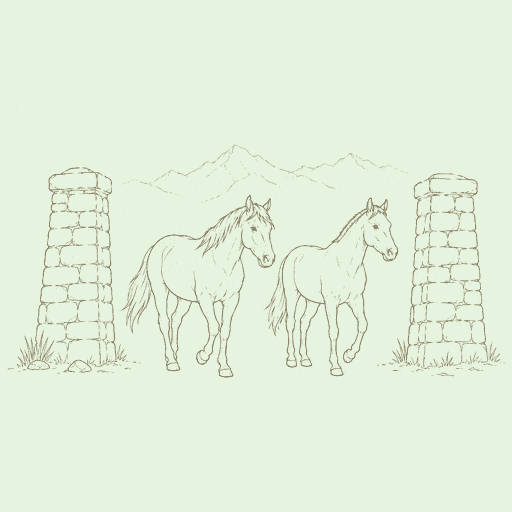
Navidad and Mouse, the two horses at the heart of the novel, function as a complex symbol of a natural, untamed spirit that exists outside the corrupting human systems of Orvop. They represent an ideal of freedom and authenticity that catalyzes the friendship between Tom Gatestone and Kalin March. The symbolic meaning of the two horses derives from Tom’s and Kalin’s perception of them. When Russel Porch first reports the theft of the horses to his family, Old Porch speaks dismissively of them, indicating that they represent nothing in the grand scheme of the family’s assets. The fact that they were moved to Paddock B in preparation for slaughter underscores the Porch family’s perception of them as useless stock whose value can only be realized in their death and disposal.
Tom’s and Kalin’s decision to steal the horses for rides becomes an act of rebellion against the generational feud and the commodification of life represented by Porch Meats. The novel emphasizes this idea when Kalin, Tom’s ghost, and Landry encounter the spirit of Pia Isan and the parade of the dead in the cave. The liberation of the horses becomes the bargaining chip for the freedom of Tom’s soul; if Kalin were to fail, then Tom’s soul would be trapped forever in the underworld. Kalin’s quest thus becomes a moral imperative: If he fails to liberate the horses, then he fails to live by the spirit that Tom embodied and brought to his life. Against all odds, Kalin therefore spurs himself to fulfill Tom’s request.
Tom’s Crossing
Tom’s Crossing is the novel’s central symbol of idealized freedom, an almost mythical destination that represents an escape from the social, legal, and historical conflicts defining life in Orvop. As a physical place, it is defined by what it lacks: It is a crossing with gateless posts where the fence has “rotted away” (58), signifying a world beyond property lines, ownership, and the endless “lawfare” between the Gatestones and the Porches (30). This makes it the ultimate sanctuary for Navidad and Mouse, whose spirits are meant to be wild and untethered. However, its symbolic power deepens profoundly through its connection to Tom Gatestone.
At the end of a long and treacherous path, the Crossing becomes the spiritual destination of the narrative, a physical manifestation of Tom’s own laughing, free spirit. The novel literalizes this by having Tom’s spirit accompany Kalin throughout his entire journey and then allowing Tom’s spirit to fade away with the horses once they cross the threshold. It is not so much that the geophysical characteristics of the Crossing will prevent the Porches from exploiting the horses, but that Kalin will create a legend for the Crossing that will make it inextricable with Tom’s memory. The journey to Tom’s Crossing therefore immortalizes the legacy of Tom Gatestone, forever cementing him in the land where he lived and died as someone who stood for freedom from the generational conflict he was born into.

Unlock the meaning behind every key symbol & motif
See how recurring imagery, objects, and ideas shape the narrative.
- Explore how the author builds meaning through symbolism
- Understand what symbols & motifs represent in the text
- Connect recurring ideas to themes, characters, and events
Featured Collections
Books on Justice & Injustice
View Collection
Books that Feature the Theme of...
View Collection
Challenging Authority
View Collection
Colonialism & Postcolonialism
View Collection
Coming-of-Age Journeys
View Collection
Fear
View Collection
Friendship
View Collection
Good & Evil
View Collection
Grief
View Collection
Mortality & Death
View Collection
Nature Versus Nurture
View Collection
Power
View Collection
Revenge
View Collection
Safety & Danger
View Collection
Teams & Gangs
View Collection
The Future
View Collection
The Past
View Collection
Truth & Lies
View Collection
Valentine's Day Reads: The Theme of Love
View Collection