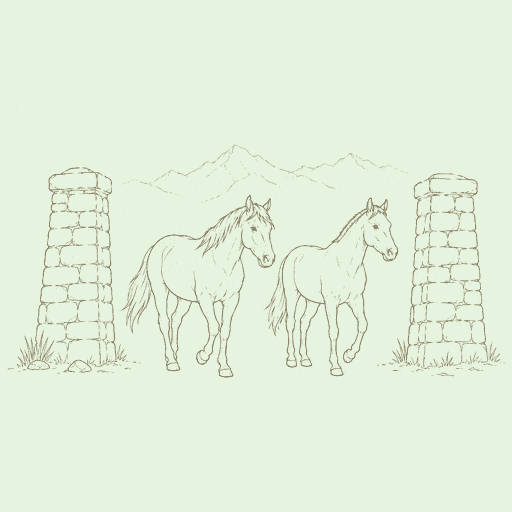
Tom's Crossing
A modern alternative to SparkNotes and CliffsNotes, SuperSummary offers high-quality Study Guides with detailed chapter summaries and analysis of major themes, characters, and more.
Summaries & Analyses
Quizzes
NEWReading Tools
Prologue-Part 1, Chapter 6Chapter Summaries & Analyses
Content Warning: This section of the guide includes discussion of bullying, death, illness, animal cruelty and death, racism, death by suicide, graphic violence, child abuse, and child death.
Part 1: “The Horses”
Prologue Summary: “Some of What Happened Before”
On April 13, 1982, Kalin March, a new student in Orvop, Utah, sits quietly on a fence in Paddock A near the Tree Streets, watching two horses when Lindsey Holt, a volatile junior, drags him off and begins kicking him. Tom Gatestone, a celebrated young horseman and Future Farmers of America (FFA) president from one of Orvop’s wealthiest families, walks past and laughs so hard at Lindsey’s clumsy attack that Lindsey stops. Tom helps Kalin up, and the three stage an impromptu horse-riding contest on the two horses for a dollar apiece. Tom lasts six seconds on the black mare before being unseated; Lindsey lasts three and lands in manure. Kalin mounts the mare with effortless calm and then rides the far more aggressive blood bay gelding with skill that visibly startles Tom. Tom pays Kalin his winnings.
That spring, Tom quietly deflects Lindsey’s ongoing harassment of Kalin. The boys begin secretly riding the two horses, naming the mare Navidad and the gelding Mouse, into the foothills and Isatch Canyon, while Tom teaches Kalin the region’s history, including the deep feud between his family, the Gatestones and the owners of the Paddock and the horses, the Porches, a feud that killed Tom’s older brother, Evan, in a truck race against Egan Porch. Tom also introduces Kalin to a route he calls the Crossing, where the horses could one day be freed. Tom explains that anything moved from Paddock A to the adjacent Paddock B is slaughtered the next day.
In late September, Tom is hospitalized with terminal cancer. On his deathbed, with his sister Landry Gatestone and family present, he extracts an oath from Kalin: If Old Porch ever moves Navidad and Mouse to Paddock B, Kalin must take them to the Crossing. Kalin swears. Tom whispers the route before dying.
Part 1, Chapter 1 Summary: “Paddock B”
On the rainy afternoon of Wednesday, October 27, Kalin prepares to leave his apartment. His mother, Allison March, questions him, and he tells her he is going camping with friends for two nights. Before he goes, she reminds him that he is cursed, warning that he will lose what he loves most if he ever touches a gun. Kalin promises there are no guns and leaves.
He walks to the paddocks, finds Paddock A empty, and hears Navidad and Mouse in Paddock B. He leads them out, passing through the first two of the nine gates, then moves the horses up through the foothills. After collecting the supplies he and Tom cached in a miner’s shack, he struggles to saddle Navidad in the downpour, slipping in the mud and cutting his cheek on the saddle’s cantle. He pulls on a pair of black boots Tom gave him, as well as a white Stetson, and heads for Isatch Canyon. At the parking lot, he hears Tom Gatestone’s distinctive whistle and finds Tom’s ghost waiting on a pale horse. Tom has no memory of dying but understands their mission. They ride into the canyon together.
Part 1, Chapter 2 Summary: “A Poker Game”
Earlier that summer, Landry Gatestone, Tom’s 15-year-old adopted sister, secretly tracked the boys’ rides all summer and later overheard Tom’s deathbed oath. That afternoon she discovered the horses in Paddock B; sneaking out after dinner, she finds both paddocks empty and hides as one of Old Porch’s younger sons, Russel Porch, pulls up, discovers the vacancy in a panic, and speeds off. Landry resolves to retrieve her horse, Jojo, and pursue Kalin.
Russel spots Kalin and the horses from two high vantage points and drives to Egan Porch’s house, where his father, Orwin “Old Porch” Porch hosts a poker game with sons Egan, Kelly, Woolsey, and Francis, along with slaughterhouse workers Trent Riddle and Billings Gale. During the game, Old Porch takes a call from a U.S. Senator confirming that a federal land bill central to his Four Summits ski resort project is advancing toward a vote.
Russel arrives, announces the horses are gone, and identifies Kalin as the thief headed for Isatch Canyon. Though the horses are worth nothing to him, Old Porch lets Russel pursue because he sees that Russel is eager to prove himself. Egan tells him to take his powerful horse, Cavalry. To embolden himself, Russel first goes to Egan’s gun cabinet and takes the Porch family heirloom, a Colt Peacemaker revolver, before concealing it and mounting up. Egan bets Old Porch $100 that Russel will fail.
Part 1, Chapter 3 Summary: “Russel Porch”
Riding Cavalry into the dark canyon, Russel briefly experiences a liberating joy before spotting Kalin’s campfire and confronting him at gunpoint. Kalin ignores the weapon and offers food. Landry then drops from a boulder and knocks Russel off his horse, seizing the Colt.
The three share Kalin’s meal around the fire. Kalin explains he is fulfilling his oath to Tom. Landry tells the boys the canyon is haunted, recounting the story of the massacred Timpanogos and Katanogos, including Chief Pareyarts’s wife, who was cornered and named her killers, including the Porches and the Gatestones, before dying by suicide.
To placate Russel, Landry produces a $20 banknote, writes a bill of sale for both horses on its back, has Russel sign it, and lets him keep the document. They part on good terms; Landry keeps the Colt but promises to return it. Russel returns to Egan’s to find the mood has turned: Riddle has won a large pot, provoking Old Porch’s drunken fury. When Russel boasts that he nearly had to use a gun, Egan discovers the Colt is missing. Confronted, Russel admits Landry Gatestone has it. Old Porch strikes, then belts Russel. During the assault, Russel falls onto a shard of a crystal tumbler Old Porch had earlier thrown and shattered; the glass pierces Russel’s neck. Old Porch wrenches out the shard, fatally opening the wound. Russel bleeds to death.
Billings Gale takes control, cleaning the scene. Old Porch and Egan smear Russel’s blood on Cavalry to frame Kalin for the killing. Old Porch then calls the police and claims Kalin stole his horses and murdered his son.
Part 1, Chapter 4 Summary: “The Gate of the Mountain”
After Russel departs, Kalin breaks camp and moves the group deeper into the canyon to avoid detection. Tom’s ghost warns that Landry does not belong on the journey, but she refuses to leave and helps repack the horses. Tom lights the path with a spectral firebrand drawn from his scabbard, casting a strange light that erases the landscape’s clear boundaries. They pass through a geological scar Tom called the Gate of the Mountain before making camp in a large dry alcove under a cliff.
After tending the horses, Landry falls asleep almost immediately. Kalin and Tom talk quietly; Tom says he feels displaced and can recall almost nothing, not even his own death. Their laughter wakes Landry, and after some back-and-forth Kalin tells her she can come along as long as she can handle herself and her horse. A great white owl settles on a nearby fallen elm. Its presence calms Landry into sound sleep, but Tom watches it without gladness, and Kalin is left wondering whether the dead are still capable of fear.
Part 1, Chapter 5 Summary: “Allison March”
Kalin’s mother, Allison March, works the night shift at the Rome University Theaters, consumed by anxiety. A co-worker approaches and asks whether Kalin is all right, mentioning that her uncle witnessed how devastated he was at Tom Gatestone’s funeral two weeks ago. Allison is surprised: She knew nothing of this close friendship. She learns Tom was a widely loved young cowboy and FFA president who died of cancer, and that their friendship likely centered on horses.
The mention of horses frightens Allison. Her own thoughts reveal that the gun curse she issued to Kalin was a fiction she invented when he was 10 to protect him from the influence of his abusive father, Connor Mayhew. Later that night, the theater manager brings a police officer to speak with her. The officer tells Allison that Kalin is in Isatch Canyon and will be retrieved in the morning. When she assumes horse theft, the officer says Kalin killed a boy and that multiple witnesses claim he cut the victim’s throat. Allison laughs in disbelief and flatly insists the police are wrong.
Part 1, Chapter 6 Summary: “Aster Scree”
Kalin wakes before dawn on Thursday, October 28, and recalls a troubling dream in which old scars became visible on his body. He cooks a small breakfast, giving most of his share to Landry, who again refuses to go home.
He tapes cardboard to the horses’ hooves for protection on rough terrain, while Landry reveals she carries two Easyboots for Jojo. She also recalls her older brother, Evan’s death in the truck race with Egan Porch. They break camp, passing the fallen elm and head up-canyon until a rockslide blocks the trail, forcing them to the canyon floor. They follow the swollen creek upstream and climb to where a long, steep field of loose polished stone, later named Aster Scree, bars further passage.
As Kalin redistributes his loads, Landry confronts him about the one-sided conversations he keeps having. He admits he can see Tom. When she challenges him, he relays a detail Tom provides about a snaffle bit Landry once stole from her Aunt Lissie that she cannot dismiss. She oscillates between calling him “crazy” and believing him.
The sloping scree takes Kalin two attempts to ride Navidad through. Landry attempts the same slope on Jojo, but is forced to concede and head down-canyon instead. Before Kalin’s final ascent on Mouse, Landry offers him the Colt. He refuses to touch it but instructs her on safe handling, ensuring the hammer rests over an empty chamber. Mouse almost slides backward near the top, but Kalin shifts his weight to restore balance and they break through to safety.
Looking back through binoculars, Kalin watches Landry ride safely down-canyon, then spots a heavy police presence at the canyon entrance, far more than two stolen horses would explain.
Prologue-Part 1, Chapter 6 Analysis
Danielewski employs a hyper localized narrative voice to tell the story, eschewing the conventions of grammar and syntax to give the narrator a distinct identity. The narrator regularly truncates the final “-g” in every gerund, switches between “was” and “were” regardless of the subject number, and speaks in fragments rather than in full sentences. This creates the sense that the narrative speaker is someone who hails from the locale of Orvop, who can speak to the events being recounted with the full confidence their casual tone belies. However, the narrative also establishes a metafictional framework that frames recounting the past as contested and subjective. From these early pages and going throughout the rest of the narrative, the narrator references and explicitly dismisses competing local accounts, such as those by Abigail Fathwell and Darin Burdelong, as “gross mistellins” to assert authority over the events surrounding Tom and Kalin (25). This drives an immediate tension between the story being told and the abstract sense of an “objective history,” a sense of what really happened to Kalin in 1982. The narrator underscores this by recalling one of Tom’s ancestors, who defined stories as tools for vengeance when the universe lacks inherent fairness. This self-conscious narration challenges the reader to view the text less as an objective account than as an invention designed to correct a historical wrong. The details of the story, including the competing accounts that contradict the narrator’s telling, are all curated to drive ambiguity around the “truth” of the story. For Danielewski, truth is an unstable element in Orvop; narrative, even when its truth values are affected by factors of artifice, is the true master of life and tradition among its denizens. The mere fact that the name of the town “Orvop” is an anagram of Danielewski’s real-life hometown, Provo, emphasizes the idea that what is being told isn’t the real truth, but a truth that matters to the objective it intends to achieve. By seizing narrative control, the storyteller shapes reality to favor Tom and Kalin’s legacy, aligning the text with the theme of Storytelling as a Tool for Vengeance and Justice.
The manipulation of truth operates within the immediate action of the narrative as the characters struggle for control over the unfolding crisis. Other people are constantly trying to reshape Kalin’s destiny to serve their own ends. Following Russel’s death at the hands of his own father, Old Porch and Egan deliberately stage the scene with the boy’s blood on Cavalry to frame Kalin for the killing. Simultaneously, Kalin’s mother, Allison, reflects on the fictitious gun curse she invented to protect her son from his abusive father’s legacy. These parallel instances of deception highlight how characters construct fictions, whether maliciously to evade consequence, as Old Porch does, or protectively, as Allison attempts. Even then, these false narratives do not deter Kalin from shaping his destiny on his own terms. If anything, Old Porch and Allison’s false stories only serve to raise the narrative stakes for Kalin, making it harder for him to resist the antagonistic forces that deter his journey.
Inasmuch as the setting of Isatch Canyon and the Orvop foothills give the conflict and narrative its literal shape, the conflict is also defined by the violent historical background of Orvop and its surrounding region. Within the present action of the narrative, that violence focuses around the longstanding feud between the wealthy Gatestone and Porch families, though this is also framed as the culmination of a generational campaign of dominance. This resulted in the erasure of the Indigenous communities that previously lived in the region. During their summer rides, Tom teaches Kalin about local atrocities, specifically linking his ancestor Alfred Gatestone and Old Porch’s ancestor Garrison Porch to historic massacres on Kaieneewa Mountain, a history Landry later reiterates and recounts to Russel. In the more recent past, the death of Tom’s and Landry’s older brother, Evan, keeps the wounds of the feud fresh, even though the families aren’t actively warring against each other at the narrative’s onset. Tom’s and Kalin’s secret rides on Navidad and Mouse are framed as acts of youthful rebellion that undermine the Porches’ authority as landowners, rather than perpetuate the bloodshed that already saturates the landscape. In spite of the generational violence that backdrops the narrative, Danielewski positions Kalin, who is an outsider to both families, as the protagonist, focusing the burden of the Porches’ animosity toward the Gatestones on him. Old Porch’s antagonism is catalyzed by the loss of his symbolic family heirloom, the Colt Peacemaker, rather than by the loss of the horses, which he deems worthless. Kalin becomes embroiled in the interfamily conflict because he and Landry possess the trophy that affirms the Porches’ claim over the land, the totem that bestows on each successive generation of Porch that they are a “peacemaker.” This spatial and historical determinism grounds the theme of The Impact of History on Identity, subverting the mythic American frontier trope of an empty wilderness by portraying it as a contested space where characters continually reenact inherited cycles of violence.
The friendship between Tom and Kalin offers an alternative model of male connection rooted in compassion rather than dominance. When Lindsey Holt violently attacks Kalin by the paddocks, Tom diffuses the situation through mockery and an impromptu riding contest, rather than through violence. While the Porch mare quickly throws the aggressive Lindsey, Kalin stays mounted by quietly stroking the animal and “whisperin in her ear” (21). Kalin’s intuitive, gentle approach to equines subverts the combative, pride-driven behaviors modeled by the local football players and the Porch family. It also becomes the root of his connection with Tom, whose “game was bulls, but his life was horses” (17). The boys’ bond, centered around protecting Navidad and Mouse, prioritizes mutual respect and animal husbandry over physical prowess. Their friendship is driven less by Tom’s benevolence toward an underdog than it is by a mutual understanding between him and Kalin. This also informs Kalin’s unwavering loyalty to Tom on his deathbed, even though he is physically and emotionally unprepared to journey through the canyon alone. By positioning empathy and cunning as superior to brute force, the narrative explores the theme of Redefining Masculinity Through Friendship, directly challenging the stoic, violent archetypes traditional to the Western genre in favor of quiet understanding. The horses transform into symbols that demonstrate the ideas of this theme, focusing the burden of Kalin’s loyalty to Tom around their liberation.
The introduction of supernatural elements, particularly Tom’s ghost, elevates Kalin’s journey from a liberation mission into a sacred, otherworldly quest. The novel extends the metaphor of Kalin’s loyalty to Tom by having Tom continue to hold Kalin to his promise, even though Tom has died in the physical world. Moreover, Tom’s ghost transforms the realistic terrain of screes and swollen creeks into a liminal space where life and death dissolve, allowing the ghost stories that Landry tells at the campsite to foreshadow later manifestations of ghosts and the canyon’s fraught history of violence. Conversely, Tom’s Crossing, the destination of Kalin’s journey, ceases to be a free zone that exists beyond property lines; it becomes a holy site linked to Tom’s free spirit, contrasted against the stories of the ghosts who have become trapped in the landscape.

Get in-depth, chapter-by-chapter summaries and analysis from our literary experts.
- Grasp challenging concepts with clear, comprehensive explanations
- Revisit key plot points and ideas without rereading the book
- Share impressive insights in classes and book clubs

Featured Collections
Books on Justice & Injustice
View Collection
Books that Feature the Theme of...
View Collection
Challenging Authority
View Collection
Colonialism & Postcolonialism
View Collection
Coming-of-Age Journeys
View Collection
Fear
View Collection
Friendship
View Collection
Good & Evil
View Collection
Grief
View Collection
Mortality & Death
View Collection
Nature Versus Nurture
View Collection
Power
View Collection
Revenge
View Collection
Safety & Danger
View Collection
Teams & Gangs
View Collection
The Future
View Collection
The Past
View Collection
Truth & Lies
View Collection
Valentine's Day Reads: The Theme of Love
View Collection