Chocolate Fever
A modern alternative to SparkNotes and CliffsNotes, SuperSummary offers high-quality Study Guides with detailed chapter summaries and analysis of major themes, characters, and more.
Summaries & Analyses
Quizzes
NEWReading Tools
Chapters 4-6Chapter Summaries & Analyses
Chapter 4 Summary: “Pop!”
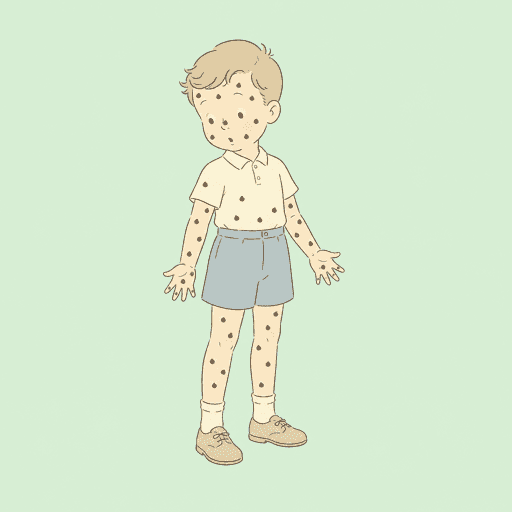
Mrs. Kimmelfarber takes Henry to the school infirmary, which is run by Nurse Molly Farthing. After making them wipe their feet, Nurse Farthing notices a cocoa smell and examines Henry’s rash, which she finds peculiar. Henry confirms that he has already had measles and chicken pox, so the nurse declares it an “unidentified rash.” Henry becomes terrified, but Nurse Farthing calms him with a reassuring touch. Suddenly, a series of popping noises fills the room. Henry realizes that the sound is coming from his own body as his brown spots rapidly grow to the size of chocolate bits and pop out all over his skin. In moments, he’s covered from head to toe in little brown lumps.
Chapter 5 Summary: “Calling Dr. Fargo”
While Henry and Mrs. Kimmelfarber scream in panic, Nurse Farthing calmly sends Mrs. Kimmelfarber to call Henry’s mother and tell her that they’re taking him to the City Hospital. The nurse comforts Henry by holding his hand during the taxi ride. At the hospital, after being checked by two other doctors, Henry is examined by Dr. Fargo, the chief of children’s medicine. Puzzled by the unprecedented brown spots, Dr. Fargo takes a sample from Henry’s arm with a cotton swab and sends it to the lab. While waiting, the doctor smells a candy bar in the air. The lab soon calls with the results, and Dr. Fargo announces that Henry’s spots are made of pure chocolate, calling the boy a “walking candy bar” (40).
Chapter 6 Summary: “Catch That Boy!”
As numerous doctors examine him, Henry hears Dr. Fargo excitedly discussing a new disease that he names “Chocolate Fever.” Overwhelmed with fear and exhaustion, Henry jumps off the examining table and runs. He bolts down a long corridor, evades nurses and a guard, and escapes onto the street. Looking back, he sees an army of doctors, nurses, guards, and policemen pursuing him. Henry runs until he’s far ahead of them, but when he sees a passing police car with its siren screaming, he thinks that he’s a wanted man. He finally collapses in a partially open garage, where he cries about his hopeless situation. Believing that his parents would only take him back to the hospital, he resolves to run away to a place where no one knows him.
Chapters 4-6 Analysis
In the novel’s second section, Smith underscores The Cost of Overindulgence by describing how Henry’s unchecked consumption leads to a fantastical physical transformation. The eruption of Henry’s spots in the school infirmary, accompanied by a series of audible pops, confirms the supernatural nature of his condition. As the spots grow from freckle-sized marks into lumps “as big as the chocolate bits his mother use[s] for making cakes and cookies” (33), the narrative makes the effects of overindulgence tangible. The text emphasizes this surprising development through both sound and typography; an entire page is dedicated to the repeated word “POP,” breaking the visual flow of prose to assault the reader with the sound of Henry’s transformation. This physical manifestation follows the classic structure of a midcentury candy cautionary tale, a genre in which a child’s inner flaws become an external, often humiliating, physical reality. The surreal turn of the spots’ rapid growth serves a didactic purpose, making the abstract danger of excess into a concrete, memorable experience for a young audience.
Once Henry is taken to the hospital, the narrative contrasts two distinct adult responses to his strange illness, showing the importance of Compassion as an Antidote to Isolation. Nurse Farthing, described as being “cool as a cantaloupe” (34), consistently provides comfort through simple, reassuring gestures like holding Henry’s hand. Her response exemplifies compassion as she consistently treats Henry as a frightened child in need of care rather than as a medical anomaly. In contrast, Dr. Fargo responds with professional excitement rather than empathy. He is more intrigued by the novelty of the case, immediately seeking to categorize it as “a new disease” and celebrating the opportunity for “making medical history” (41). His diagnosis that Henry is “nothing more than a walking candy bar” completes the boy’s objectification (40), reducing his identity to his condition. For Dr. Fargo, Henry is a scientific puzzle, not a patient. This clinical detachment amplifies Henry’s fear and alienation and renders his flight from the hospital into an attempt at self-preservation.
Henry’s desperate escape from the hospital marks his transition from a passive patient to a fearful fugitive. His decision to jump off the examining table is a direct reaction to being treated as a scientific curiosity by what he perceives as an “army of people pursuing him” (43). In his mind, doctors and nurses are no longer helpers but pursuers, and his frantic run through the city streets represents his complete rejection of an adult world that seeks to define and contain him rather than heal him. His perception of the chase escalates his paranoia. When he sees a police car, he immediately concludes, “I’m a wanted man!” (44). This internal conclusion demonstrates how deeply his condition has alienated him from society at large. His unique diagnosis has effectively criminalized him in his own mind.
The narrative structure shifts from a contained medical drama to a suspenseful chase, externalizing Henry’s internal panic and helplessness as he navigates a world that now appears hostile and threatening. While hiding in a garage, Henry’s emotional reaction and subsequent resolve reveal the depth of his isolation and mark an important turning point in his development. His decision that he can’t go home because his parents would simply “take him back to Dr. Fargo and the hospital” shows his loss of faith in all forms of adult protection (46). This moment solidifies his status as an outcast. The garage is a liminal space where he mourns his predicament before making a key decision. His anger toward the “stupid spots” marks an attempt to mentally separate himself from his condition even as it physically defines him. By choosing to run away to a place “where no one has ever heard of [him]” (47), Henry takes active control of his fate for the first time. Though born of desperation, this act is an important step toward self-reliance. He’s no longer a passive subject being examined and discussed; he’s an active agent, embarking on a journey that will force him to confront his choices and, eventually, understand that Moderation as a Path to Maturity is his only way back to a normal life.
The narrative style throughout these chapters reinforces Henry’s escalating panic and the story’s cautionary tone through direct, action-oriented language and structure. The chapter titles “Pop!,” “Calling Dr. Fargo” (34), and “Catch That Boy!” are simple, exclamatory phrases that mimic the blunt, high-stakes reality of Henry’s experience (41). This mirrors the straightforward moral logic of the candy cautionary tale, in which cause and effect are dramatic and unambiguous. The prose itself quickens its pace during Henry’s escape, using short, repetitive sentences to convey his desperation: “His head hurt. His side hurt. His legs hurt. But he kept running” (44). This stylistic choice allows the reader to grasp Henry’s panicked state of mind by stressing his physical and emotional exhaustion. By aligning the narrative structure and prose style so closely with Henry’s subjective experience, the story makes its fantastical premise feel immediate and its central conflict personal.

Get in-depth, chapter-by-chapter summaries and analysis from our literary experts.
- Grasp challenging concepts with clear, comprehensive explanations
- Revisit key plot points and ideas without rereading the book
- Share impressive insights in classes and book clubs