Chocolate Fever
A modern alternative to SparkNotes and CliffsNotes, SuperSummary offers high-quality Study Guides with detailed chapter summaries and analysis of major themes, characters, and more.
Summaries & Analyses
Quizzes
NEWReading Tools
Important Quotes
Content Warning: This section of the guide includes discussion of racism and bullying.
“And so his parents, perhaps being not as wise as they were kind, let Henry have as much chocolate as he liked.”
(Chapter 1, Page 16)
This piece of direct characterization critiques Mr. and Mrs. Green’s permissive parenting style. The juxtaposition of “wise” and “kind” suggests that their kindness is a form of negligence, contributing to Henry’s problem. This authorial intrusion foreshadows the lesson about self-control and moderation that Henry must learn for himself.
“And when he ate mashed potatoes, just a few drops of chocolate syrup swished through seemed to make them taste a lot better. Chocolate sprinkles sprinkled on top of plain buttered noodles were tasty, too.”
(Chapter 1, Page 17)
This quote uses absurd examples of Henry’s eating habits to illustrate the depth of his chocolate obsession. By putting chocolate on savory foods like mashed potatoes and buttered noodles, the author establishes the unnatural extent of his consumption, foreshadowing that such an extreme diet will inevitably have equally extreme consequences.
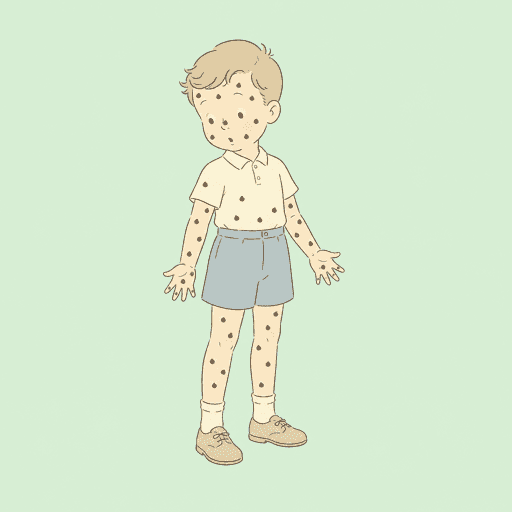
“There were little brown freckles all over his skin. Now this would not have been such a startling discovery except for one thing—those little brown freckles were not there when he woke up this morning!”
(Chapter 2, Page 22)
This passage marks the inciting incident of the plot, where Henry’s overindulgence manifests as a physical ailment. The narrator builds suspense by initially misidentifying the spots as common “freckles” before revealing their sudden, unnatural appearance. The spots function as a motif of The Cost of Overindulgence, as the physical manifestation of Henry’s dietary choices impacts his self-image and his interactions with others.
“‘Forget the milk,’ she cried. ‘Look! Now he has them on his face!’”
(Chapter 3, Page 28)
Mrs. Kimmelfarber’s exclamation marks the rapid escalation of Henry’s condition. The spots, previously confined to his arms, spread to his face, making his problem public and undeniable. Her cry shatters Mr. Pangalos’s casual dismissal, transforming Henry’s ailment from a private worry into a shocking public spectacle.
“A tear, just one, welled up in Henry’s right eye and began to trickle down his cheek, running slowly in and out of the little brown spots.”
(Chapter 3, Page 28)
This passage conveys Henry’s fear and helplessness as the spots spread visibly to his face. The single tear speaks to his sadness and isolation. The description of the tear running “in and out” of the spots creates a visual link between his emotional pain and its physical cause.
“Pop! Pop! Pop! Now they all heard it. […] Henry looked at his arm and in an instant knew where the noise was coming from. His little brown spots were growing bigger and bigger. They were popping out all over him.”
(Chapter 4, Page 33)
The passage’s opening combines repetition, onomatopoeia, and exclamation points to call attention to the rapid, audible expansion of Henry’s magical brown spots. His direct observation of his spots growing and erupting creates a sense of urgency and escalates the fantastical strangeness of his ailment.
“No rash in the whole history of rashes ever appeared so fast. Or grew so big. Or popped out with a noise you could hear. Impossible!”
(Chapter 5, Page 36)
Dr. Fargo’s exclamation establishes the medical absurdity and unprecedented nature of Henry’s condition. The hyperbolic claim about “the whole history of rashes” emphasizes how far Henry’s ailment is from known medical science, framing him not just as a patient but as a medical anomaly. The list of impossible traits heightens the tension and the story’s comedic, fantastical tone.
“‘Who has been eating a candy bar in my office?’ he demanded.”
(Chapter 5, Page 39)
Dr. Fargo’s question is a moment of irony, as he unknowingly identifies the cause of Henry’s condition while searching for a mundane explanation. The sensory detail of the candy-bar smell strengthens the thematic link between the chocolate motif and The Cost of Overindulgence. This line heightens the situation’s absurdity by framing the medical mystery as a simple case of misplaced candy.
“All kinds of doctors were examining him now, poking and prodding as if he were not a boy, but a pincushion.”
(Chapter 6, Page 46)
This simile illustrates Henry’s sense of dehumanization at the hands of the medical establishment. By comparing him to a “pincushion,” the text emphasizes his loss of autonomy and identity, reducing him to an object for scientific curiosity. This feeling of being prodded and objectified directly fuels his desperate decision to escape the hospital.
“So he did something very simple. Something his heart told him he had to do to survive. He jumped off the examining table and began to run.”
(Chapter 6, Page 42)
The narrator’s simple, direct prose highlights the primal nature of Henry’s flight. By framing the decision as “[s]omething his heart t[ells] him he ha[s] to do to survive,” the text elevates his escape from a childish impulse to a necessary act of self-preservation. The escape marks the start of the protagonist’s efforts to play a more active role in shaping his own story.
“I can’t go home, he thought, and I won’t go back to the hospital. All right then, I’m on my own. Somewhere there must be a place for me. A place to go until these stupid big brown spots disappear.”
(Chapter 6, Page 46)
Henry’s internal monologue signifies an important shift in his character as he accepts his isolation and resolves to take control of his situation. His determination to find a place “on [his] own” establishes his desperation but also his emerging self-reliance.
“‘Boy, are you ugly!’ he said.”
(Chapter 7, Page 49)
This blunt statement from a schoolyard bully demonstrates Henry’s social suffering. His internal condition has become an external, public problem, making him a target of scorn and isolation. The boy’s cruelty establishes the social stakes of Henry’s unusual affliction and explains why he expects Mac to reject him later in the story.
“I have Chocolate Fever, one of the most horrible and catching diseases in the world.”
(Chapter 7, Page 52)
In a moment of quick thinking, Henry turns his condition into a defense mechanism. By inventing a frightening narrative, he seizes control of the situation. This act of self-preservation demonstrates his resilience and is a key step in his journey.
“Hey! I know who he is. I heard it on the radio when I came home from school. There’s a kid who ran away from a hospital this morning…and the police are looking for him. His name is Henry Green.”
(Chapter 7, Page 54)
This revelation elevates Henry’s personal crisis to a public manhunt, increasing the stakes of his flight. His unique medical case is no longer a private matter, making him a recognizable fugitive. This development adds external pressure to his internal struggle and complicates his quest for a cure.
“‘I wouldn’t say ugly,’ Mac said. ‘Unique, maybe.’”
(Chapter 8, Page 61)
Mac’s gentle correction offers Henry a new perspective on his condition, directly countering the schoolyard taunts of “ugly.” By reframing Henry’s appearance as “unique,” Mac provides an important moment of validation and kindness. This simple but powerful statement begins to heal the emotional wounds inflicted by the bullies’ words.
“So all that staring and stuff, what it did was make me proud. You know, black is beautiful.”
(Chapter 8, Page 63)
Mac models how to transform social judgment into self-respect and pride. This lesson is key for Henry, offering him a coping mechanism and showing that being different or “unique” can be a source of strength. At the same time, the comparison between the protagonist’s humorous and magical condition to the real-world injustice of racism is problematic.
“A good child don’t cause his parents heartache or grief or worry. No, sir!”
(Chapter 8, Page 64)
Acting as a moral compass, Mac shifts Henry’s perspective from self-pity to empathy for his worried parents. This direct appeal to responsibility is a key moment in Henry’s emotional development. Mac’s words prompt Henry to consider the consequences of his actions on others, a key step toward learning the lesson of Moderation as a Path to Maturity.
“‘There’s no mistake about it,’ Louie called back over his shoulder. ‘We know exactly what we’re doing. We’re hijacking a cargo of expensive furs.’”
(Chapter 9, Page 69)
This declaration from the hijacker is an example of dramatic irony that creates comedy. The reader, like Mac, knows that the truck contains candy, not furs, rendering Louie’s confident assertion utterly absurd. This scene uses humor to highlight the unexpected and chaotic consequences of Henry’s chocolate-centric journey.
“As the first streaks of dawn appeared in the eastern sky, the big man was still holding his arms about the boy, cushioning his body from the shocks and jolts of the road.”
(Chapter 10, Page 72)
This description reveals the depth of Mac’s protective nature, solidifying his role as a compassionate guardian for Henry. The author uses this tender image to characterize Mac as a gentle and caring figure. Mac models Compassion as an Antidote to Isolation by providing safety and security to someone feeling isolated and scared.
“‘Looks like our friends over there bought a pack of trouble,’ Mac said to Henry. ‘Instead of furs, they got something they don’t want.’”
(Chapter 10, Page 75)
This line from Mac employs situational irony. The hijackers expected valuable furs but instead stole candy, showing how Henry’s unique situation foils even criminal intentions. The thieves’ frustration comically emphasizes the central theme that an excess of a good thing—in this case, chocolate—can be a burden rather than a prize.
“They were licking him as if he were some sort of new dog yummy. His arms and legs and face were covered with happy, licking dogs.”
(Chapter 10, Page 78)
Unlike humans who react to Henry’s spots with fear or mockery, the dogs are drawn to him with pure, joyful instinct. Their affection provides a stark contrast to Henry’s previous social isolation and demonstrates the efficacy of Compassion as an Antidote to Isolation.
“We go after furs, and we get candy bars. We get to our hide-out, and we’re invaded by dogs. It’s getting so a guy can’t make a dishonest living anymore.”
(Chapter 10, Page 80)
Lefty’s complaint provides a humorous and ironic conclusion to the hijacking subplot. His lament, delivered as he’s being arrested, frames the chaotic events as a personal inconvenience for a would-be criminal. The line is a lighthearted commentary on justice, suggesting that in Henry’s extraordinary world, even a life of crime is comically thwarted.
“Although life is grand, and pleasure is everywhere, we can’t have everything we want every time we want it! It’s a hard lesson, but it comes in time.”
(Chapter 11, Page 84)
Mr. Cane explicitly states the novel’s central theme of Moderation as a Path to Maturity. His words frame Henry’s physical ailment as a manifestation of a deeper, universal lesson about self-control. This moment marks the turning point in Henry’s journey, shifting the focus from a medical cure to a moral and emotional one.
“Vanilla pills, Henry Green. The very thing that will cure your Chocolate Fever within the hour. That is, if you have truly learned the first—and hardest—part of your cure.”
(Chapter 11, Page 85)
This passage introduces the vanilla pills, which function as a motif of Moderation as a Path to Maturity. Mr. Cane’s explanation links the physical cure directly to Henry’s internal growth, stressing that understanding moderation is the true remedy. The conditional nature of the cure (“if you have truly learned”) reinforces that maturity is a prerequisite for healing.
“Could you ever have too much cinnamon? Could a person overdo it and…was there such a thing as Cinnamon Fever?”
(Chapter 12, Page 93)
Henry’s final thought demonstrates that he has internalized the lesson of moderation beyond just chocolate. This rhetorical question shows his character development, as he now applies his newfound wisdom to other potential indulgences. This concluding reflection on the novel’s message underscores that maturity requires self-restraint.

Unlock every key quote and its meaning
Get 25 quotes with page numbers and clear analysis to help you reference, write, and discuss with confidence.
- Cite quotes accurately with exact page numbers
- Understand what each quote really means
- Strengthen your analysis in essays or discussions