Chocolate Fever
A modern alternative to SparkNotes and CliffsNotes, SuperSummary offers high-quality Study Guides with detailed chapter summaries and analysis of major themes, characters, and more.
Summaries & Analyses
Quizzes
NEWReading Tools
Character Analysis
Content Warning: This section of the guide includes discussion of racism and bullying.
Henry Green
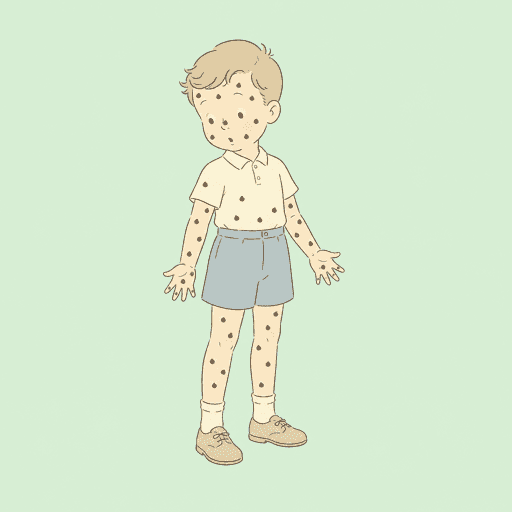
Henry is the novel’s dynamic protagonist, a young boy whose identity is almost entirely consumed by his singular obsession with chocolate. His character arc is a clear illustration of the theme of Moderation as a Path to Maturity. He begins as a boy of unchecked appetites and grows into someone who understands the value of moderation. Initially, Henry’s love for chocolate is presented as a harmless, if extreme, personality trait. He eats it for every meal and in every conceivable form, and his parents’ permissiveness allows this habit to flourish without consequence. This single-minded indulgence defines his world, but it also makes him vulnerable to the central conflict of the story. His journey begins when his internal imbalance manifests externally as the titular “Chocolate Fever,” turning his greatest pleasure into a source of physical and social distress.
The appearance of the brown spots forces Henry into the role of an outcast, testing his resilience and forcing him to confront the world without the comfort of his home or his defining obsession. His experiences while on the run are formative. In the schoolyard, he faces bullying but learns to use his wits and imagination, improvising a narrative about his disease into a weapon to defend himself. This moment marks a positive shift in the protagonist’s agency. Later, his encounter with Mac provides him with an important new perspective on being different. Through these trials, Henry’s initial fear and self-pity evolve into a more mature understanding of himself and the world. His decision to run away is born of fear, but the journey itself becomes an essential part of his growth.
Henry’s transformation is complete when he meets Mr. Cane, who provides both the literal cure and the explicit moral lesson that Henry needs to internalize. By accepting that he has had “too much of a good thing” (84), Henry demonstrates a newfound self-awareness. His final act in the novel, choosing maple syrup over chocolate, is a quiet but important indication of his character’s deep change. He hasn’t rejected pleasure entirely but has learned to temper it with balance. His concluding thought about a potential “Cinnamon Fever” shows that the novel’s moral lesson isn’t just about chocolate; it’s a broader, more mature understanding that any excess can be detrimental, solidifying his successful passage from indulgence to moderation.
Mac
Mac is a deuteragonist who provides Henry with the moral guidance and emotional support necessary to navigate his crisis. A large, kind, and principled truck driver, Mac is a static character whose wisdom and stability serve as an anchor for the frightened protagonist. When he encounters Henry, he looks past the boy’s alarming physical appearance and offers him unconditional help, immediately establishing his role as a source of safety and reason. Mac’s actions are consistently driven by a strong moral compass; he models responsibility by insisting that Henry must call his parents to end their worry, gently challenging Henry’s impulsive decision to run away from his problems. His calm and competent demeanor, especially during the confrontation with the hijackers, contrasts sharply with the panic and incompetence of other characters, reinforcing his status as a trustworthy guardian. However, Mac undergoes no character development and has little motivation of his own beyond his efforts to teach and protect Henry. He therefore embodies the familiar and oft-critiqued trope of a Black mentor figure who exists solely to aid a white protagonist, a trope most famously embodied by Jim in Mark Twain’s The Adventures of Huckleberry Finn (1884).
Mac’s most significant contribution to Henry’s development is his ability to foster a sense of perspective. He develops the theme of Compassion as an Antidote to Isolation by accepting Henry’s condition. Mac also teaches Henry to see his condition as something that makes him “unique” rather than something to be ashamed of. This lesson is framed problematically by a conflation of Henry’s magical, temporary illness and the real, systemic issue of racism, but it shifts Henry’s focus from self-pity to a potential source of strength. Mac helps Henry understand that being an outsider is a survivable, and even powerful, experience. Mac offers a pathway toward empathy and self-acceptance, making him the story’s most important catalyst for Henry’s emotional maturation.
Alfred “Sugar” Cane
Mr. Cane functions as the archetypal wise old man and a key mentor who provides the final resolution to Henry’s conflict. His name immediately connects him to the world of sweets that is the source of Henry’s problem. As the owner of a major candy distribution company, he’s a master of this world, yet he understands its dangers. Mr. Cane is the only character beside the protagonist who has personal experience with Chocolate Fever, which allows him to offer Henry a unique form of empathy that’s both comforting and curative. This shared history makes him the ultimate authority on Henry’s condition, validating the boy’s experience while also showing him a future beyond the illness.
Mr. Cane’s primary role is to articulate the central theme of the novel, the necessity of moderation. By framing this as a “hard lesson” of growing up, he elevates Henry’s struggle from a strange medical anomaly to a universal rite of passage. The vanilla pills that he provides become a motif of Moderation as a Path to Maturity, representing the balance that Henry must find in his own life. Mr. Cane thus delivers both the physical and philosophical cure, embodying the wisdom that resolves the narrative and solidifies its moral message.
Dr. Fargo
Dr. Fargo is a flat, comical character who represents the impersonal and ineffective nature of a purely clinical approach to medicine. As the chief of children’s medicine, he’s professionally accomplished, yet he’s more fascinated by the novelty of Henry’s disease than he is concerned with the well-being of his patient. His eccentric, confused demeanor is captured in his repetitive speech and his inability to remember his own name. Dr. Fargo sees Henry not as a scared child but as a chance at “making medical history” with the discovery of Chocolate Fever (41). This detachment and focus on the phenomenon rather than the person contribute directly to Henry’s terror and his decision to flee the hospital, showing a system that prioritizes scientific curiosity over compassionate care.
Nurse Molly Farthing
Nurse Farthing is a narrative foil to the eccentric Dr. Fargo, representing the compassionate and reassuring side of the medical profession. She’s a flat character defined by her calm competence and genuine concern for Henry. From the moment Henry arrives at the infirmary, Nurse Farthing provides a steadying presence. While other adults panic, she remains composed and methodical. Her touch is described as a source of comfort for Henry, as her “cool hand” helps to soothe his fear. She treats Henry with kindness and dignity, focusing on his emotional state as much as his physical symptoms. Through her character, the narrative introduces Compassion as an Antidote to Isolation.
Louie and Lefty
Louie and Lefty are a pair of incompetent hijackers who function as comic relief antagonists. They’re flat characters whose criminal aspirations far exceed their actual abilities. Their introduction provides an external conflict that is more absurd than threatening, serving primarily to advance the plot and strengthen the bond between Henry and Mac. The central irony of their caper, in which they steal a truck full of candy bars instead of the expensive furs they expected, emphasizes their foolishness. Their politeness and bumbling nature make them entirely non-menacing, and their eventual capture by a swarm of candy-hungry dogs solidifies their role as figures of ridicule rather than genuine villains. Lefty’s final lament that “a guy can’t make a dishonest living anymore” perfectly encapsulates their pitiful and humorous failure (80).
The Schoolyard Boys
The schoolyard boys are a group of bullies who embody the social cruelty that often accompanies being different. As flat characters, their purpose is to represent a specific, negative societal reaction to Henry’s condition. They immediately ostracize him based on his appearance, using insults like “ugly” and surrounding him in a physically intimidating circle. Their mob mentality demonstrates how fear and ignorance can manifest as aggression. This encounter is a critical moment for Henry, as it forces him to confront the social repercussions of his overindulgence and find the inner strength to stand up for himself. The boys’ retreat when Henry cleverly invents a terrifying narrative about his disease highlights their cowardice and serves as Henry’s first real victory on his journey.
Henry’s Family
The Green family, composed of Henry’s parents; his brother, Mark; and his sister, Elizabeth, are flat characters who collectively establish the loving but overly permissive environment that precipitates the story’s conflict. They’re described as kind and caring, yet their failure to set limits on Henry’s chocolate consumption is the root cause of his ailment. The narrator notes that they’re “not as wise as they [a]re kind” (16), a critique of a parenting style that prioritizes immediate happiness over long-term well-being. Their role in the narrative is primarily to provide a baseline of normalcy and love from which Henry departs and to which he ultimately returns. Their joyful reaction to his homecoming reinforces the idea of family as a safe haven, even if their initial permissiveness inadvertently forces Henry to learn The Cost of Overindulgence for himself.
Mrs. Kimmelfarber
Mrs. Kimmelfarber is Henry’s math teacher and the first authority figure to witness his strange transformation. A flat character, her primary role is to represent the initial panic and confusion of the adult world when confronted with the unexplainable. Her reaction quickly shifts from academic annoyance to genuine alarm as she sees the brown spots appearing on Henry’s skin. While she follows protocol by taking Henry to the nurse, her flustered state contributes to the growing sense of chaos surrounding his condition. She sets in motion the chain of events that leads Henry from the classroom to the hospital and, eventually, on his journey of self-discovery.

Unlock analysis of every major character
Get a detailed breakdown of each character’s role, motivations, and development.
- Explore in-depth profiles for every important character
- Trace character arcs, turning points, and relationships
- Connect characters to key themes and plot points