Maroo Of The Winter Caves
Maroo Of The Winter Caves
A modern alternative to SparkNotes and CliffsNotes, SuperSummary offers high-quality Study Guides with detailed chapter summaries and analysis of major themes, characters, and more.
Summaries & Analyses
Quizzes
NEWReading Tools
Chapters 13-16Chapter Summaries & Analyses
Content Warning: This section of the guide includes discussion of animal death.
Chapter 13 Summary: “Blizzard”
After the ibex is gone, Maroo and Otak continue their journey. Maroo leaves an offering of shells in the crevasse where she fell. By sundown, they reach a high plateau, completely exhausted. As it begins to snow again, Maroo insists that they build a snow house for shelter. While working, they discover the fresh tracks of a large cave lion. Unsettled, they quickly finish the structure. Inside, Maroo uses embers from the horn to kindle Old Mother’s fire. A blizzard traps them in the snow house, and their meat supply dwindles. Frightening sounds, including a scream and a catlike growl, come from outside, deepening the children’s fear of the mountain spirits. Remembering Old Mother’s advice that stories give people hope, Maroo comforts Otak by telling him a story. He grows restless and wants to hunt, but Maroo refuses to let him go out in the storm, causing a quarrel. As the blizzard begins to die down, they drink an herbal drink that Maroo prepares and fall asleep, planning to leave at dawn.
Chapter 14 Summary: “Across the Pass”
The next morning, the blizzard has passed. Otak tries to hunt but fails to spear a hare and misses a flock of ptarmigan with his sling, leaving him frustrated. As they travel, they again find the fresh tracks of the cave lion leading toward the Pass of the Spirits. They cautiously approach the pass, which is narrowed by a large, dark cave that Old Mother warned them about. The strong scent of a lion and a scattering of bones at the entrance terrify them, and they hurry past. Once they have crossed, they see the Great River and the plains far below, realizing that they’re within a day’s journey of the autumn camp. They make camp in a rock shelter as snow begins to fall again. A hare suddenly appears, and Maroo grabs Otak’s spear and kills it. Otak is furious, shouting that she had no right to use his spear and that Rivo is his hunting dog, not hers to use. After arguing, they eat the hare and go to sleep. Maroo later wakes to find that Otak and Rivo are gone.
Chapter 15 Summary: “The Mountain Spirit”
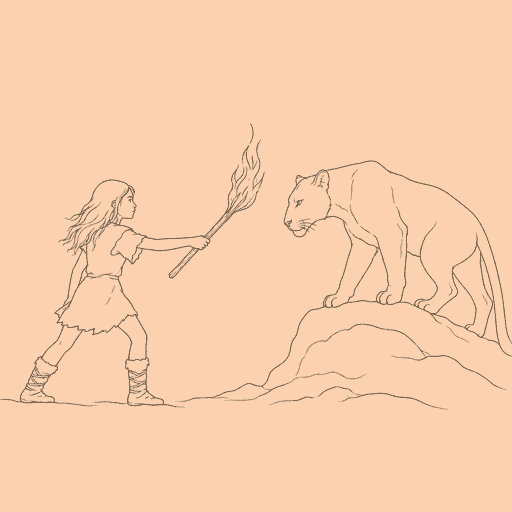
Maroo realizes that Otak has likely gone into the new snowstorm to prove he can hunt. She searches for him but finds no trace. Remembering Old Mother’s warning that one of them must survive to bring help, she makes the difficult decision to continue on alone, leaving Otak’s fur bedding behind for him. Before setting out, she prays to Areg’s spirit to keep Otak safe. As she descends the mountain, she becomes disoriented in the blizzard, walks in a circle, and begins to run in a panic. She forces herself to stop and calm down, as Old Mother had advised, and soon regains her sense of direction. The storm finally clears, and a full moon illuminates her path. Her way is blocked by a large lion, which Maroo believes is the mountain spirit. She retrieves a pitch-coated torch from her pack and uses the fire horn at her belt to ignite it. She then confronts the animal. When the lion lunges, she shoves the flaming torch into its face. The lion howls in pain and flees into the rocks. At sunrise, Maroo sees that she has reached the mountain’s foothills, with the tents of her people visible on the plain below.
Chapter 16 Summary: “At the Crossing Place”
Young men from the four tribes set out to rescue Maroo’s family, with Maroo guiding them from a sledge since she’s too tired to walk. They find the family hungry but alive and transport them back to the main camp on sledges. A feast is held to celebrate their return, but the family grieves for Otak, believing him to be dead. Maroo continues to question whether she was right to leave him, and Old Mother reassures her that she made the correct decision. During the celebration, a dog’s barking draws attention. Rivo runs into the firelight, followed by an exhausted but living Otak. He explains that he got lost in the blizzard and sprained his ankle, surviving because Rivo repeatedly hunted enough food to keep them alive until he recovered. The elders Keriatek and Sovi quietly decide that the dog will come with them to the winter caves. Reunited and safe, the family travels with their people and Rivo toward the winter caves.
Chapters 13-16 Analysis
When Maroo kills a hare with Otak’s spear, his furious reaction, “You took my spear!” (119), exposes the community’s gendered division of roles and the tension it creates between the siblings. Otak’s anger reflects his belief that hunting belongs to men and forms an important part of becoming an adult hunter. Maroo’s pragmatic act of survival therefore challenges the role that Otak hopes to fulfil. This conflict disrupts their shared mission, revealing how their Coming of Age Through Shared Responsibility is complicated by the expectations attached to hunting. Maroo’s responsibilities have expanded to include decision-making and providing for them both, while Otak remains determined to prove that he can contribute as a hunter. His subsequent decision to run off and hunt alone reflects his wounded pride and his desire to demonstrate his ability. The tension between the siblings highlights how their growing responsibilities develop differently: Maroo responds to the family’s immediate needs, while Otak remains focused on proving himself through a successful hunt.
The journey’s final stage emphasizes the physical dangers of the White Mountain and the children’s spiritual understanding of it. The children experience the landscape through the beliefs they have inherited, feeling the “deadly cold breath of the glacier” and interpreting strange noises as the moans of “wind spirits” (105). Their belief in spirits shapes the way they understand the unfamiliar and dangerous environment around them. Maroo’s offering of precious shells at the crevasse reflects her respect for the spiritual forces she believes inhabit the mountain. The blizzard, the crevasses, and the lion reinforce the children’s belief that the mountain is inhabited by powerful spirits, echoing Old Mother’s warning that the mountain “feels that you are there” (109). The Pass of the Spirits and the cave mark the most intimidating stage of the children’s journey, combining real physical danger with the fears created by their spiritual beliefs. By presenting the mountain through the children’s perspective, Turnbull maintains the ambiguity between natural danger and spiritual interpretation, allowing both to shape the tension of the journey.
Maroo’s solitary descent from the mountain becomes a test of her ability to apply what Old Mother has taught her. Lost in the blizzard and beginning to run wildly, she recalls Old Mother’s lesson about a man who “could go mad and run blindly until he died of exhaustion” (126). By forcing herself to stop, drop to her knees, and let her fear subside, Maroo draws on Old Mother’s practical wisdom to regain control of her fear. This moment illustrates Tradition as an Emotional Anchor, demonstrating that the wisdom passed down by the elders provides practical guidance in moments of danger. Maroo’s ability to master her panic by drawing on these teachings is a significant step in her maturation. She demonstrates that she can apply Old Mother's guidance independently when faced with danger. Her ability to find her way after calming herself suggests that the lessons she has inherited help her respond with clear judgment in a dangerous situation.
The climactic confrontation with the cave lion brings together the physical dangers of the mountain and Maroo’s spiritual understanding of them. When the moonlit path is blocked by the lion, Maroo believes it to be the mountain spirit that Old Mother warned her about. Her decision to fight back by lighting a pitch torch demonstrates Human Adaptability as the Key to Survival, as she uses the fire she has carefully preserved throughout the journey to protect herself. The preserved fire once again serves as a practical means of survival, allowing Maroo to confront a danger she can’t overcome through strength alone. By thrusting the flaming torch into the lion’s face, Maroo drives the animal away and believes she has defeated the mountain spirit. Turnbull leaves this interpretation unresolved, allowing the encounter to be understood through Maroo’s beliefs rather than confirming the lion’s supernatural nature. This victory, achieved through courage, practical knowledge, and quick judgment, demonstrates Maroo’s growth into a capable and resourceful leader.
The final reunion at the crossing place confirms the importance of Rivo to the family’s survival. Otak’s survival, made possible through Rivo’s hunting while Otak recovered from his injury, demonstrates that Rivo has become much more than a companion. The relationship between the children and Rivo, which began with an act of compassion, now proves valuable to the entire family. Rivo’s role in keeping Otak alive reinforces Human Adaptability as the Key to Survival, showing how cooperation between humans and animals contributes to survival in difficult circumstances. The elders’ quiet decision that “[t]he dog will come with [them] to the winter caves” reflects their recognition of Rivo’s place within the group (136). Their acceptance of Rivo brings the novel’s exploration of trust, cooperation, and survival to a satisfying conclusion, showing how a relationship that began with compassion becomes an enduring part of the family’s life.

Get in-depth, chapter-by-chapter summaries and analysis from our literary experts.
- Grasp challenging concepts with clear, comprehensive explanations
- Revisit key plot points and ideas without rereading the book
- Share impressive insights in classes and book clubs