Maroo Of The Winter Caves
Maroo Of The Winter Caves
A modern alternative to SparkNotes and CliffsNotes, SuperSummary offers high-quality Study Guides with detailed chapter summaries and analysis of major themes, characters, and more.
Summaries & Analyses
Quizzes
NEWReading Tools
Symbols & Motifs
Content Warning: This section of the guide includes discussion of death.
The White Mountain
The White Mountain functions as the novel’s central symbol, representing the family’s passage into an unfamiliar and dangerous landscape that Maroo and Otak must cross to save their family. Its glaciers and cave lions and the tribe’s beliefs about its spirits make it the family’s most feared route, testing the knowledge, judgment, and perseverance that the children have learned from their elders. The mountain is introduced early as a place of immense danger, with cave lions and a dangerous glacier, although “it [i]s the spirits that the tribe fear[s] most” (13). This foreshadowing establishes the mountain as a place where physical dangers and spiritual fears become closely intertwined in the family’s understanding of the landscape. For Maroo and Otak, the journey across it becomes their first direct encounter with a place they have previously known only through stories and warnings. Crossing the mountain requires the children to apply inherited knowledge, support one another, and continue despite fear, linking the symbol to the novel’s exploration of Coming of Age Through Shared Responsibility.
The mountain tests both the children’s practical skills and their ability to face fears shaped by the tribe’s spiritual beliefs. The treacherous glacier, with its hidden crevasses, represents the constant dangers of the natural environment and requires caution, knowledge, and teamwork. Maroo’s near-fatal fall into a crevasse emphasizes the consequences of a single misstep in such a hazardous landscape. The Pass of the Spirits introduces a different kind of challenge. Old Mother’s warning, “You will be afraid when you reach the cave” (89), prepares the children for a place long associated with spirits the tribe believes are dangerous, while the scent of a cave lion and the cave itself intensify their fear. Later, after Otak disappears, Maroo’s confrontation with the cave lion that she believes to be the mountain spirit shows how inherited beliefs shape her understanding of the dangers she faces. By continuing despite her fear, she demonstrates the judgment and responsibility that Old Mother entrusted to her.
Fire
Fire is a recurring symbol that represents life, community, and the knowledge that enables survival. As a fundamental element of survival, the hearth fire is the center of every camp, providing warmth, cooked food, and protection from the darkness and cold of the Ice Age. Its presence signifies safety, continuity, and the family’s shared way of life. The constant need to create and maintain fire highlights the practical knowledge passed from one generation to the next, supporting the novel’s exploration of Human Adaptability as the Key to Survival. When Maroo is tasked with carrying burning embers in a horn, the act reflects the responsibility she has inherited for preserving the knowledge and resources essential to her family’s survival, linking her growing responsibility to the survival of her community.
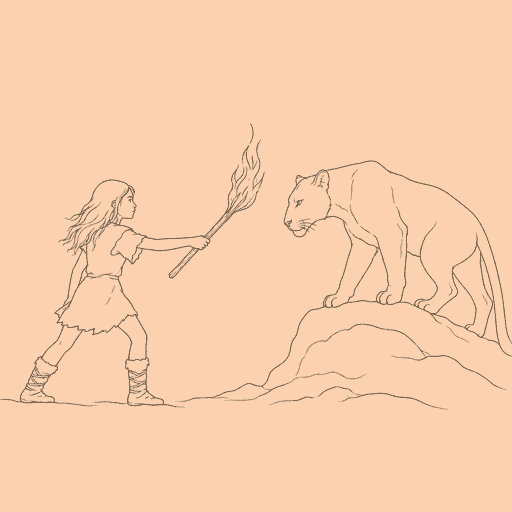
The symbol’s meaning evolves as fire transitions from a tool of sustenance to one of protection. While it consistently serves to warm the family and cook their meals, its most dramatic function appears during Maroo’s climactic confrontation with the cave lion she believes to be the mountain spirit. Faced with the terrifying lion, she uses the fire that she has carefully preserved to protect herself. The moment when “[p]itch and fire unite[]” (129), Maroo applies the knowledge and skills she has inherited, demonstrating her ability to respond resourcefully to danger. Fire therefore symbolizes the responsibility and resourcefulness that come with applying inherited knowledge in moments of crisis.
Spirits
The belief in spirits is a pervasive motif that provides the novel’s characters with a way of interpreting the dangers they encounter. This spiritual worldview is central to the theme of Tradition as an Emotional Anchor, offering a sense of order and a means of coping with dangerous or unexplained experiences. The mountain, animal, and ancestral spirits that the family believes in shape how they understand the natural world and influence the decisions they make as they travel. Their beliefs also guide how they respond to uncertainty throughout their journey. When they encounter the “calling spirit” at the high rock, they leave an offering of fish in the hope of ensuring safe passage. This ritual demonstrates their belief that showing respect to the spirit world forms an important part of traveling safely.
This motif shapes how the characters interpret the dangers they encounter throughout their journey. The White Mountain is terrifying because the tribe believes its spirits are “unfriendly to people” (13), adding a spiritual dimension to the mountain’s physical dangers. Maroo’s fear of Areg’s spirit and her offering of shells to the spirit of the crevasse that nearly killed her reveal how these beliefs influence her response to events she can’t control. In her final confrontation, Maroo believes the cave lion to be the “mountain spirit,” showing how her spiritual beliefs shape her understanding of the danger she faces. Driving the lion away allows Maroo to interpret her survival through the beliefs that have guided her throughout the journey.

Unlock the meaning behind every key symbol & motif
See how recurring imagery, objects, and ideas shape the narrative.
- Explore how the author builds meaning through symbolism
- Understand what symbols & motifs represent in the text
- Connect recurring ideas to themes, characters, and events